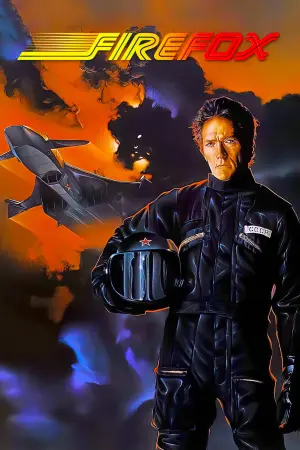
Firefox
...the most devastating killing machine ever built... his job... steal it!
Firefox (1982)
Timing:
2:16 (136 min)

6.008/10
530
530

4.828/10
2074
2074

5.9/10
31000
31000

Country
Production
Genre
Science Fiction, Action, Adventure, Thriller
Budget
$18 000 000
Revenue
$46 708 276
Director
Actors
Scenario
Producer
Clint Eastwood, Fritz Manes
Operator
Bruce Surtees
Composer
Artist
Thomas Riccabona
Audition
Mary Selway, Marion Dougherty
Editing
Short description
The Soviets have developed a revolutionary new jet fighter, called 'Firefox'. Worried that the jet will be used as a first-strike weapon—as there are rumours that it is undetectable by radar—the British send ex-Vietnam War pilot, Mitchell Gant on a covert mission into the Soviet Union to steal the Firefox.
What's left behind the scenes
- The real MiG-31 entered combat duty back in 1980 and was a fairly traditional interceptor developed in the 1970s. The aircraft from Thomas's book, like the real MiG-31, is a direct descendant of the MiG-25. In his second book about "Fire Fox", Craig Thomas described the aircraft as it was depicted in the film.
- The film was released a year after the first flight of the F-117A prototype – the first combat aircraft to use stealth technology. The word itself is never uttered in the film, however, the angular features of the "fiery fox" do resemble real stealth aircraft.
- Initially, Eastwood intended to use a Swedish Saab 37 Viggen as the "Russian" aircraft. The Swedes flatly refused, and numerous mock-ups had to be used (a total of 9 mock-ups were made, two of which were capable of flight). The standard combined shooting technique using a blue screen did not suit the filmmakers – the jet black aircraft, according to the script, had to fly over the snowy plains of the Arctic and against the backdrop of forests, so a special "reverse bluescreen" shooting technology was developed. The footage was later used in the film "Back to the Future Part II".
- The film also featured: the piston-engine A-1 Skyraider (the Vietnam episode), the Republic F-105 Thunderchief, the McDonnell Douglas F-4 Phantom II, the Northrop F-5, the Tu-16, the Tu-154 and others.
- Leaving the Moscow hotel, Gant buys a Havana cigar, getting used to smoking "to look like a Russian officer".
- During the hijacking, the MiG-31 rolling out of the hangar runs over the same security guard twice.
- A KGB general told the General Secretary that to save fuel, the hijacker should fly as low as possible. In reality, to save fuel, the hijacker should have climbed to a sufficient cruising altitude.
- A NATO submarine is attempting to surface under Arctic ice with its periscope and antennas extended. In the next frame, after surfacing, neither is visible on the conning tower.
- High-ranking KGB officers wear standard military uniforms, armed and in boots, including during a reception with the General Secretary.
- "Moscow Metro" was filmed in Vienna, with German signage and a map of the Vienna Metro visible in the shots. The scene with a worker lighting a cigarette directly in a subway car would have been practically impossible in Moscow in the early eighties.
- The real MiG-31 entered combat duty as early as 1980 and was a quite traditional interceptor developed in the 1970s. The aircraft from Thomas's book, like the real MiG-31, is a direct descendant of the MiG-25. In his second book about "Fire Fox," Craig Thomas described the aircraft as it was portrayed in the film.
- The film was released a year after the first flight of the F-117A prototype – the first combat aircraft to use stealth technology. The word itself is never pronounced in the film, but the angular features of the "fire fox" do indeed resemble real stealth aircraft.
- Initially, Eastwood planned to "film" a Swedish Saab 37 Viggen in the role of the "Russian" aircraft. The Swedes flatly refused, and numerous mock-ups had to be used (a total of 9 mock-ups were made, two of which were capable of flight). The usual combined shooting technology on a blue screen did not suit the filmmakers – the coal-black aircraft, according to the script, had to fly over the snowy plains of the Arctic and against the backdrop of forests, so a special "reverse bluescreen" shooting technology was developed. The footage was later used in the film "Back to the Future Part II."
Did you like the film?
 Auditions in India
 Casting calls in USA
 Castingi w Polsce
 Кастинги в Україні
