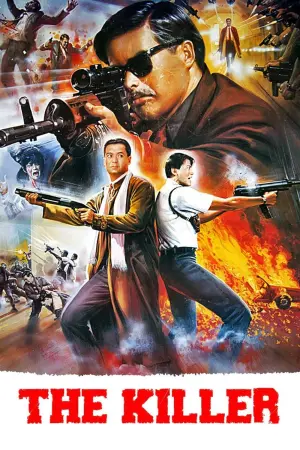
The Killer
One Vicious Hitman. One Fierce Cop. Ten Thousand Bullets.
喋血雙雄 (1989)
Timing:
1:50 (110 min)

7.589/10
897
897

7.747/10
11739
11739

7.7/10
55000
55000
![Watch film The Killer | The Killer (1989) ORIGINAL TRAILER [HD 1080p]](https://i.ytimg.com/vi/Cdxehm0NxkU/sddefault.jpg)
Country
Production
Genre
Action, Crime, Drama, Thriller
Budget
$0
Revenue
$2 350 174
Director
Actors
Scenario
Producer
Operator
Composer
Lowell Lo Koon-Ting
Artist
Hui Wai-Kwok
Audition
Editing
Fan Kung-Wing
All team (28)
All team (28)
Short description
Mob assassin Jeffrey is no ordinary hired gun; the best in his business, he views his chosen profession as a calling rather than simply a job. So, when beautiful nightclub chanteuse Jennie is blinded in the crossfire of his most recent hit, Jeffrey chooses to retire after one last job to pay for his unintended victim's sight-restoring operation. But when Jeffrey is double-crossed, he reluctantly joins forces with a rogue policeman to make things right.
What's left behind the scenes
- Initially, John Woo wanted the orchestra in the second scene to play jazz, and the main character to play the saxophone. However, producer Tsui Hark objected, believing that a Hong Kong audience would not accept something so foreign to them as jazz. As a result, a Chinese composition was used in the film, and the prologue with the saxophone-playing hero was later realized by Woo in 'Hard Boiled'.
- Initially, John Woo wanted the orchestra in the second scene to play jazz, and for the main character to play the saxophone. However, producer Tsui Hark opposed this, believing that a Hong Kong audience would not accept something so foreign as jazz. As a result, a Chinese composition was used in the film, and the prologue with the saxophone-playing hero was later realized by Woo in 'Hard Boiled'.
- The film features genuine firearms. Due to the strictness of Hong Kong law, all weapons had to be imported, and their use on set was closely monitored. After filming the shooting scenes on the streets of Hong Kong, the police often received complaints from local residents about the noise.
- There were difficulties obtaining permits, and some shots of the Tony Wong murder scene were filmed by pretending that director John Woo was making a documentary about the annual dragon boat race competition. Woo had filmed a significant portion of the material (the race itself) five months earlier, and now only brought a few key members of the film crew to shoot the rest. Woo himself edited the scene with the boat races, spending three weeks on it. In fact, Woo, a big fan of musicals, intended to present the entire episode as a musical number. He even edited it in accordance with the soundtrack.
- John Woo invented and developed all the action scenes directly on set and immediately discussed them with the actors, stunt performers, and stunt coordinator. Woo never pre-plans action scenes and stunts in his films, partly because he is afraid that the idea might be stolen, and partly because he prefers to work (as he himself said in an interview) 'like an artist,' for whom 'everything depends on his mood.' When planning non-action scenes in his films (say, lines in dialogues), Woo often improvises and changes everything at the last moment.
- Filming the scene where Chow Yun-Fat's character rescues Sally Yeh from the criminals was difficult for everyone, but especially for Yun-Fat himself, as he cannot stand violence. John Woo had to persuade the actor to pull himself together and make his performance finally look convincing. Yun-Fat stopped holding back when delivering the blows, and soon he even had to be asked to be a little more careful, because the punches became so forceful that several stunt performers were injured. In the scene in the temple, Yun-Fat himself was injured when a piece of plaster fell on his face and the actor nearly lost an eye.
- The producer (Tsui Hark) strongly disliked the film and demanded a complete re-edit. He believed, in particular, that the focus should be on the police officer, not the criminal, and that the film should therefore begin with a scene introducing the police officer to the audience. He thought the restaurant scene, after which Sally Yeh’s character went blind, should be completely cut, with only some of its fragments inserted into the film later as flashbacks. Neither John Woo nor the other members of the film’s creative team were willing to accommodate his requests, and he couldn’t insist, as the film’s premiere in Hong Kong was approaching soon. Upon its release in Taiwan, the film gained immense popularity.
- It took 36 days to film the final scene. It was filmed in a building that only resembled a temple, while in reality, the temple was the building viewers saw from the windows of the main character’s home, played by Chow Yun-Fat.
- 20,000 rounds of ammunition were used during the filming of the shootout in the beach house, and 40,000 during the filming of the final shootout in the temple.
- In one scene, Chow Yun-Fat’s character is shown with a bandage around his left arm. During the filming of this scene, the actor was also filming the action movie “A Better Tomorrow 3: Love and Death in Saigon” (Tsui Hark, 1989). He cut himself during filming there, had the wound bandaged, and then Chow Yun-Fat immediately went to John Woo’s set. Woo ordered that the bandage be left on.
- The scene of Danny Lee chasing the criminal through the streets of Hong Kong was filmed directly on the streets of Hong Kong among ordinary passersby, who were so shocked by what they saw that they called the police. The police arrived, learned that filming was taking place, and became so enraged that they threatened to arrest everyone. According to John Woo, Danny Lee had to calm down the police. He was known in Hong Kong as an actor who usually played police officers and was respected, so the police calmed down and left.
- Chow Yun-Fat’s wound under his left eye was genuine, sustained during the filming of a shootout scene. Despite the injury, the actor refused to stop filming or go to the hospital.
- The dragon boat race footage was shot five months before work began on the film, so John Woo simply borrowed relevant material from a documentary about the competition and edited it together with his own footage. A couple of dragon boat crews were also hired specifically for the film. John Woo asked them to stage a crash, but the superstitious owners flatly refused.
- Initially, John Woo wanted the orchestra in the second scene to play jazz, and for the main character to play the saxophone. But producer Tsui Hark opposed this, believing that a Hong Kong audience would not accept something so foreign to them as jazz. As a result, a Chinese composition was used in the film, and the prologue with the saxophone-playing hero was later realized by Woo in 'Hard Boiled'.
Did you like the film?
 Auditions in India
 Casting calls in USA
 Castingi w Polsce
 Кастинги в Україні
