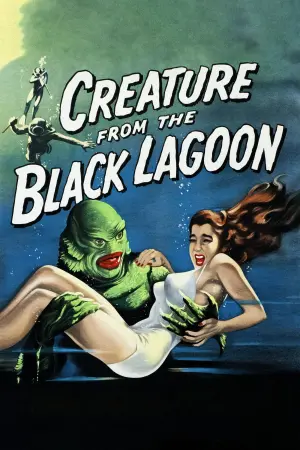
Creature from the Black Lagoon
From the Amazon's forbidden depths came the Creature from the Black Lagoon
Creature from the Black Lagoon (1954)
Timing:
1:19 (79 min)

6.828/10
731
731

6.648/10
1724
1724

6.9/10
33431
33431

Country
Production
Genre
Adventure, Horror, Science Fiction
Budget
$0
Revenue
$1 300 000
Director
Actors
Richard Carlson, Julie Adams, Richard Denning, Antonio Moreno, Nestor Paiva, Whit Bissell, Bernie Gozier, Henry A. Escalante, Ricou Browning, Ben Chapman
All actors and roles (10)
All actors and roles (10)
Scenario
Producer
William Alland
Operator
William E. Snyder
Composer
Artist
Audition
Editing
Ted J. Kent
All team (42)
All team (42)
Short description
When scientists exploring the Amazon River stumble on a “missing link” connecting humans and fish, they plan to capture it for later study. But the Creature has plans of his own, and has set his sights on the lead scientist's beautiful fiancée, Kay.
What's left behind the scenes
- The first film in the series about Gillman (the gill-man) – a creature similar to an ichthyander.
- The film is part of "Universal's Classic Horror Film Series".
- The film is discussed by Stephen King in his book "Danse Macabre". Despite a somewhat critical assessment, he included it in his list of the 100 most significant horror and science fiction films from 1950 to 1980, which is appended to the book.
- Between 1952 and 1959, American filmmakers released more than fifty films in 3D, which required special glasses to view. This film, the thirty-second in the series, became the first to require only one print thanks to a vectograph made by "Polaroid". Previously, two prints and two projectors operating simultaneously were necessary, which significantly increased the cost of screening and did not particularly eliminate display problems. The use of the vectograph came too late to save 3D, which never gained popularity with the public.
- The film was the third of four films in which Jack Arnold used stereophonic sound (following "It Came from Outer Space" (1953) and "The Glass Web" (1953)). This film saw one of the greatest successes of stereophonic cinema.
- The film featured one of the rare post-war monsters that became well-known, popular, and sparked a wave of imitations. The new monster enriched the collection of monsters at "Universal" Studios.
- The monster in this film was played by two actors: Ricou Browning underwater and Ben Chapman on land.
- Ricou Browning was an Olympic swimming champion and could stay underwater for 4-5 minutes. From a technical standpoint, the underwater filming was very challenging.
- Clifford Stine constructed a 35mm double camera, an "Arriflex", which he placed in a waterproof case. The delightful underwater shots were very impressive. The creature’s rubber suit cost $15,000. The creature's eyes in the film were part of the suit, so the actor playing it could barely see. This shortcoming was addressed in the second film.
- The idea for the film came to William Allend, who heard it from the famous Mexican cinematographer Gabriel Figueroa, who told him about a humanoid creature inhabiting South America. It became the basis for the film.
- The creature's figure was made in the likeness of the "Oscar" statuette awarded by the American Film Academy.
- Underwater, Ric Browning wore a light-colored suit, while on the surface, actor Ben Chapman wore a darker creature suit.
- In the episode where the creature carries Julie Adams to its cave, Ben Chapman missed the entrance and hit the actress in the head against the wall, causing her to lose consciousness.
- Interestingly, the film's original screenplay was written in fascist Germany and approved by Hitler himself. It featured a Golem instead of the creature, which emerged from the swamps and killed peaceful Germans. Ingmar Bergman watched this film on every birthday.
- The film’s initial title was simply “The Black Lagoon.”
- Jean Renoir made minor revisions to the script. The initial script already included the possibility of a sequel.
- The film was shot in Wakulla Springs, Florida, which is now a state park. The park remains in its pristine condition and is teeming with exotic birds, animals, trees, and plants.
- The film grossed $1.3 million in the US box office.
- Frank Lovejoy was considered for the role of Dr. Reed.
Did you like the film?
 Auditions in India
 Casting calls in USA
 Castingi w Polsce
 Кастинги в Україні
