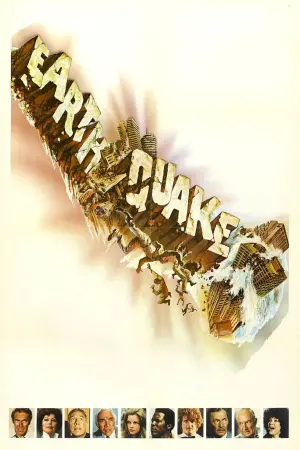
Earthquake
When the big one finally hits L.A.
Earthquake (1974)
Timing:
2:3 (123 min)

6.1/10
307
307

6.255/10
778
778

5.9/10
19000
19000

Country
Production
Genre
Action, Drama, Thriller
Budget
$7 000 000
Revenue
$79 666 653
Director
Actors
Scenario
Mario Puzo, George Fox
Producer
Mark Robson, Bernard Donnenfeld, Jennings Lang
Operator
Philip H. Lathrop
Composer
Artist
Audition
William Batliner, Robert J. LaSanka
Editing
Dorothy Spencer
All team (129)
All team (129)
Short description
Various interconnected people struggle to survive when an earthquake of unimaginable magnitude hits Los Angeles, California.
What's left behind the scenes
- The full theatrical version had a runtime of 140 minutes, while the television version ran for 160 minutes.
- Producer Jennings Lang (1915-1996) offered a cameo role to his friend Walter Matthau (1920-2000). Matthau agreed to play it even without a fee, but on the condition that he would be credited as “Walter Matushchansky.” He subsequently used this invented name repeatedly. Initially, it was supposed to be the role of a “drunkard at the very end of the bar,” but the screenwriter George Fox significantly expanded the role and wrote lines for the character. After filming, the performer of this role was credited as “Walter Matushchansky,” after which rumors began to circulate that “Matushchansky” was Matthau’s real surname.
- The swaying effect of the “Black Tower” (a high-rise office building on the set) was achieved by filming a reflection in a mirror moving back and forth. This scene was filmed before the start of principal photography and was decided to be left in the film as a joke at the expense of the “Universal” film company (whose executives’ offices were located in the building at the time).
- The film employed 141 stunt performers, which was a record at the time of filming.
- Ava Gardner (1922-1990) surprised director Mark Robson (1913-1978) by insisting on performing all the stunt scenes herself – including the scene where her character has to dodge falling concrete blocks and steel pipes.
- There was no scene in the script of Richard Roundtree falling off a motorcycle. Stuntman Bud Ekins (1930-2007) fell accidentally, but the fall was left in the film.
- The film's producers specifically went to Europe hoping to interest Audrey Hepburn (1929-1993) in the role of Remy Royce-Graff. At that time, Hepburn had not acted in nearly 10 years and declined the offer because she disliked the heroine's lines and the demands placed on the character. When filming had already begun, Ava Gardner was cast in the role.
- Riding the wave of success of the film "Airport" (1970) by directors George Seaton (1911-1979) and Henry Hathaway (1898-1985), based on the eponymous bestseller (1968) by Arthur Hailey (1920-2004), the management of Universal Pictures very much wanted to try their luck with another disaster film, and Jennings Lang was tasked with creating it. The idea for the film was inspired by the 6.6 magnitude earthquake on February 9, 1971, in the San Fernando Valley.
- In the 1970s, movie theaters were asked to install the new Sensurround audio system as a marketing ploy for disaster films. This system sent low-frequency sound waves into the theater seats, making the audience feel as if they were right in the middle of the events depicted in the film. During screenings of this particular film, the system shook the audience so much that they felt like a real earthquake had begun. Unfortunately, installing the system required removing several rows of seats, and it was also a very expensive system. It was used for several other films in the 1970s, but then structural damage to the movie theaters began to occur, the audience felt sick when the system was activated, and complaints about the unbearable rumble from the theaters arose, bringing an end to the use of Sensurround.
- The first draft of the screenplay was written by Mario Puzo (1920-1999), but it did not suit the management of Universal Pictures because it had too many characters and the action took place over too large an area of Los Angeles. The film's projected budget soared, so the script needed to be rewritten. Puzo was unable to do this, as Paramount Pictures had just given the green light to "The Godfather Part II" (Francis Ford Coppola, 1974) at that time, but many of the characters and plotlines devised by Puzo were included in the film, and the area of action was "reduced" to the size of Hollywood.
Did you like the film?
 Auditions in India
 Casting calls in USA
 Castingi w Polsce
 Кастинги в Україні
