The Untouchables
What are you prepared to do?
The Untouchables (1987)
Timing:
1:59 (119 min)

7.754/10
6107
6107

7.783/10
53572
53572

7.8/10
353000
353000
Country
Production
Genre
Crime, Drama, History, Thriller
Budget
$25 000 000
Revenue
$76 270 454
Director
Actors
Scenario
Producer
Operator
Stephen H. Burum
Composer
Artist
Audition
Editing
Short description
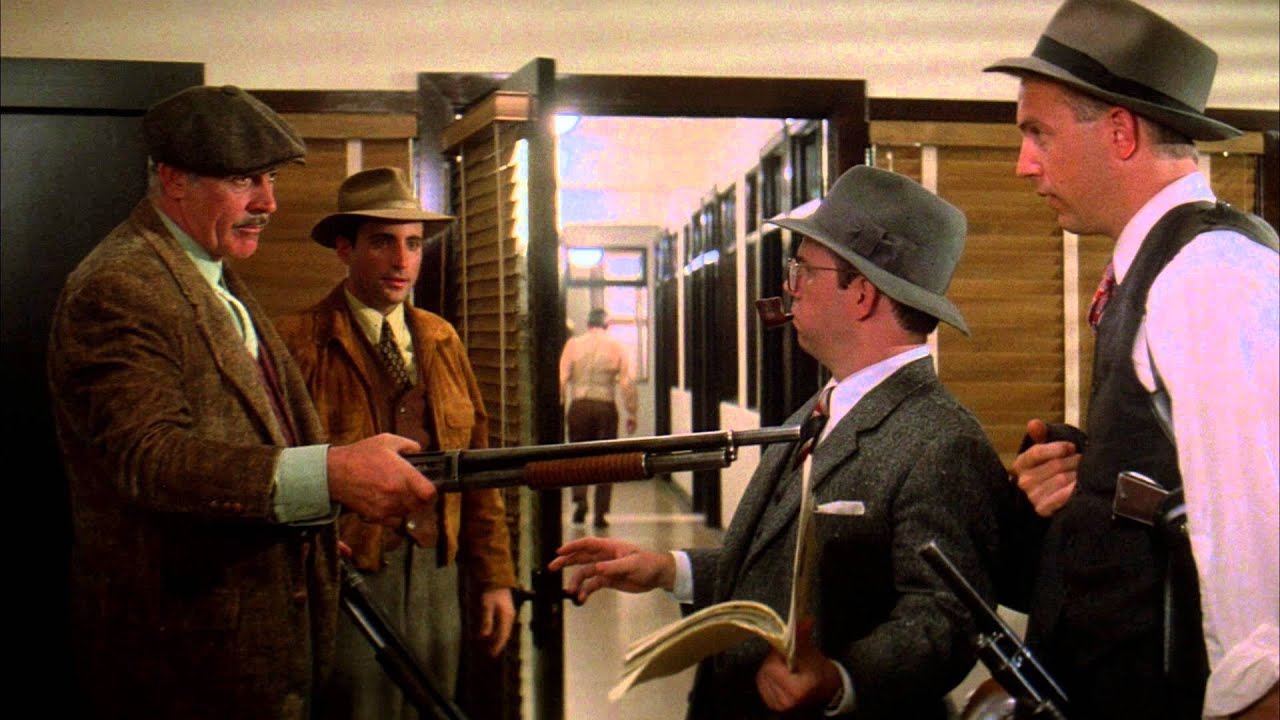
Young Treasury Agent Eliot Ness arrives in Chicago and is determined to take down Al Capone, but it's not going to be easy because Capone has the police in his pocket. Ness meets Jim Malone, a veteran patrolman and probably the most honorable one on the force. He asks Malone to help him get Capone, but Malone warns him that if he goes after Capone, he is going to war.
What's left behind the scenes
- The film is based on the memoirs of Eliot Ness, written by Oscar Fraley, "The Untouchables" (1957).
- The set for Capone’s personal barbershop in the “Lexington Hotel” included small items (cologne bottles, a shaving brush) that belonged to Al Capone.
- Brian De Palma met with Bob Hoskins to discuss the role of Al Capone, which Hoskins would have received had Robert De Niro declined it. Since De Niro starred in the film, Hoskins received a letter from Brian thanking him for the time he agreed to spend on the project, and a check for $200,000. Hoskins subsequently called De Palma and inquired – whether there were any other films where Brian would refuse to cast him in a leading role.
- Albert H. Wolff, who was part of the real "Untouchables" team, served as a consultant on the set and also helped Kevin Costner better get into the role of Eliot Ness.
- Mel Gibson and Harrison Ford turned down the role of Eliot Ness.
- Robert De Niro didn't have time to gain the weight needed for the role, so he wore special padding to make him look heavier.
- Kevin Costner, Sean Connery, and Andy Garcia underwent special training that included handling various types of weapons and studying police tactics.
- Michael Douglas and Don Johnson were considered for the role of Eliot Ness.
- According to Brian De Palma and Art Linson, Sean Connery suggested filming the scene of the conversation between Ness and Malone in a Catholic church. Originally, their conversation was supposed to take place on the street.
- Sergei Eisenstein's 'Battleship Potemkin' (1925) served as inspiration for Brian De Palma for the scene on the staircase at the train station.
- While the existence of Ness, his "Untouchables" team, and, of course, Al Capone, is beyond doubt, much of the film is simply invented by the screenwriter and does not correspond to real facts.
- For his role, Robert De Niro specifically found Al Capone’s tailors and ordered them to make clothes exactly like Capone’s. Immersing himself in the role, he even insisted on wearing shirts made of the same silk used for the gangster’s shirts. This is despite the fact that the shirts themselves never appeared in the frame.
- In the initial version of the script, the final shootout between Capone’s men and Ness’s took place on a stopped train. Brian De Palma moved the scene’s location to the stairs of a railway station after it became clear that finding and restoring a train from the 1930s would be too expensive.
- The dinner scene, where Al Capone (Robert De Niro) unexpectedly beats two of his men to death with a baseball bat, is based on events of May 7, 1929. Two of Capone’s most dangerous men, Albert Anselmi and John Scalise, decided to kill Capone and take over his gang. Capone found out and invited the most influential members of his organization, including Anselmi and Scalise, to dinner. During the dinner, Capone beat Anselmi and Scalise to death with a baseball bat, after which he shot them in the head.
- The character of Oscar Wallace (Charles Martin Smith) is partially based on Frank Wilson, an IRS agent who worked on the charges against Capone for tax evasion. Wilson worked on this case since 1928 and, in real life, never crossed paths with Ness and his men. Wilson was not killed by Capone’s men, although Capone offered a bounty for his head.
- During the filming of Malone's murder scene, Sean Connery did not expect the firecrackers with 'blood' to explode with such force. After the first takes, Connery was taken to the hospital, with splinters and fake blood in his eyes.
- In the film, Frank Nitti, Al Capone's right-hand man, the 'underboss' played by Billy Drago, dies at the hands of Eliot Ness. In reality, Frank Nitti was convicted along with Capone for tax evasion in 1930. Nitti received only 18 months of imprisonment, while Capone was sentenced to 11 years. After his release, Nitti was proclaimed by the media as the new boss of the 'Chicago Syndicate,' which began to generate enormous profits under his leadership. However, in the 1940s, the Syndicate's affairs deteriorated. Frank Nitti faced a sentence for extortion and had also alienated the other bosses of the 'Chicago Syndicate.' On March 19, 1943, fearing imprisonment, Nitti, who suffered from claustrophobia, committed suicide by shooting himself on the Central Illinois Railroad in Riverside, Illinois.
- A red circle can be seen on the 'Lucky Strike' cigarette pack held by Eliot Ness. However, before the start of World War II, a green circle was drawn on cigarettes of this brand.
- Although the maple leaf has been a symbol of Canada since the 19th century, it first appeared on the national flag only in 1965. This means that bottles of Canadian whiskey confiscated by the police could not have featured the modern version of the flag.
- Monty (Robert Swan), a Canadian border official, holds the rank of captain. However, Canadian border guards do not use American ranks. It would be more correct to call Monty an inspector.
- The film is set in 1930, and Eliot Ness is listening to the Amos 'n' Andy show on the radio. However, this show first aired in December 1936, and that specific program is dated November 16, 1952.
- The set decoration for Capone's personal barbershop in the "Lexington Hotel" included small items (cologne bottles, a shaving brush) that belonged to Al Capone.
- Brian De Palma met with Bob Hoskins to discuss the role of Al Capone, which Bob would have received had Robert De Niro turned it down. Since De Niro starred in the film, Hoskins received a letter from De Palma thanking him for the time he agreed to spend on the project, and a check for $200,000. Afterwards, Bob called De Palma and inquired if there were any other films where Brian would decline to cast him in a leading role.
- Albert H. Wolff, who was part of the real "Untouchables" team, served as a consultant on set and also helped Kevin Costner better get into the role of Eliot Ness.
- "Battleship Potemkin" (1925) served as inspiration for Brian De Palma for the scene on the staircase at the train station.
- Although the existence of Ness, his "Untouchables" team, and, of course, Al Capone, is beyond doubt, much of the film is simply fiction created by the screenwriter and does not correspond to real facts.
- During the filming of the Malone murder scene, Sean Connery did not expect the firecrackers with "blood" to explode with such force. After the first takes, Connery was taken to the hospital; splinters and artificial blood got into his eyes.
- In the film, Al Capone's right-hand man, "underboss" Frank Nitti, played by Billy Drago, dies at the hands of Eliot Ness. In reality, Frank Nitti was convicted along with Capone for tax evasion in 1930. Nitti received only 18 months in prison, while Capone was sentenced to 11 years. After his release, Nitti was proclaimed by the media as the new boss of the "Chicago Outfit," which under Nitti began to generate enormous profits. However, in the 1940s, the Outfit's affairs deteriorated. Frank Nitti faced a term for extortion, and he also managed to alienate the other bosses of the "Chicago Outfit." On March 19, 1943, fearing imprisonment, Nitti, who suffered from claustrophobia, committed suicide by shooting himself on the Central Illinois Railroad in Riverside, Illinois.
Did you like the film?
 Auditions in India
 Casting calls in USA
 Castingi w Polsce
 Кастинги в Україні
