Miracle on 34th Street
Capture the spirit of Christmas with this timeless classic!
Miracle on 34th Street (1947)
Timing:
1:36 (96 min)

7.363/10
703
703

7.827/10
8664
8664

7.9/10
61000
61000
Country
Production
Genre
Comedy, Drama, Family
Budget
$630 000
Revenue
$2 650 000
Director
Actors
Maureen O'Hara, John Payne, Edmund Gwenn, Natalie Wood, Porter Hall, Philip Tonge, Alvin Greenman, Harry Antrim, James Seay, Jerome Cowan
All actors and roles (10)
All actors and roles (10)
Scenario
Producer
William Perlberg
Operator
Lloyd Ahern
Composer
Cyril J. Mockridge
Artist
Audition
Editing
Robert L. Simpson
All team (22)
All team (22)
Short description
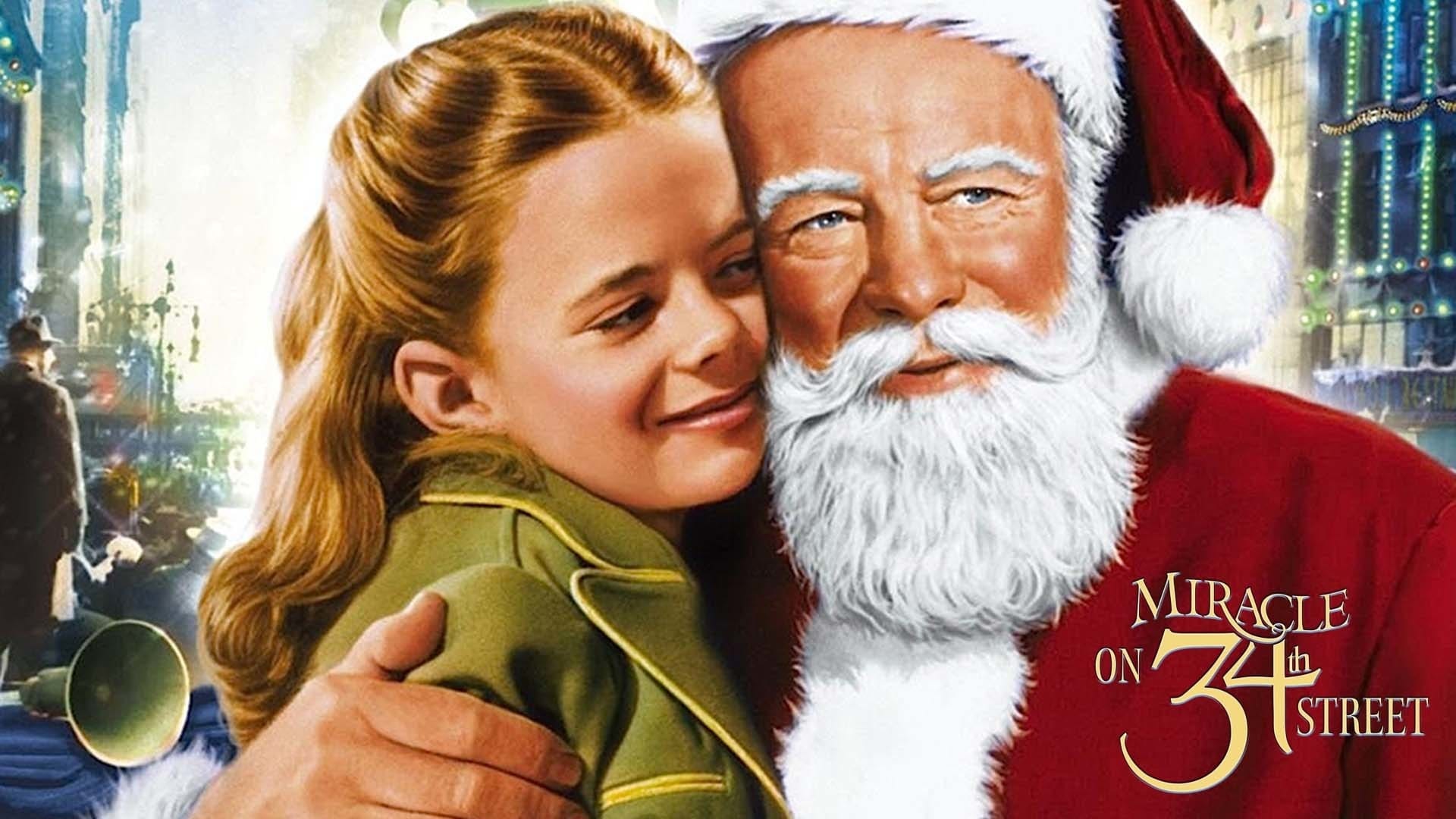
Kris Kringle, seemingly the embodiment of Santa Claus, is asked to portray the jolly old fellow at Macy's following his performance in the Thanksgiving Day parade. His portrayal is so complete that many begin to question if he truly is Santa Claus, while others question his sanity.
What's left behind the scenes
- At a party celebrating the end of filming, Natalie Wood was genuinely amazed to see Edmund Gwenn without a beard. During filming, the young actress considered Edmund Gwenn to be a real Santa Claus.
- The film's producers approached the management of Macy's and Gimbels department stores for permission to film in their sales areas. In both cases, they were told that they would like to see what could come of it first. A refusal would mean additional effort in editing and reshoots. A screening of already filmed scenes was organized for the department store management, and fortunately, they liked what they saw. Permission was granted.
- Macy's department store traditionally holds a parade on Thanksgiving Day. Few people know this, but Edmund Gwenn actually portrayed Santa Claus in such a parade on November 28, 1946. Gwenn did everything expected of Santa Claus at such an event, and even gave a short speech after the parade. He was introduced to department store visitors by Philip Tong, who played Julian Shellhammer in the film "Miracle on 34th Street." Gwenn removed the coverings from the department store's window displays, which were filled with Christmas gifts, to the sounds of Tchaikovsky's suite from the ballet "The Nutcracker." This is how Macy's traditionally opened its Christmas sales season.
- Actress and society columnist Hedda Hopper wrote in her column on May 3, 1947, that "when the film ('Miracle on 34th Street') premieres at the Roxy Theater in New York, Macy's department store will have to close for half a day so that all 12,000 of its employees can go to the cinema."
- Maureen O'Hara joined the film's cast almost against her will. She had just returned to Ireland when she had to return to America for filming. The actress stopped objecting and making demands as soon as she read the script.
- In the 1970s, Natalie Wood and her husband Robert Wagner were approached with a proposal to film a television remake of the movie with their daughter Natasha Gregson Wagner in the role of Susan. Wood responded with a firm refusal. She herself became a movie star and America's sweetheart at a young age and did not want her younger daughter (born in 1970) to start filming at such a young age.
- Filming took place during severe frosts in New York. The cameras froze several times for the operators.
- The film's box office receipts totaled four times the amount spent on its production.
- The influential organization "National Legion of Decency" gave the film "Miracle on 34th Street" (1947) a "B" rating (partially questionable content) because Maureen O'Hara played a divorced woman.
- In 2015, of the actors who participated in the filming of "Miracle on 34th Street" (1947), only Alvin Greenman, who played the supporting role of Alfred, was still alive. The last of the main cast members, Maureen O'Hara, passed away in October 2015.
- The idea for the script came to Valentine Davies when he was looking for a Christmas gift for his wife. The commercial side of the joyful pre-holiday bustle made him wonder how a real Santa Claus would feel about all of it.
- The film's action takes place during the Christmas season, but the head of the "20th Century Fox" film company, Darryl F. Zanuck, insisted that the premiere be held in May. He believed that people went to the movies more often in the summer. His subordinates had to organize an advertising campaign geared towards a summer premiere while keeping the fact that the film was Christmas-themed a secret.
- In the American Film Institute (AFI) ranking "100 Years…100 Movies: AFI’s 100 Most Inspiring American Movies," the film "Miracle on 34th Street" (1947) ranked 9th.
- The scenes in Macy's department store were filmed "on location," meaning in the actual Macy's department store on the corner of 34th Street. The filming was complicated by the fact that the filming equipment required more power than the department store's electrical wiring could provide. Therefore, additional power sources had to be installed in the building's basement.
- The head of 20th Century Fox, Darryl F. Zanuck, was strongly opposed to this project, believing the film would be too banal. Eventually, he agreed to allocate a rather modest budget to the film on the condition that director and screenwriter George Seaton then make three films of the studio's choosing. Seaton was so eager to make this film that he agreed without question.
- The girl from Denmark spoke Dutch in the film, but with a noticeable American accent.
- It so happened that two Christmas-themed films – 'Miracle on 34th Street' and Henry Koster's romantic comedy 'The Bishop's Wife' – were nominated for the 1947 Academy Award for Best Picture. Throughout the history of the award, only three Christmas films have been nominated in the Best Picture category – the aforementioned two, and Frank Capra's 'It's a Wonderful Life,' which he filmed the previous year.
- The founder of the Macy's department store chain, Rowland Hass Macy, died in 1877, 70 years before the filming of 'Miracle on 34th Street'.
- The Christmas-decorated windows of Macy's department store, captured in the film, were later sold to the oldest toy store in the United States, FAO Schwarz, and then to Marshall & Ilsley bank in Milwaukee, Wisconsin. Since then, they have decorated the lobby of the bank's main branch on North Water Street every December.
- Initially, the film was planned to be called "A Christmas Miracle on 34th Street," but the premiere was moved to summer, and the word "Christmas" had to be removed from the title.
- On December 22, 1947, a radio broadcast of the "Lux Radio Theater" series prepared a 60-minute adaptation of the film "Miracle on 34th Street" for listeners. Maureen O'Hara, Edmund Gwenn, John Payne, and Natalie Wood, who had starred in the film, participated, voicing the characters they played.
- During the filming of "Miracle on 34th Street" (1947), Natalie Wood was 8 years old.
- While working on "Miracle on 34th Street," Natalie Wood was also filming "Scudda Hoo! Scudda Hay!" and "The Ghost and Mrs. Muir."
- Thelma Ritter's first film role.
- Images of characters from Warner Brothers (Bugs Bunny, Beaky Buzzard and others) are visible in the Christmas window displays of Macy's department store – which is surprising, considering the long-standing rivalry between that company and 20th Century Fox, which made 'Miracle on 34th Street'.
- Edmund Gwenn wore a false beard during filming.
- 'Miracle on 34th Street' (1947) became one of the first colorized films (this refers to a technology in cinema or photography whereby the original black and white image is transformed into color).
- The role of Kris was initially offered to Cecil Kellaway, but the actor turned it down. Only after that was Edmund Gwenn approved for the role, as he was Kellaway's cousin. Kellaway played Santa Claus in 1964 in one of the episodes of the American sitcom 'Bewitched' (1964-1972), which also starred ten-year-old Bill Mumy, a screen star and America's darling in those years.
- The actor who played Judge Gene Lockhart also starred in another classic Christmas-themed film. He played Bob Cratchit in Edwin L. Marin's 'A Christmas Carol' (1938).
- June 2008: In the American Film Institute (AFI)'s "10 Top Films in the Fantasy Genre" ranking, the film "Miracle on 34th Street" (1947) ranked 5th.
- The predecessor to the modern United States Postal Service was the Post Office Department, which existed from 1829 to 1971.
- When Maureen O'Hara first read the script, the film was titled "Big Heart".
- On December 23, 1949, a 30-minute radio adaptation of "Miracle on 34th Street" aired on the popular program "Screen Director's Playhouse," with Edmund Gwenn voicing the role of Chris. On December 21, 1950, the same program broadcast a 60-minute radio adaptation of the film. Edmund Gwenn also participated in its recording.
- In 1994, "Smithmark" Publishing released a lavishly illustrated, large-format book, "Miracle on 34th Street: Hollywood Classic" by Sarah Parker Danielson.
- Cinematographer Charles J. Clarke was removed from the film "Miracle on 34th Street" and sent to Mexico to help Henry King finish filming "The Captain from Castile" (1947). He was replaced on "Miracle on 34th Street" by Lloyd Ahern.
- In exchange for permission to film "Miracle on 34th Street", George Seaton filmed the comedies "Apartment for Peggy" (1948), "Chicken Every Sunday" (1949), and the war drama "The Big Lift" (1950) for 20th Century Fox.
- When filling out his employee record card, Kris Kringle lists the names of Santa Claus's reindeer in the "closest relatives" section. In the original manuscript of Clement Clarke Moore's poem "A Visit from St. Nicholas", the name of one of them is given as "Donder", although "Donner" is the commonly accepted spelling. Kringle listed the reindeer's name as it appeared in Moore's work.
- In a dialogue with a girl from Holland, presented in the film without translation, Santa Claus asks what gift she would like for Christmas. The girl replies that she doesn't need anything, as she considers having a new (adoptive) mother to be the gift.
- A Danish girl sings the song "Sinterklaas Kapoentje, Leg wat in mijn schoentje, Leg wat in mijn laarsje, Dank je Sinterklaasje!". One translation reads: "Saint Nicholas, rogue and scoundrel, Put something in my little shoe. Put something in my little shoe. Thank you, Saint Nicholas."
- Trying to explain Chris's conviction that he is Santa Claus, Dr. Pierce cites the example of a Hollywood restaurant owner who believed himself to be the heir to the Russian throne, despite all evidence to the contrary. Dr. Pierce has forgotten the man's name. This episode concerned Mikhail Romanov, the owner of the "Romanoff's" restaurant in Hollywood, which was frequented by film stars at the time.
- The character of District Attorney Thomas Mara is clearly based on Thomas I. Dewey, the Manhattan District Attorney who later became Governor of New York and twice unsuccessfully sought the Republican nomination for President of the United States (in 1944 and 1948). Jerome Cowan, who played the role, actually resembled Dewey. Moreover, both men wore mustaches, which was quite unusual for public figures at the time. The judge in the film mentions that their District Attorney is a Republican, which was unusual for someone in an elected office in New York at the time.
- At the end of the court hearing for Chris's case, 21 mailbags were brought into the courtroom.
- Judging by the number of olive picks on the table next to the telephone, Mrs. Shelhammer drank 9 martinis before speaking with Mrs. Walker.
- The son of the District Attorney, Thomas Mara Jr., finishes his testimony in court and tells Kris Kringle: "And don't forget the football helmet. To make it the real thing." At that time, Tim Mara was the owner of the "New York Giants" football team.
- The film's producers approached the management of Macy's and Gimbels department stores for permission to film in their sales areas. They were told in both cases that they would like to see what could come of it first. A refusal would have meant additional effort in post-production and reshoots. A screening of already filmed scenes was organized for the department store management, and fortunately, they liked what they saw. Permission was granted.
- The film takes place during the Christmas season, but the head of 20th Century Fox, Darryl F. Zanuck, insisted that the premiere take place in May. He believed that people go to the movies more often in the summer. His subordinates had to organize a promotional campaign geared towards a summer release while keeping the fact that the film was Christmas-themed a secret.
- The scenes in Macy's department store were filmed “on location,” meaning directly in Macy's department store at the corner of 34th Street. Filming was complicated by the fact that the filming equipment required more power than the department store's electrical wiring could provide. Therefore, additional power sources had to be installed in the building's basement.
- Darryl F. Zanuck, head of 20th Century Fox, was strongly opposed to this project, believing the film would be too commonplace. He eventually agreed to allocate a rather modest budget to the film on the condition that director and screenwriter George Seaton would then film three films of the studio's choosing. Seaton was so eager to make this film that he agreed without question.
- The film was initially planned to be titled “A Christmas Miracle on 34th Street,” but the premiere was moved to the summer, and the word “Christmas” had to be removed from the title.
- Images of Warner Brothers characters (Bugs Bunny, Tweety Bird, and others) can be seen on Macy's department store's Christmas window displays – which is surprising, considering the longstanding rivalry between that company and 20th Century Fox, which made “Miracle on 34th Street.”
- “Miracle on 34th Street” (1947) was one of the first colorized films (referring to a technology in cinema or photography by which the original black-and-white image is transformed into color).
- When Maureen O'Hara first read the script, the film was titled "Big Heart".
- Cinematographer Charles J. Clarke was removed from the film "Miracle on 34th Street" and sent to Mexico to help Henry King finish filming "Captain from Castile" (1947). He was replaced on "Miracle on 34th Street" by Lloyd Ahern.
- In exchange for permission to film "Miracle on 34th Street," George Seaton filmed the comedies "Apartment for Peggy" (1948), "Chicken Every Sunday" (1949), and the war drama "Big Lift" (1950) for 20th Century Fox.
- Trying to explain Chris's conviction that he is Santa Claus, Dr. Pierce cites the example of a restaurant owner in Hollywood who believed himself to be the heir to the Russian throne, despite all evidence to the contrary. Dr. Pierce forgot the man's name. The episode referred to Mikhail Romanov, the owner of "Romanoff's" restaurant in Hollywood, which was frequented by movie stars at the time.
Did you like the film?
 Auditions in India
 Casting calls in USA
 Castingi w Polsce
 Кастинги в Україні
