How the West Was Won
It's here! The mightiest adventure ever filmed!
How the West Was Won (1962)
Timing:
2:42 (162 min)

7.012/10
422
422

6.887/10
1230
1230

7.1/10
25000
25000
Country
Production
Genre
Western
Budget
$15 000 000
Revenue
$46 500 000
Director
Actors
Scenario
John Gay, James R. Webb
Producer
Bernard Smith
Operator
Composer
Artist
Audition
Editing
Short description
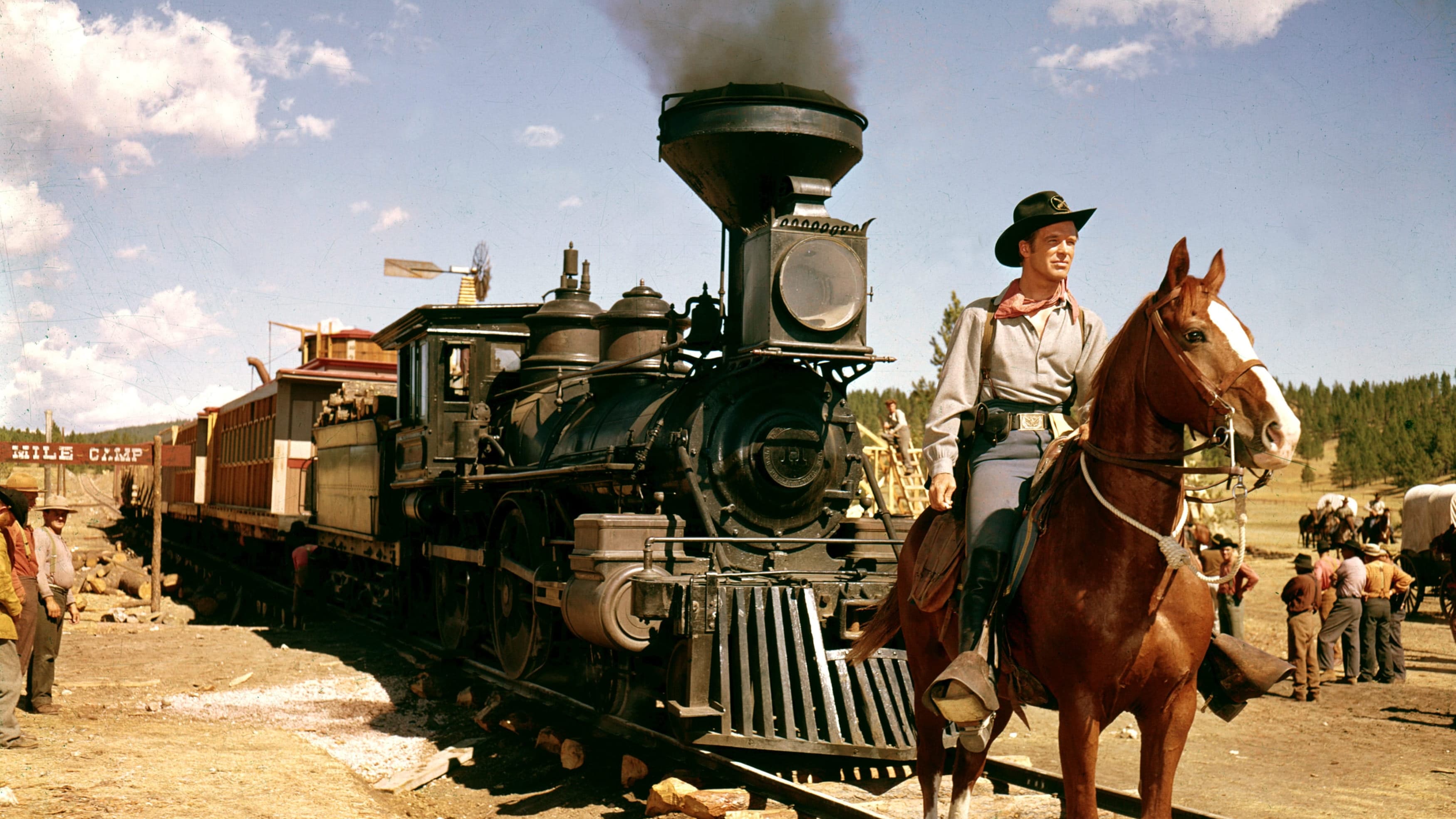
The epic tale of the development of the American West from the 1830s through the Civil War to the end of the century, as seen through the eyes of one pioneer family.
What's left behind the scenes
- The film was shot for presentation in cinemas supporting the 'Cinerama' system.
- Three out of the film's five parts were shot by Henry Hathaway, 'The Civil War' by John Ford, and 'The Iron Horse' by George Marshall.
- A more accurate translation of the title is "How the West Was Won".
- In 1997, the film was added to the U.S. National Film Registry.
- James R. Webb's screenplay was based on a series of articles published in Life magazine. Writer Louis L'Amour based a novel of the same name on the screenplay.
- Stuntman Bob Morgan nearly died during filming. Towards the end of the film, a shootout takes place between the sheriff and bandits on a moving train. Morgan played one of the bandits and was near logs on the platform when the chains holding the logs snapped, and Morgan was pinned beneath them. He sustained such injuries that he didn't begin to walk on his own again for five years.
- The film was intended to be shown in cinemas equipped with the 'Cinerama' system (a panoramic cinematic system developed in 1952; its feature was the simultaneous use of three film reels, each of which captured its part of the panoramic frame with a large horizontal viewing angle). Because of this, everything would be visible on the screen down to the smallest detail, so the costumes for the film were not sewn on a sewing machine, but by hand, as they would have been sewn in the time period depicted in the film.
- The 'Cinerama' system's equipment did not allow for close-up shots – except perhaps positioning the main actor in the center and bringing the equipment itself directly to them. This disconcerted and hindered the concentration of many actors, as the large apparatus with three lenses was placed less than half a meter from their face.
- John Ford always sat next to the cameraman and watched the filming, but the 'Cinerama' equipment had three lenses, and Ford constantly found himself in the field of view of one lens or another, until the cameraman, Joseph LaShelle, came up with the idea of building a kind of platform for Ford to sit on.
- The film involved over 12,000 extras from several Native American tribes.
- The film stock was so expensive that the actors were specifically asked to memorize their lines and actions in order to shoot as few takes as possible.
- It was impossible to combine the images from the three lenses so that the dividing lines were completely invisible, and directors had to go to great lengths to mask them. For this, they used objects – specifically trees, lampposts, window frames, railings, building corners, doorways, and wooden crates.
- All three lenses on the Cinerama cameras were positioned at an angle to each other, and it was more difficult for the actors to perform for three lenses than for the usual single one. When their image was projected onto three screen panels, it seemed as if they were looking slightly up or slightly down, rather than at their scene partner. This is clearly visible in an earlier film shot in the Cinerama system—it’s “The Wonderful World of the Brothers Grimm” (Henry Levin, George Pal, 1962). Fortunately, this problem was solved by the time work began on this film. To compensate for the angles at which the lenses were positioned, the actors didn’t look directly at their partners, but slightly to the side, so that when their image was projected onto the Cinerama screen, it appeared as if they were looking at each other. But it wasn’t easy for the actors, which is why the Cinerama system with three images was abandoned after the release of this film.
- A more accurate translation of the title is “How the West Was Won.”
Did you like the film?
 Auditions in India
 Casting calls in USA
 Castingi w Polsce
 Кастинги в Україні
