Godzilla
The world ends, Godzilla begins.
Godzilla (2014)
Timing:
2:3 (123 min)

6.359/10
9773
9773

6.141/10
125423
125423

6.4/10
463000
463000
Country
Production
Genre
Action, Drama, Science Fiction
Budget
$160 000 000
Revenue
$524 978 362
Website
Director
Actors
Scenario
Producer
Roy Lee, Thomas Tull, Jon Jashni, Dan Lin, Mary Parent, Brian Rogers, Patricia Whitcher, Alex Garcia, Yoshimitsu Banno, Kenji Okuhira
Operator
Seamus McGarvey
Composer
Artist
Harrison Yurkiw, David Clarke
Audition
Sarah Halley Finn, Heike Brandstatter, Coreen Mayrs
Editing
Bob Ducsay
All team (344)
All team (344)
Short description
Ford Brody, a Navy bomb expert, has just reunited with his family in San Francisco when he is forced to go to Japan to help his estranged father, Joe. Soon, both men are swept up in an escalating crisis when an ancient alpha predator arises from the sea to combat malevolent adversaries that threaten the survival of humanity. The creatures leave colossal destruction in their wake, as they make their way toward their final battleground: San Francisco.
What's left behind the scenes
- Scoot McNairy, Henry Cavill, Caleb Landry Jones, and Aaron Shang were considered for the leading roles.
- Joseph Gordon-Levitt could have played the main male role, but he turned it down.
- The working title of the film is "Nautilus".
- The film's release is timed to coincide with the 60th anniversary of the franchise.
- While filming, cinematographer Seamus McGarvey accidentally wandered onto the set of "Planet of the Apes: Revolution" (2014), which was being filmed nearby in Vancouver, on the lakeshore. The set was very similar to the one used for "Godzilla", and so McGarvey wandered around with his light meter for quite some time, not recognizing anyone, until he realized his mistake.
- Director Gareth Edwards described Godzilla as an anti-hero: "Godzilla is definitely a representation of nature's fury. The main theme of the story is the struggle between man and nature, and Godzilla certainly embodies nature. It’s impossible to win this fight. Nature will always be the victor – that’s the subtext of our film. Godzilla is the punishment we deserve."
- Director Gareth Edwards and a team of designers reviewed all previous incarnations of Godzilla to create the creature’s appearance in the film. Edwards said: "I tried to look at it like this: imagine Godzilla was a real creature, and someone from Toho studio saw him in the 1950s, then ran to the studio to make a film about him, and tried his best to remember and draw him."
- This film stars Bryan Cranston, known for his role as a high school teacher with cancer in the series "Breaking Bad" (2008-2013). Takashi Shimura starred in the original "Godzilla" (1954) and played a similar role in "Live" (1952).
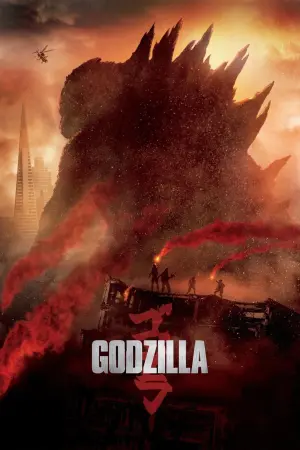
- The film's poster and trailer were first presented at Comic-Con 2012.
- The monologue used in the fan-made trailer belongs to Robert Oppenheimer, a nuclear physicist who worked on the atomic bomb.
- Cinematographer Seamus McGarvey wanted the scenes from the 1950s to have a "clean look with muted colors and soft edges." To achieve this effect, he shot these scenes with a vintage lens from the 1960s and then digitally tinted the blacks in these scenes with purple.
- This is the last film produced by Warner Bros. in collaboration with Legendary Pictures.
- Legendary Pictures filed a lawsuit to remove producers Dan Lin, Roy Lee, and Doug Davison from the project. The studio filed a complaint for declaratory relief in the Los Angeles Superior Court, alleging that Lin, Lee, and Davison threatened to sue if the studio exercised its right to ask them to leave the project. The complaint also stated that all the trio had done was introduce a screenwriter for the project to the studio.
- Following the 50th anniversary release of the film «Godzilla: Final Wars» (2004), Toho studio announced that it would not produce any Godzilla films for ten years. Director Yoshimitsu Banno received rights from Toho to film a short IMAX 3D film based on a revised story from «Godzilla vs. Hedorah» (1971). Banno and producer Kenji Okuhira were then joined by cinematographer Peter Anderson, who brought producer Brian Rogers into the project, and further negotiations with Toho studio took place, but this time regarding a full-length 3D film. Kerner Optical production company also joined the project through Anderson. For several years, the project consistently faced issues with budget increases and the need for additional funding. Ultimately, in 2009, the project came into the hands of Legendary Pictures.
- After Legendary Pictures acquired the rights from Toho in March 2010, the studio officially announced the project. Warner Bros. Pictures served as a co-producer. Producers Dan Lin and Roy Lee joined Brian Rogers and executive producers Yoshimitsu Banno, Kenji Okuhira, Doug Davison, Thomas Tull, and John J. Jashni to begin work on «Godzilla». Legendary Pictures also stated that the project would not be a continuation of the 1998 film «Godzilla».
- In July 2010, at Comic-Con International in San Diego, Legendary Pictures first unveiled concept art for «Godzilla».
- In the fall of 2010, it became known that Legendary Pictures had hired screenwriter David Callaham to work on «Godzilla». Director Gareth Edwards joined the project in January 2011. It was then announced that Callaham's initial script would be rewritten. In July 2011, David S. Goyer was brought in to work on the script, but he was unable to finish due to scheduling conflicts, after which Max Borenstein was hired in November 2011 to write a new script based on Goyer's version.
- The film uses original sound from the film "2001: A Space Odyssey" (1968) – fragments of micropolyphonic works by the Hungarian avant-garde musician Ligeti.
- At the 12th minute of the film, when Vivienne and other employees are running from the radiation cloud, Vivienne is seen running last in a shot from behind, and in the next shot, from the front, she is running first.
- In the scene of Godzilla emerging from the water off the coast of San Francisco, she destroys the Golden Gate Bridge. And at the end of the film, when she leaves, the bridge is visible in the background, completely intact and undamaged.
- At the 22nd minute of the film, a kettle boils. However, no one put it on. That is, the characters opened an empty apartment with keys, and during the dialogue it starts whistling on its own.
- Scoot McNairy, Henry Cavill, Caleb Landry Jones, and Aaron S. Shan were considered for the main roles.
- Godzilla's skin is covered in burn scars. The original Godzilla from Ishiro Honda's 1954 film was also covered in scars reminiscent of the burns on the bodies of those who survived the atomic bombings of Hiroshima and Nagasaki.
- To recreate Godzilla’s roar, sound engineers used a series of speakers with a total height of 3.5 meters, a width of 5.5 meters, and a combined power of 100,000 watts.
- Professional parachutists under the direction of Norman Kent and Craig O’Brien participated in the parachute jump scene.
- A 30-meter-long model of the Golden Gate Bridge was constructed for filming scenes in San Francisco.
- During the filming of scenes where various insects crawl on plants, actors and crew members were instructed to watch where they stepped to ensure no insects were present. Insects were specifically placed on the plants and then collected afterward.
- Bryan Cranston had to wear a wig because he had recently finished filming the series “Breaking Bad” (2008-2013). When he was first offered a role in “Godzilla,” Cranston almost turned down the offer, but the enthusiasm of director Gareth Edwards and his previous film “Monsters” (2010) convinced the actor to at least read the script, and upon reading it, he agreed to film.
- Sound engineers Eric Adal and Ethan Van der Ryn spent several months creating Godzilla's roar. To reproduce the original monster’s roar, they tried numerous variations. Finally, on the 50th attempt, they managed to create the sound they were aiming for. The sound engineers tested it using 100,000-watt concert amplifiers belonging to The Rolling Stones near the Warner Bros. studio building. The resulting roar shook gutters and roofs, and the sound could be heard for almost 5 kilometers. Residents of nearby towns were informed about the tests through announcements in the local press and flyers, however, calls reporting Godzilla's appearance still began arriving at the Burbank, California police department.
- The working title of the film was "Nautilus".
- While filming this movie, cinematographer Seamus McGarvey accidentally wandered onto the set of "Planet of the Apes: Revolution" (2014), which was being filmed nearby, also in Vancouver. The set was very similar to the one used for "Godzilla," and so McGarvey wandered around there for quite a while with his light meter, not recognizing anyone, until he realized his mistake.
- Director Gareth Edwards described Godzilla as an anti-hero: "Godzilla is definitely a representation of nature's fury. The main theme of the story is the struggle between man and nature, and Godzilla certainly embodies nature. It’s impossible to win this fight. Nature will always be the victor—that’s the subtext of our film. Godzilla is the punishment we deserve."
- Director Gareth Edwards and a team of designers reviewed all previous incarnations of Godzilla in order to create the creature’s look for the film. Edwards said: "I was trying to look at it like this: imagine Godzilla was a real creature, and someone from the Toho studio saw him in the 1950s, then ran to the studio to make a film about him, and tried his best to remember and draw him."
- Cinematographer Seamus McGarvey wanted the scenes from the 1950s to have a "clean look with muted colors and soft edges." To achieve this effect, he shot those scenes with a vintage lens from the 1960s and then tinted the blacks in those scenes purple using digital processing.
- Following the release to mark the 50th anniversary of the "Godzilla: Final Wars" (2004) franchise, Toho studio announced that it would not produce any Godzilla films for ten years. Director Yoshimitsu Banno received rights from Toho to film a short IMAX 3D film based on a modified story from "Godzilla vs. Hedorah" (1971). Banno and producer Kenji Okuhira were then joined by cinematographer Peter Anderson, who brought producer Brian Rogers into the project, and further negotiations with Toho studio took place, this time regarding a full-length 3D film. Kerner Optical production company also joined the project through Anderson. For several years, the project consistently faced issues with budget increases and the need for additional funding. Ultimately, in 2009, the project came under the control of Legendary Pictures.
- In the fall of 2010, it became known that Legendary Pictures had hired screenwriter Dave Callaham to work on "Godzilla." Director Gareth Edwards joined the project in January 2011. It was then announced that Callaham's initial script would be rewritten. In July 2011, David S. Goyer was brought in to work on the script, but he was unable to complete it due to scheduling conflicts, after which Max Borenstein was hired in November 2011 to write a new script based on Goyer's version.
- The film utilizes original sound from "2001: A Space Odyssey" (1968) – excerpts from the micropolyphonic works of Hungarian avant-garde musician Ligeti.
- In the scene depicting Godzilla's emergence from under the water off the coast of San Francisco, she destroys the Golden Gate Bridge. However, at the end of the film, as she departs, the bridge is visible in the background, completely intact and undamaged.
Did you like the film?
 Auditions in India
 Casting calls in USA
 Castingi w Polsce
 Кастинги в Україні
