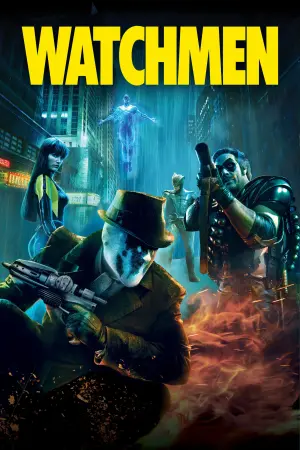
Watchmen
Justice is coming to all of us. No matter what we do.
Watchmen (2009)
Timing:
2:43 (163 min)

7.4/10
9979
9979

7.691/10
334281
334281

7.6/10
609000
609000

Country
Production
Genre
Action, Mystery, Science Fiction
Budget
$130 000 000
Revenue
$185 258 983
Director
Actors
Scenario
Producer
Operator
Composer
Artist
Chris Beach
Audition
Kristy Carlson, Michelle Allen
Editing
Short description
In a gritty and alternate 1985 the glory days of costumed vigilantes have been brought to a close by a government crackdown, but after one of the masked veterans is brutally murdered, an investigation into the killer is initiated. The reunited heroes set out to prevent their own destruction, but in doing so uncover a sinister plot that puts all of humanity in grave danger.
What's left behind the scenes
- The film is based on Alan Moore's comic book "Watchmen" (1986-1987).
- Robin Williams, Doug Hutchinson, and Paddy Considine auditioned for the role of Rorschach. Jude Law and Tom Cruise were considered for the role of Adrian Veidt. Ron Perlman and Thomas Jane were candidates for the role of Edward Blake.
- The director initially intended to use only songs by famous musicians – Bob Dylan, Jimi Hendrix, and Simon & Garfunkel. But then Snyder decided that a film based on visuals couldn't do without a fresh sound.
- The original author, Alan Moore, believes that comics and cinema are incompatible. Moore considers "300" to be the most hated comic book adaptation, written and directed by Zack Snyder. During an interview with ReelzChannel.com, Snyder spoke about Alan Moore's attitude towards the adaptation, saying that in the worst case, he would watch the film on DVD at home in cold London and say it was, of course, rubbish, but not complete garbage. When Moore found out about this, he commented on Snyder's words as follows: "And that's in the worst case? I don't think he understands what 'worst case' means. It will never happen. I will never watch that [censored] movie." Despite Alan Moore disowning the comic book adaptation, Zack Snyder hopes that one day he will watch the film and be satisfied with the adaptation.
- Alan Moore's twelve-chapter graphic novel was first published in 1986-1987 and has been repeatedly republished since then.
- In 2003, the director's position was offered to Michael Bay, who rejected the offer without much hesitation.
- In July 2004, Paramount Pictures became the next home for the troubled "Watchmen," inviting Darren Aronofsky to direct the film based on a completed screenplay by David Hayter. The director soon left the project and was replaced by Paul Greengrass. The studio planned to release the film in the summer of 2006, but in the spring of 2005, due to potentially excessive costs, they abandoned the project, after which the producers turned to Warner Bros. In December 2005, the project's transition to the new studio was officially announced, but neither Paul Greengrass nor David Hayter, who had been working on the screenplay for several years, were invited. By agreement between the studios, Paramount Pictures received 25% of the film rights and international distribution.
- On February 14, 2008, 20th Century Fox filed a lawsuit against Warner Bros., accusing it of violating its rights to "Watchmen." On December 24, 2008, the court ruled in favor of 20th Century Fox's claim to the film's copyright. An agreement reached in January 2009 between the two film giants stipulated that 20th Century Fox would receive a $10 million monetary compensation and a certain percentage of the film's box office revenue, but would not have any further rights to it.
- While Paul Greengrass was the director of "Watchmen," Simon Pegg was one of the main candidates for the role of Rorschach, and he met with the producers several times regarding his participation in the film. Hillary Swank and Joaquin Phoenix could have also landed other key roles at that time.
- Director Zack Snyder personally asked the original comic series artist Dave Gibbons to create the first teaser poster for "Watchmen." The artist responded to the request with great enthusiasm and designed the poster so that careful examination would reveal hints of the film's future plot.
- Actor Nathan Fillion was considered for the roles of The Comedian and Nite Owl.
- Jessica Biel was considered for one of the roles in the film.
- Carla Gugino plays Sally Jupiter, the mother of Laurie Jupiter, played by Malin Åkerman, although the age difference between the two actresses is only seven years.
- When casting the film, Zack Snyder provided each actor with a copy of the original graphic novels and a copy of the script. On set, the director allowed the actors to keep their own copy of the comics so that they could modify individual dialogues if necessary to better match the source material.
- Zack Snyder was keen to offer Gerard Butler, the main star of his previous box-office hit '300', one of the roles in the film and even promised it to him. When all the roles were filled and none were available, the director offered him, as compensation, a role in the direct-to-DVD release 'Tales of the Black Freighter'. This animated short film is an adaptation of a fictional comic book, scenes from which periodically appear throughout various chapters of Alan Moore's 'Watchmen'.
- Among many other films on television screens, one can see the classic film "300 Spartans" (1962) about the same events as Zack Snyder's previous work "300" (2007), which made the director famous.
- Actor Jeffrey Dean Morgan's first impulse after reading the initial three pages of the script was to refuse the role of The Comedian. He believed that they contained the only scene involving this character and did not want to get involved with a hero who was allotted so little screen time. The actor's agent convinced him to finish reading the script before making a final decision.
- Thomas Jane was one of the main candidates for the role of The Comedian for director Zack Snyder, but his commitment to another project prevented him from appearing in "Watchmen."
- Zack Snyder deliberately cast actors significantly younger than their characters for many roles due to the large number of flashbacks throughout the film. The director believed that it would be much easier to make the actors look older than younger with makeup and computer graphics. This is especially noticeable with Carla Gugino, who was only 37 years old at the time of filming, although during much of the film's events she is well over sixty.
- The origin of the name Rorschach leads to the well-known Rorschach test, widely used in psychotherapy.
- Copies of the film were delivered to some cinemas under the false title "Old Heroes Never Die".
- The first trailer for the film, attached to theatrical releases of "The Dark Knight," generated such interest in Alan Moore's graphic novel that "Watchmen" briefly returned to the national bestseller lists.
- The Comedian's guns in the film were real firearms, not props specially prepared for filming, as is usually the case. They were D&L Sports “Professional Model” 45 caliber.
- Dozens of scenes in the film were intentionally designed to replicate the drawings from the original graphic novel as accurately as possible.
- The initial director's cut of the finished film was approximately three hours long. Through tremendous effort, the runtime was reduced, and the animated short film "Tales of the Black Freighter" originally integrated into the script became a separate project, although the director seriously considered including it in the final version.
- Filming took place from September 17 to December 31, 2007, in Vancouver, Canada and its surroundings.
- In the early 1990s, the project was developed based on a script by Sam Hamm. Robin Williams was to play Rorschach, Jamie Lee Curtis – Silk Spectre, Gary Busey – The Comedian, and Richard Gere and Kevin Costner were considered for the role of Nite Owl. The project underwent numerous script revisions under the direction of Terry Gilliam and Charles McKeown and eventually was shelved.
- The first official still from the film – a test shot of Rorschach – appeared in the trailer for '300' (2007). The shot shows Wesley Coller, one of the producers, dressed in a Rorschach costume, against the backdrop of New York City. Snyder created the shot to demonstrate the atmosphere of the future film. Zack's wife, Deborah Snyder, bet him $100 that no one would notice the shot. Zack won the bet.
- Zack Snyder created storyboards based on the comic book.
- The rights to adapt the comic book were purchased along with the rights to 'V for Vendetta' (2006). Joel Silver, having produced 'V for Vendetta,' was also slated to produce 'Watchmen' when Terry Gilliam was set to direct the film.
- Warner Bros. considered Darren Aronofsky for the director's position. Darren expressed interest in the project, but he found the original story told in the comic book to be outdated. Aronofsky planned to move the action from the eighties to the present day, replacing the storylines about the Vietnam War with references to the situation in Iraq and global terrorism. The studio was dissatisfied with his vision of the film and hired Zack Snyder.
- The choral and organ music from the teaser is part of the composition “Prophecies,” written by Philip Glass for “Koyaanisqatsi” (1982). The trailer also contains a portion of Glass’s composition “Pruit Igoe.” A reworked version of both compositions can be heard in the film during the story about Doctor Manhattan.
- The song “The Beginning is the End is the Beginning” by Smashing Pumpkins plays in the film's trailer.
- Daniel Craig turned down the role of Rorschach, and Hilary Duff turned down the role of Silk Spectre.
- Jeffrey Dean Morgan played The Comedian, whose middle name is Morgan.
- When Matthew Goode was offered the role of Adrian Veidt, he hadn't read the comic yet. Matthew called a friend and asked if he should even read the script. His friend not only advised him to read the script, but also the graphic novel, and to accept the role without hesitation.
- When production of the film began (in 1987), the actors who ultimately played the main roles, with the exception of Jackie Earle Haley, hadn't even started their acting careers.
- When Patrick Wilson was offered the role of Dan Dreiberg, he called a friend, a big comic book fan, and asked him what he thought of "Watchmen." His friend said that if Patrick ever decided to star in a superhero movie, "Watchmen" would be the perfect choice. After getting the role, Patrick invited his friend to the set during the filming of the prison escape scene.
- On Adrian Veidt’s monitors, one can notice: an advertisement for Apple computers “1984”; the music video for “Addicted to Love”; "Altered States" (1980); the opening credits of “MacGyver” (1985); "Rambo: First Blood Part II" (1985).
- Three songs by Bob Dylan can be heard in the film: “The Times They Are a-Changin” in the opening credits, “All Along the Watchtower” shortly before the ending, and “Desolation Row” in the closing credits. These songs are also mentioned in the comic. However, in the film, we only hear “The Times They Are a-Changin” in its original version, while the other two are played as cover versions by Jimi Hendrix and “My Chemical Romance.”
- In the scene where a youth gang attacks Lori Juspeczyk / Silk Spectre II and Dan Dreiberg / Nite Owl II, one of the guys is wearing a t-shirt with the "V" symbol, mirroring the emblem of the main character from "V for Vendetta" (2006).
- Sally Jupiter's retirement party is a recreation of Leonardo da Vinci's famous "The Last Supper".
- The film was released in 3,611 theaters, setting a record for R-rated movies.
- When Alan Moore was writing the comic, he was greatly surprised to learn that the ending was strikingly similar to the episode "The Architects of Fear (#1.3)" from "The Twilight Zone" (1963). The film includes a scene where Sally Jupiter is watching this series.
- The shot of The Comedian shaking hands with Nixon is based on a photograph of Richard Nixon shaking hands with Elvis Presley.
- In the early stages of the project's development, Terry Gilliam stated that adapting the comic would cost $1 million per page.
- In the comic, the phrase “Who Watches the Watchmen?” is never written out in full. The phrase is always partially obscured either by an object or a person. However, in the film, the viewer sees the complete phrase at least twice.
- In the opening credits, Silhouette kisses a nurse, which is a reference to the famous photograph of a sailor kissing a nurse during the Victory over Japan Day celebrations. A sailor can be seen behind Silhouette and the nurse.
- Adrian Veidt’s computer is an Apple Macintosh SE/30. It is running an early version of “Mac OS”.
- Shortly before the finale, as we see buildings under construction, the Twin Towers of the World Trade Center can be seen in the background. The twin towers are also visible from Adrian Veidt’s office.
- On Moloch's nightstand, one can notice a copy of Allen Ginsberg's "Howl".
- On Adrian Veidt's desk, one can notice a biography of Hollis Mason, "Under the Hood." The book is also mentioned in Alan Moore's comic.
- Most of the songs used in the film are also mentioned in the comic.
- Some of the actors (such as Lynn Colliar), who played television announcers, are actually television announcers from Vancouver.
- During Dan and Laurie's dinner, one can hear the phrase: "I'm so glad I ordered the four-legged chicken!" In the corresponding scene in the comic, there is an image of a waiter serving a four-legged chicken.
- Shortly before the comic's finale, a newspaper headline can be seen reading "R.R. is running for president." One might assume the initials belong to Ronald Reagan, but a few pages later they are revealed to stand for Robert Redford. The film references Reagan instead of Redford.
- Dr. Manhattan refers to Laurie as a young woman in comparison to Jenny Slate. Malin Åkerman, who played Laurie, is two years older than Laura Mennell (Jenny).
- If you look closely at a clip from "Rambo: First Blood Part II" (1985), you can see a smiley face pin attached to Martin Kove, which is associated with Watchmen.
- Laurie Juspeczyk's last name is never spoken during the course of the film. Rorschach even calls her Jupiter, although the comic includes a scene where Laurie objects to her mother using the Jupiter surname to downplay their Polish roots.
- Dr. Manhattan's body was modeled after the body of Greg Plitt.
- Compared to the comic, the film changed Edward Blake's age from 61 to 67, and Rorschach's from 45 to 35. These changes notably impacted the timeline of Watchmen: for example, the Soviet Union's creation of the atomic bomb was pushed back ten years (as can be noticed in the article when Kovacs is ten years old); and Rorschach was only seventeen at the meeting of the Watchmen in 1966.
- The comic mentions that Captain Metropolis and Silhouette were a gay couple. This is not stated in the film. However, during the farewell scene for Sally Jupiter, it can be observed that Captain Metropolis and Silhouette are looking at each other intently.
- In the comic, after Rorschach meets Adrian Veidt, he makes a note in his journal that Adrian might be gay. This scene is absent from the theatrical version but is included in the director's cut. The film contains several references to Veidt's sexuality: a folder labeled “BOYS” can be seen on Adrian’s computer; and in the opening credits, Veidt stands opposite the “Studio 54” club along with “The Village People”.
- During the opening credits, Neil Armstrong can be heard saying “Good luck, Mr. Gorsky.” This is a reference to a rumor that, as a young boy, Armstrong was playing in his yard and accidentally threw a ball into his neighbor's yard. When retrieving the ball, he overheard Mrs. Gorsky saying to her husband, “Oral sex? I'll give you a blowjob only when the neighbor's boy flies to the moon.” For a long time, there was a rumor that Armstrong’s first words upon stepping onto the lunar surface were: “Good luck, Mr. Gorsky.” However, the rumor proved false after being debunked by numerous sources, including Armstrong himself.
- Billy Crudup portrayed Dr. Manhattan in all scenes while wearing a glowing suit covered in 2500 LEDs. Additionally, after a take with Crudup in the suit, another take was filmed without the actor to capture background objects for easing the subsequent digital character integration process. To simulate the lighting for additional scenes shot without the actor, cinematographers used a pole the size of Billy Crudup, equipped with the same LEDs as the actor’s suit.
- It should be noted that the filmmakers "modified" Doctor Manhattan's teleportation. The graphic novel does not show any energy fields arising from this – Manhattan simply disappears in one panel and appears in the next.
- During the fight between The Comedian and the masked man, a glass hits the door of room "3001" and knocks off the "1", which is a subtle reference to Zack Snyder's previous work – "300 Spartans".
- The scenes with the imprisonment of The Mothman, the murder of Dollar Bill, and the waiting in the prostitute's reception room (Rorschach's mother) were inspired by the photographs of Weegee, the first and foremost crime photojournalist. Weegee's real name was Arthur Fellig, and he was a police photographer-superhero. Initially, he had an animalistic instinct for being at the crime scene before the police, and later acquired a real photo-super-mobile. The police allowed him to listen to their frequency, he had a darkroom in the trunk, and a darkroom in the back seat. He always photographed with a shutter speed of 1/200 and a flash. Essentially, his main artistic technique was the ability to be in the most disgusting place at the most vile time. That is, where the Watchmen are.
- When Doctor Manhattan destroys the Viet Cong soldiers, "Ride of The Valkyries" plays, which is a reference to "Apocalypse Now" (1979).
- The "Watchmen" comic can be seen on Dan's table in the scene where he and Laurie have sex for the first time. The comic can also be seen in the scene where a gang beats Hollis Mason (the scene is only present in the director's cut).
- The song playing during the love scene between Night Owl II and Silk Spectre II is Leonard Cohen’s 1984 version of “Hallelujah.” The song is very often used in various films, both in its original form and in different cover versions. In most cases, the song plays to emphasize sadness or misfortune. However, in “Watchmen,” the composition emphasizes absolutely opposite emotions. Moreover, the viewer hears the final verse, which is often missing in cover versions, but which perfectly suits this scene.
- In the scene of New York’s destruction by Ozymandias, one can notice a newspaper vendor and a young Black boy in glasses standing nearby. In the graphic novel, they appear in almost every chapter, and the boy (named Bernie) is constantly reading the comic book “Tales of the Black Freighter,” which is strangely intertwined with the story of “Watchmen.” They receive no attention in the theatrical version, but can be seen in the director’s cut.
- In the film, Adrian Veidt/Ozymandias destroyed the largest cities in the world using a reactor that replicated the power of Doctor Manhattan. In the graphic novel, he used this power indirectly: he needed it to teleport a giant monster to New York.
- On one of the television monitors in Adrian Veidt’s office, the film “Rambo 2” is playing, in which the main character returns to Vietnam after the war to rescue American prisoners of war left to their fate. This seems very strange, since in the reality of “Watchmen,” the Vietnam War ended with a completely different outcome.
- The director originally intended for the film to feature exclusively songs by famous musicians – Bob Dylan, Jimi Hendrix, and Simon & Garfunkel. But then Snyder decided that a film made 'from pictures' could not do without a fresh sound.
- The original author, Alan Moore, believes that comics and cinema are incompatible. Moore considers '300' to be the most hated comic book adaptation, written and directed by Zack Snyder. During an interview with ReelzChannel.com, Snyder spoke about Alan Moore's attitude towards the adaptation, saying that in the worst case, he would watch the film on DVD at home in cold London and say that it was, of course, awful, but not completely terrible. When Moore found out about this, he commented on Snyder's words as follows: 'And that's in the worst case? I think he doesn't understand what the worst case is. That will never happen. I will never watch that [censored] movie.' Despite Alan Moore disowning the comic book adaptation, Zack Snyder hopes that one day he will watch the film and be satisfied with the adaptation.
- Copies of the film were delivered to some cinemas under the false title 'Old Heroes Never Die'.
Did you like the film?
 Auditions in India
 Casting calls in USA
 Castingi w Polsce
 Кастинги в Україні
