9th Company
They stood together while their country fell apart
9 рота (2005)
Timing:
2:19 (139 min)

6.794/10
257
257

6.846/10
481951
481951

7/10
22000
22000
Production
Genre
War, Action, Drama, History
Budget
$6 700 000
Revenue
$26 146 165
Website
Director
Actors
Aleksey Chadov, Artur Smolyaninov, Konstantin Kryukov, Ivan Kokorin, Artyom Mikhalkov, Soslan Fidarov, Mikhail Porechenkov, Dmitriy Mukhamadeev, Fyodor Bondarchuk, Amadu Mamadakov
All actors and roles (10)
All actors and roles (10)
Scenario
Yuri Korotkov, Iskander Galiev
Producer
Fyodor Bondarchuk, Aleksander Rodnyansky, Iskander Galiev, Sergey Melkumov, Elena Yatsura, Dmitry Rudovsky
Operator
Maxim Osadchy-Korytkovsky
Composer
Ivan Burlyaev
Artist
Audition
Editing
Igor Litoninskiy
All team (54)
All team (54)
Short description
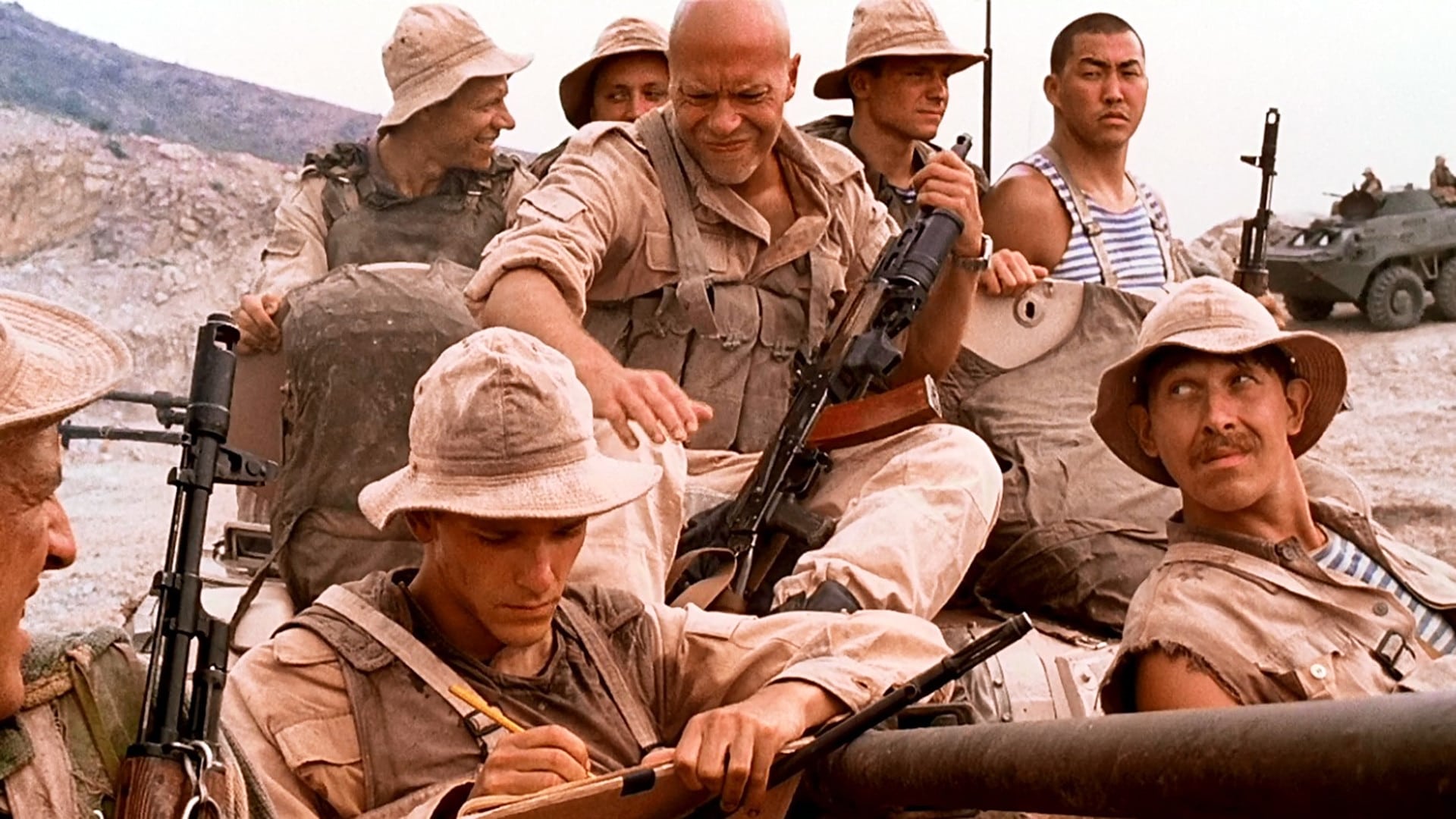
Russian army recruits complete training and take their posting in late 1980s Afghanistan, where the insurgents are slowly gaining the upper hand.
What's left behind the scenes
- The screenplay by Yuri Korotkov was based on real events. The 9th Company of the 345th Separate Guards Parachute Regiment was arguably the most legendary unit of the Soviet Army in Afghanistan.
- Filming took place in Crimea, Moscow, Uzbekistan (in the areas where the real Afghan 'training camps' were formerly located), and in Finland.
- The film crew received support on location from the Presidents of Ukraine and Uzbekistan, the defense ministers of these countries, as well as the governor of the Moscow region, General Gromov, who was the commander of the Southern Group of Forces of the USSR at the time of the withdrawal of the Soviet contingent from the rebellious republic.
- The film's budget was $9 million. The most expensive scene was the plane explosion. It took 17 days to prepare and film, and cost $450,000.
- The film expedition lasted 150 calendar days. Shooting days (Moscow and Crimea) totaled 111. Filming took place from May 25th to October 12th, 2004.
- 18 locations in Crimea, Uzbekistan, and Moscow were used for filming. Crimean locations included: Angarsky Pass, Perevalnoe (Chatyr-Dag), Eski-Kermen, Saki, Novofedorovka, Beketovo, Rou Rocks, Kuchuk-Yanishar, Yuzhnoye, Buyuk-Yanishar, Old Crimea, Agarmysh, Balaklava (quarry), Cape Chauda. Uzbek locations included: Charvak, Brichmulla, Big Chimgan, Chirchik airfield, Chatkal.
- Producer Elena Yatsura spent a total of 480 hours in flights. During filming in Ukraine, the crew traveled approximately 10,000 kilometers on Crimean roads.
- The total number of people involved in filming was: crew – 150 people, extras – 2000 people. During the filming period, the crew drank 25,000 liters of tea and coffee and consumed 13,500 kg of breakfasts and lunches. The 'mujahideen' were dressed in authentic Afghan clothing purchased in Afghanistan. A total of 300 costumes were purchased. Four railcars of props arrived in Crimea for filming.
- Once, a props assistant found a puppy in Simferopol. The dog was named Mina, became the darling of the film crew, and even played a role. Now Mina has grown up, lives in Moscow, and has already been approved for her next role – in Alla Surikova’s film.
- A donkey, who made her debut in "Prisoner of the Caucasus", was used in the scene with the old Afghan man. The crew came to the Yalta Zoo in search of a donkey and explained that they needed an animal that wasn't afraid of the camera, loud noises, and everything associated with filming. "You won't find anyone better," said the trainer, "She was young in 'Prisoner of the Caucasus', but now she's an experienced actress. Take her, you won't regret it." '9th Company' didn't regret it. The donkey wasn't afraid of anything and performed her role perfectly.
- Approximately one and a half thousand servicemen from the naval forces, coastal defense troops, ground forces, army aviation of the ground forces, and the Ukrainian Air Force participated in the Crimean filming.
- For filming, the artists had to repaint the brightly colored Ukrainian equipment into 'desert' colors and khaki, and the training towns – from yellow and blue to protective shades. The crew bought almost all the acrylic paint in Simferopol for this purpose. More than 1,000 kg of paint was used in total – because the equipment and houses then needed to be restored to their original appearance. About fifty large and small 'Soviet' posters were created.
- Once, scenes with helicopters were being filmed in Beketovo. The helicopters were supposed to fly in from the direction of Foros. And there, at President Kuchma’s residence, a trilateral summit was taking place. The security detail of Presidents Kuchma and Nazarbayev noticed the helicopters with red stars on their sides, which were flying very low over the meeting place of the heads of state. Eyewitnesses say that if the President of Russia hadn't left Foros at that moment, his security would have been quicker to react, and it's unknown how things would have ended for '9th Company'. As it was, Fyodor Bondarchuk was summoned 'on the carpet' the next day, and had a serious conversation with men in civilian clothes.
- Once, during filming in the Stary Krym Quarry, two Mi-24 helicopters were circling above the mountains to get another take. At that moment, a hang glider flew towards them. A collision was barely avoided. After this incident, Fyodor Bondarchuk sent people to all the surrounding mountains to find the place from which the ill-fated hang glider had taken off. The launch site was never found. However, the hang glider proudly told everyone for another six months the story of how he participated in the filming of "The 9th Company."
- The most difficult scene in the film was the explosion of the Afghan village. The village was built by a team from the Yalta studio. Construction took 4 months. The real village was created using the classic Eastern method – from clay – and covered an area of 2 hectares. Before filming began, tourists made pilgrimages to the "Afghan town" – as the object was located very close to Koktebel. On the day the explosion was scheduled and everything was ready (9 tons of explosives, 7 kilometers of wires), the sky became overcast, and the filming had to be postponed. The "charged" village was left overnight under reinforced guard. The next morning, a special person was stationed on a hill to report on the weather – when a large patch of clear sky appeared between the clouds, the explosion was detonated, and the lovingly created village was blown into the air.
- Once in the Stary Krym Quarry, where the "village" object was being built, the tail of a mortar mine appeared from the ground. Mikhail Vasilyevich Lavrikov, the deputy commander of the Separate Marine Infantry Brigade of the Ukrainian Navy, learned about this. The object was put under guard, and they tried to call in sappers, but the sappers were out on assignment. There was nothing for it – Lavrikov tied a rope to the tail, hid behind a hillock, and pulled. It turned out that it was only the tail, and the mine itself, which had been lying there since the Great Patriotic War, had decayed.
- The main battle scene was filmed in the locality of Kuchuk-Yanishar. To build the "Last Stand" fortification, 12 KAMAZ trucks of facing stone and 30 KAMAZ trucks of rubble were brought in from the Stary Krym Quarry. They used peat and cement for the pyrotechnic charges – to create a lot of dust. Three-ton boulders were also brought from the same quarry and installed by cranes.
- When they were filming the "Position Under Fire" scene, a fire broke out. The wooden ceiling of the dugout and the camouflage netting caught fire. The fire spread so quickly that they had to call the fire department. They arrived and said, "The whole of Crimea now knows there's a fire on "The 9th Company!"
- Approximately 70,000 meters of film were shot in total. Cinematographer Maxim Osadchy, together with colorist Bozhedarka Maslennikova, spent over five hundred hours color correcting and achieving the exact shades envisioned during filming. As a result, the Afghan scenes turned out more sepia-toned and reddish, while the training camp scenes are colder and greenish.
- Sound engineer Kirill Vasilenko specifically traveled to Ukraine to record ambient sounds. An additional 20 hours of sounds were recorded – firearms, airplanes, helicopters, tanks, barracks sounds, APCs, mortars, large-caliber weapons, and Grads. Several editing teams worked on the sound montage. In Moscow, three people worked on atmospheric sounds and dialogue. In St. Petersburg, all sound effects (gunshots, explosions, etc.) were placed. And in Australia, a specialist worked on ricochets. Overall coordination and collection of all material were carried out in London. The transmission of sounds and images between countries and continents was carried out via the Internet.
- "9th Company" is the only Russian film in recent decades, and the second in the entire history of cinema, for which sound work was done at the British studio “Pinewood Shepperton Studios.” The first was Sergei Bondarchuk’s “Waterloo” (1970). Among the films created with the direct participation of “Pinewood” are all the Bond films, Ridley Scott’s “Black Hawk Down,” Tim Burton’s latest film “Charlie and the Chocolate Factory,” and many, many others.
- Nikolai Fomenko and Vladimir Mashkov could have played the role of Warrant Officer Pogrebnyak (“Khokhlov”), but in the end, neither of them was able to participate in the filming. As a result, Fyodor Bondarchuk had to try on the “warrant officer’s” uniform himself.
- Upon arriving at the unit, one of the characters receives a Kalashnikov machine gun with a bent barrel, despite the fact that the barrel on this machine gun is easily replaceable (in case of overheating or damage).
- It should be noted that many facts in the film were distorted – the events in the film take place in 1989, not 1988, as was actually the case. Also, the losses of the Soviet army in this battle, according to the film, amount to almost 100%, while in reality 6 out of 39 people died. A serious distortion of the facts is that in the film the paratroopers were 'forgotten' on the height and engaged in battle alone, without any command or support. Another distortion is that the battle took place in the highlands, in the snow, not in the sands, as shown in the film.
- The BTR and BMP have a modern camouflage paint scheme (and specifically, a Ukrainian one). In Afghanistan, the equipment was generally a solid green color.
- In the scene with the downed An-12, the propellers instantly stop rotating after the plane explodes.
- Transport planes were always accompanied during takeoff by a pair of helicopters firing off flares.
- Filming took place in Crimea, Moscow, Uzbekistan (in the locations of former Afghan training camps), and Finland.
- The film crew received support on location from the presidents of Ukraine and Uzbekistan, the defense ministers of these countries, and also from the governor of the Moscow region, General Gromov, who had been the commander of the Soviet Southern Group of Forces at the time of the withdrawal of the Soviet contingent from Afghanistan.
- The most expensive scene was the plane explosion. Preparation and filming took 17 days and cost $450,000.
- The total number of people involved in the filming: the crew consisted of 150 people, and the extras numbered 2000.
- Once, a props assistant found a puppy in Simferopol. The dog was named Mina, became the darling of the film crew, and even appeared in the film.
- This is the second Russian film for which sound work was carried out at the British Pinewood Shepperton Studios. The first was Sergei Bondarchuk's "Waterloo" (1970).
- Upon arriving at the unit, one of the characters receives a Kalashnikov machine gun with a bent barrel. Despite the fact that the barrel on this machine gun is easily replaceable (in case of overheating or damage).
- The film does not claim historical accuracy. The main events of the film take place in 1989, and not in 1988, as was actually the case. Also, the losses of the Soviet army in the film are almost 100%, although in reality 6 out of 39 people died. In the film, the paratroopers were left on the height and engaged in combat alone. Also, the battle took place in the highlands in the snow, and not in the sands, as depicted in the film.
- In the scene with the downed An-12, the propellers immediately stop spinning after the plane explodes.
- On location, the film crew received support from the Presidents of Ukraine and Uzbekistan, the defense ministers of these countries, as well as the Governor of the Moscow Region, General Gromov, who had been the commander of the Soviet Southern Group of Forces at the time of the Soviet contingent's withdrawal from Afghanistan.
- The most expensive scene was the plane explosion. Preparation and filming took 17 days and cost $450,000.
- The total number of people involved in the filming was: 150 crew members and 2000 extras.
- Once, a props assistant found a puppy in Simferopol. The dog was named Mina, became the film crew's favorite, and even appeared in the film.
- This is the second Russian film to have its sound work done at the British Pinewood Shepperton Studios. The first was Sergei Bondarchuk's "Waterloo" (1970).
Did you like the film?
 Auditions in India
 Casting calls in USA
 Castingi w Polsce
 Кастинги в Україні
