Collateral
It started like any other night.
Collateral (2004)
Timing:
2:0 (120 min)

7.2/10
6259
6259

7.449/10
92650
92650

7.5/10
465000
465000
Country
Production
Genre
Drama, Crime, Thriller
Budget
$65 000 000
Revenue
$220 239 925
Director
Actors
Scenario
Producer
Operator
Composer
Artist
Aran Mann, Gerald Sullivan, Christopher Tandon
Audition
Editing
Paul Rubell, Jim Miller
All team (279)
All team (279)
Short description
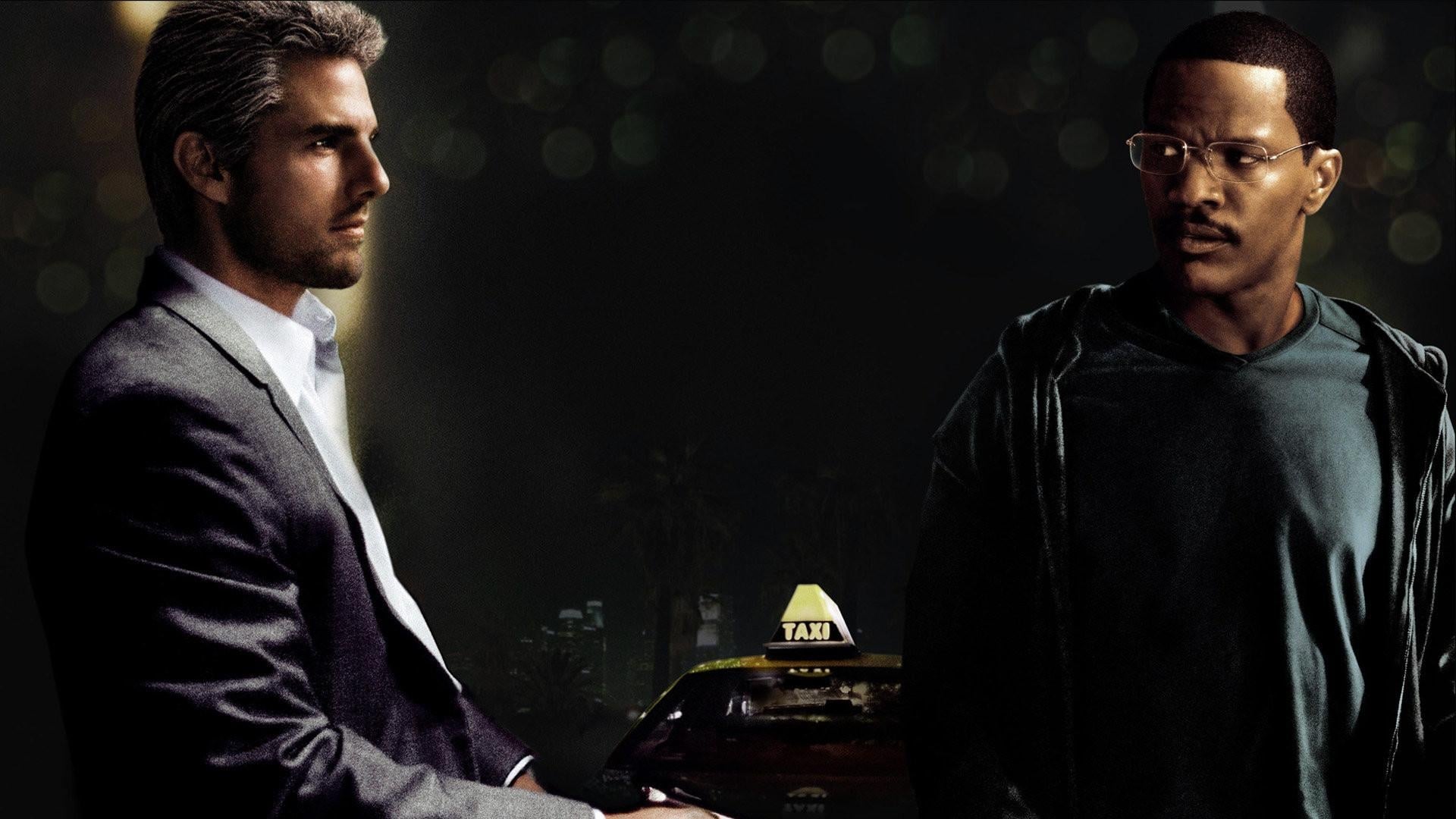
Cab driver Max picks up a man who offers him $600 to drive him around. But the promise of easy money sours when Max realizes his fare is an assassin.
What's left behind the scenes
- Adam Sandler was considered for the role of taxi driver Max, but Jamie Foxx ultimately landed the part.
- Val Kilmer was offered the role of the detective, but due to repeated delays in filming, the schedule shifted and coincided with filming for "Alexander" (2004). The actor ultimately chose to work with Oliver Stone.
- James Newton Howard replaced Hans Zimmer, also due to the delay in the start of filming.
- Russell Crowe was also considered for the project, he was to play Vincent. Edward Norton could have also landed the role.
- Filming was originally planned for Manhattan, but director Michael Mann was dissatisfied with the location and decided to shoot the entire film in Los Angeles.
- To help Tom Cruise and Jamie Foxx better play their roles, Michael Mann wrote detailed biographies of Vincent and Max, thoroughly describing each character's life stages.
- Frank Darabont wrote a draft of the script back in September 2000. However, the script was subsequently substantially revised.
- The role of Vincent was offered to Colin Farrell.
- When Max and Vincent visit Max's mother in the hospital, she says that Max "can stand in front of a mirror and talk to himself." Given that Max is a taxi driver, this phrase is a reference to the "You talkin' to me?" scene from the film *Taxi Driver* (1976).
- One of the photographs in Ida's room depicts Misha Barton. The other two photographs are stills from the television series *Sister, Sister* (1994) and *Recipe for Success* (1998).
- According to Michael Mann, Vincent is able to blend into a crowd, to be completely unnoticed among many people. During preparation for his role, Tom Cruise worked as a "FedEx" courier, delivering packages to one of the Los Angeles markets. No one recognized him.
- After three weeks of filming, Paul Cameron (the cinematographer) left the project due to creative differences. Michael Mann replaced him with Dion Beebe.
- The pistol Vincent uses in the jazz club is a Ruger Mk III .22. Vincent's other pistol is a Heckler and Koch (HK) USP .45ACP.
- The events of the film take place on January 24-25, 2004.
- Stuart Beattie (the screenwriter) wanted Robert De Niro to play Max. De Niro had already played a taxi driver in Martin Scorsese's film, but Max is the complete opposite of Travis Bickle. The studio believed that a younger actor should play the role of Max.
- Before Michael Mann took the director's chair, the producers offered to direct the film to Spike Lee, Martin Scorsese, Fernando Meirelles, and Steven Spielberg.
- Tom Cruise underwent weapons training under the guidance of Mick Gould. Michael Mann also practiced shooting various types of weapons in order to understand how to best film the action scenes.
- Vincent's flash drive is a PNY Attaché.
- Vincent's computer is an HP TC-1100 tablet PC.
- In the film, the FBI task force consists of actual officers from the FBI's operational divisions, the Drug Enforcement Administration, and the Los Angeles Police Department.
- Vincent's sunglasses are Silhouette 4048.
- Vincent's phone is a Nokia 6800.
- Max's last name is Durocher. His full name can be found by looking at his driver's license.
- One of the few films without opening credits; moreover, viewers who happen to tune in will not even know the title, as all the credits begin only after the film ends with the inscription “Directed by Michael Mann”.
- Approximately 80% of the film's scenes were shot using a digital video camera, as the plot largely unfolds at night.
- The film begins at an airport and ends in the subway. Michael Mann's “Heat” (1995) begins in the subway and ends at an airport.
- Towards the end of the film, a display in the subway shows the inscription: “Today is January 25th. Time is 5:40 AM.” The film also contains other time references: 9:30 PM – on Max's “Fare reader” display before Vincent kills his second victim. 10:00 PM – when Agent Fanning calls his colleague from the morgue. 2:20 AM – FBI agents drive to the club. 4:47 AM – when Max calls Annie on his cell phone from the roof of a multi-story garage.
- Vincent kills 12 people.
- The film was shot in Cheboksary and Novocheboksarsk.
- At the age of 17, screenwriter Stuart Beattie was traveling home from Sydney Airport when he came up with the idea for a film about a maniac in the backseat of a regular taxi and an unsuspecting driver. Beattie wrote down the idea and later, while studying at Oregon State University in the United States, he developed it into a screenplay (titled “The Last Domino”), which he revised many times over the years.
- Javier Bardem took only two days to film his scenes. It took several months to learn to speak with the intonation characteristic of Mexicans.
- The taxi dispatchers were voiced by assistant director Michael Waxman, who was not credited in the titles. He read his lines almost as a tongue-twister, as it was believed at the time that they would find an actor to properly voice the lines later, but this idea never materialized, and the lines spoken by Waxman remained in the film.
- The stunt with the car crashing into a concrete wall and flipping over was filmed in one take (and the car stopped exactly where it needed to). Director Michael Mann ordered two more takes, but the very first one was used in the film.
- Stuart Beattie was working as a waiter when he accidentally ran into Julie Richardson, whom he had known since his student days. Richardson had already become a producer and was looking for material for a thriller. Beattie offered Julie Richardson his "Last Domino," and she liked the script. Her boss, Frank Darabont, also liked it. Soon after, the revised script was acquired by "DreamWorks Pictures."
- Mark Ruffalo doesn't use a weapon in the film, but he underwent special training to get used to handling it and look natural with it.
- Stuart Beattie (screenwriter) wanted Robert De Niro to play Max. De Niro had already played a taxi driver in Martin Scorsese's film, but Max is the complete opposite of Travis Bickle. The studio felt that a younger actor should play the role of Max.
- Approximately 80% of the film's scenes were shot on a digital video camera, as the plot mainly unfolds at night.
Did you like the film?
 Auditions in India
 Casting calls in USA
 Castingi w Polsce
 Кастинги в Україні
