White Nights
Two men. Not soldiers. Not heroes. Just dancers. Willing to risk their lives for freedom-and each other.
White Nights (1985)
Timing:
2:16 (136 min)

6.732/10
123
123

7.006/10
2346
2346

6.7/10
9000
9000
Country
Production
Genre
Drama, Thriller
Budget
$0
Revenue
$42 160 849
Director
Actors
Scenario
Producer
William S. Gilmore, Taylor Hackford
Operator
David Watkin
Composer
Artist
Stuart Rose
Audition
Nancy Klopper, Jeremy Zimmermann, Noel Davis
Editing
William Steinkamp, Fredric Steinkamp
All team (102)
All team (102)
Short description
After his plane crashes in Siberia, a Russian dancer, who defected to the West, is held prisoner in the Soviet Union. The KGB keeps him under watch and tries to convince him to become a dancer for the Kirov Academy of Ballet again. Determined to escape, he befriends a black American expatriate and his pregnant Russian wife, who agree to help him escape to the American Embassy.
What's left behind the scenes
- Helen Mirren convincingly played Galina Ivanova, which is not surprising considering her father was Russian. Her birth name is Elena Lidia Vasilievna Mironova. Her grandfather, Pyotr Vasilievich Mironov, was a military engineer and served on the Russian Government Committee in London, where he oversaw arms procurement for the Russian army. A staunch monarchist, he remained in Great Britain after the revolution (according to other sources, he fled Soviet Russia).
- Actress Helen Mirren and director Taylor Hackford met on the set of this film. They subsequently married.
- Director Taylor Hackford faced criticism and ridicule for using old photographs of Helsinki in the film, which he presented as photographs of Leningrad. In fact, Hackford used photographs of Leningrad obtained at his request from representatives of a Finnish tourist agency. Despite the criticism, he endured the mockery for a long time and remained silent about the origin of the photographs so as not to compromise his Finnish friends.
- Director Taylor Hackford encountered quite predictable difficulties when choosing locations for filming. A large part of the film's plot unfolded in the USSR, particularly in Siberia and Leningrad. Given the film's subject matter – and especially the participation of Mikhail Baryshnikov – filming there was out of the question. Siberia could not be filmed on location either, as the technical capabilities of that period did not allow for accurately recreating the typical lighting for northern latitudes. The filmmakers took several trial trips to countries bordering the Arctic Circle and eventually chose the Finnish island of Reposaari. The majority of the island's population, which by that time numbered 1071 people, adhered to communist ideals, so producer William S. Gilmore had to use maximum diplomacy to obtain permission to film. One way or another, the Finnish communists proved to be pragmatic. Filming meant investment in the island's economy and temporary work for its inhabitants (the port, chemical plant, and fish processing plant located on the island had long been in decline). In short, only three residents of the island opposed filming and turning their village into a Siberian town for two weeks.
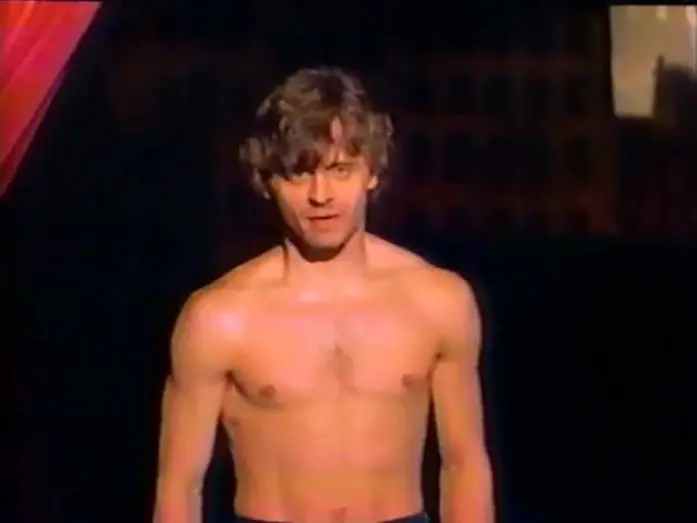
- The beginning of the film shows an excerpt from the ballet "The Young Man and Death" (choreographer – Roland Petit, librettist – Jean Cocteau), which premiered in 1946 on the stage of the Théâtre des Champs-Élysées.
- While preparing for filming, Helen Mirren, Gregory Hines (1946-2003), and Isabella Rossellini visited Leningrad.
- The filmmakers needed to find a location that could pass for the interior of the Leningrad Order of Lenin and Order of the October Revolution Academic Opera and Ballet Theatre named after S.M. Kirov. Ultimately, they decided to film in the premises of the Teatro Nacional de São Carlos in Lisbon. Throughout Western Europe, it most resembled the theatre in Leningrad in terms of atmosphere and the elegance of its decor, as Mikhail Baryshnikov also agreed. At that time, the theatre had already existed for almost 200 years. It served as a symbol of the revival of the Portuguese capital after the devastating earthquake of 1783. The interiors of the Kirov Theatre were filmed in Portugal, while the exterior shots were taken directly in Leningrad in the then USSR. In 1992, the Kirov Theatre was renamed the State Academic Mariinsky Theatre.
- The film opens with an excerpt from the ballet “The Young Man and Death” (choreographer – Roland Petit, librettist – Jean Cocteau), which premiered in 1946 on the stage of the Théâtre des Champs-Élysées.
- The filmmakers needed to find a venue that could pass for the interior of the Leningrad Order of Lenin and Order of the October Revolution Academic Theatre of Opera and Ballet named after S.M. Kirov. Eventually, it was decided to film in the premises of the Teatro Nacional de São Carlos in Lisbon. Throughout Western Europe, it most resembled the theatre in Leningrad in terms of atmosphere and the elegance of its interior, as Mikhail Baryshnikov also agreed. At that time, the theatre had been around for almost 200 years. It served as a symbol of the revival of the Portuguese capital after the terrible earthquake of 1783. The interiors of the Kirov Theatre were filmed in Portugal, and the exterior – directly in Leningrad in the then USSR. In 1992, the Kirov Theatre was renamed the State Academic Mariinsky Theatre.
Did you like the film?
 Auditions in India
 Casting calls in USA
 Castingi w Polsce
 Кастинги в Україні
