The Way of the Gun
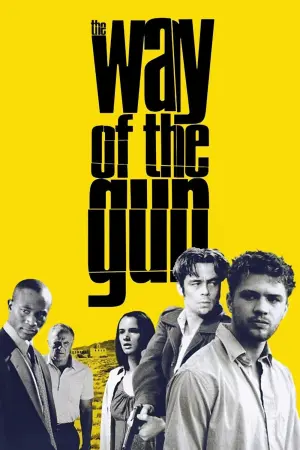
Choose your side carefully, because the only way out is the way of the gun.
The Way of the Gun (2000)
Timing:
1:59 (119 min)

6.317/10
410
410

6.409/10
2948
2948

6.6/10
37000
37000
Country
Production
Genre
Action, Crime, Drama, Thriller
Budget
$21 000 000
Revenue
$13 069 740
Director
Actors
Scenario
Producer
Kenneth Kokin, Russell D. Markowitz
Operator
Composer
Artist
Audition
Lynn Kressel
Editing
Stephen Semel, Christine White
All team (48)
All team (48)
Short description
Two criminal drifters without sympathy get more than they bargained for after kidnapping and holding for ransom the surrogate mother of a powerful and shady man.
What's left behind the scenes
- The film owes its realistic gunfight scenes (referring to the coordination of character movements, the correct choice of cover, and the professional "clearing" of rooms) to a consultant. This role was taken by the brother of director Christopher McQuarrie, a former member of the US Navy SEALs.
- During the filming of the scene that opens the film, Ryan Phillippe accidentally hit Sarah Silverman for real. When the actress came to, Phillippe was almost in tears. The blood in the scene was fake, but the bump on the actress's cheek was very real.
- The main characters of the film bear the surnames of Butch Cassidy (1866-1908) and the Sundance Kid (1867-1906), famous bank robbers.
- Benicio Del Toro suggested the unusual car chase during the kidnapping. This idea came to him after watching "Police Academy 6: City Under Siege" (1989), where a similar stunt was pulled off by a pair of criminals.
- Unlike many other action films, this production meticulously accounted for every shot fired, and the characters reloaded their weapons on time. The only exception was the shootout in the courtyard of the brothel, where Ryan Phillippe and Benicio Del Toro, playing the main characters, fire without reloading their weapons. This scene became a kind of tribute – with a touch of irony – to classic action films.
- The final shootout took place in a brothel – the same location where George Roy Hill’s Western "Butch Cassidy and the Sundance Kid" (1969) concludes.
- The screenwriter and director wrote many lines for Benicio Del Toro's character, but the actor convinced him that the less his character spoke, the better.
- In all scenes, Nicky Katt, who played Obekks, drove the car himself.
- All the actors in the film shoot from the "Weaver stance," named after its creator, Los Angeles Deputy Sheriff Jack Weaver (1928-2009). It was subsequently developed by U.S. Marine Corps Colonel John Dean "Jeff" Cooper (1920-2006). The shooter holds the weapon with both hands. A more modern stance (one hand on the grip, the other supporting it) is often preferred in shooting competitions and the military.
- The American Film Association threatened to give the film an NC-17 rating (no one 17 and under admitted), so the filmmakers had to reduce the number of violent scenes.
- Viewers had already seen the painting shown on the wall of the Mexican brothel in Uli Edel's TV film "Purgatory" (1999).
- James Caan played the role of the heroine Juliette Lewis's father, while Jeffrey Lewis, the actress's father, played Ebner.
- The film owes its realistic gunfight scenes (referring to the coordination of character movements, the correct choice of cover, and the professional "clearing" of rooms) to a consultant. This role was played by the brother of director Christopher McQuarrie, a former member of the US Navy SEALs special forces unit.
- Benicio Del Toro suggested the unusual car chase during the kidnapping. He came up with this idea after watching "Police Academy 6: City Under Siege" (1989), where a similar stunt was pulled off by a pair of criminals.
- The final shootout took place in a brothel – the same location where George Roy Hill's Western "Butch Cassidy and the Sundance Kid" (1969) ends.
- All the actors in the film shoot from the "Weaver stance", named after its creator, Los Angeles Deputy Sheriff Jack Weaver (1928-2009). It was subsequently developed by US Marine Corps Colonel John Dean "Jeff" Cooper (1920-2006). The shooter holds the weapon with both hands. A more modern stance (one hand on the grip, the other supporting it) is often preferred in shooting competitions and in the military.
- Viewers had already seen the painting shown on the wall of the Mexican brothel in Uli Edel's TV film 'Purgatory' (1999).
Did you like the film?
 Auditions in India
 Casting calls in USA
 Castingi w Polsce
 Кастинги в Україні
