Fahrenheit 451
What if you had no right to read?
Fahrenheit 451 (1966)
Timing:
1:53 (113 min)

7.108/10
919
919
Country
Production
Genre
Drama, Science Fiction
Budget
$1 500 000
Revenue
$2 000 000
Director
Actors
Julie Christie, Oskar Werner, Cyril Cusack, Anton Diffring, Jeremy Spenser, Bee Duffell, Alex Scott, Gillian Aldam, Michael Balfour, Ann Bell
All actors and roles (10)
All actors and roles (10)
Scenario
Producer
Lewis M. Allen, Miriam Brickman
Operator
Composer
Artist
Yvonne Blake, Ron Benton
Audition
Editing
Short description
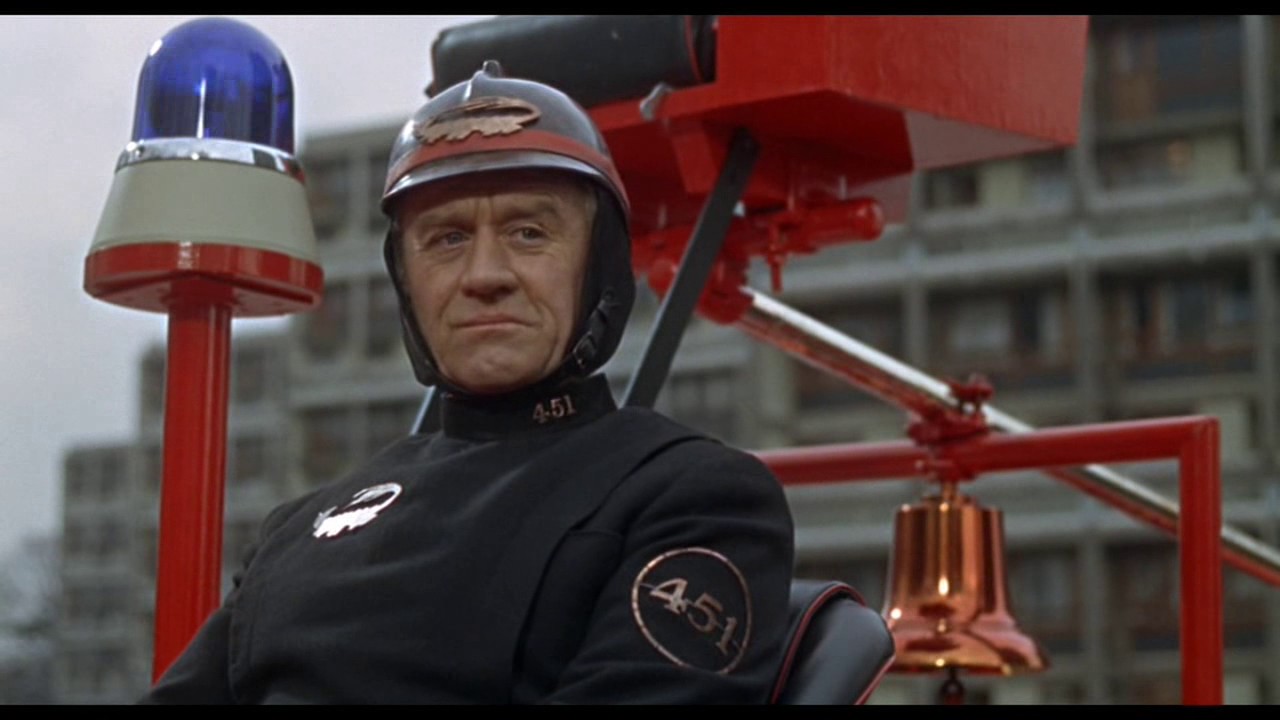
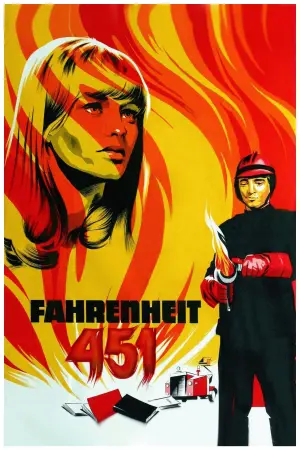
In the future, the government maintains control of public opinion by outlawing literature and maintaining a group of enforcers, known as “firemen,” to perform the necessary book burnings. Fireman Montag begins to question the morality of his vocation…
What's left behind the scenes
- Among the burnt books, one can find works by Ray Bradbury – “The Martian Chronicles” and, appropriately, “Fahrenheit 451”.
- Filming period: January 13 – April 15, 1966.
- Firefighters are also burning the magazine “Cahiers du Cinéma,” where François Truffaut worked. The cover features a frame from Godard’s film “Breathless” (1960), for which Truffaut wrote the screenplay.
- François Truffaut's first color film.
- Truffaut's first and only English-language film.
- Truffaut became so enthusiastic about the idea of filming the novel that he began writing the screenplay without having fully mastered English. He later admitted that the English dialogue seemed very awkward to him, and he preferred the version dubbed in French.
- According to producer Lewis M. Allen, Truffaut had a poor command of English in general, and everyone spoke French on set – even the English actors Julie Christie and Nicholas Rowe. Allen himself knew French to the extent of his school curriculum, while editor Tom Noble didn't know it at all.
- Truffaut said he dreamed of filming 'Fahrenheit 451' because he was always attracted to the idea of making actors read books directly on camera.
- All the captions in the film are read, not written. This fully corresponds to the idea of a new world where there is no place for printed text.
- Truffaut burned his most beloved books in the film. The producer ironically noted that Truffaut himself may have been the one throwing them into the fire.
- During the filming, Truffaut had a falling out with actor Oskar Werner, who had previously appeared in his film 'Jules and Jim' (1962). They did not speak to each other for a long time, and Truffaut clearly did not forgive the offense, placing a photograph of Werner in a crypt for the deceased in the drama 'The Green Room' (1978) – six years before the actor’s actual death.
- Oskar Werner specifically had his hair cut short, and in the finale his character appears with a short haircut, thereby disrupting the plot’s continuity. This was Werner’s way of getting revenge on Truffaut.
- According to the producer, lawyers suggested burning only books by authors who had long since passed away, so as not to offend the living. Truffaut ignored the request, believing that every author whose book was burned should be flattered that it made it into the film.
- Before Cybill Shepherd was cast as the fire captain, Laurence Olivier, Sterling Hayden, and Michael Redgrave were considered for the role.
- According to the producer, he came up with the idea to give both female roles to Julie Christie. The idea came to him at the very last moment.
- Terence Stamp was originally supposed to play the role of Guy Montag. Lewis M. Allen said that Stamp turned down the role because he believed Julie Christie would overshadow him.
- Paul Newman, Jean-Paul Belmondo, Charles Aznavour, and Peter O'Toole were also considered for the role of Montag. It is said that Montgomery Clift also declined the role.
- The epigraph of the novel states that the ignition temperature of paper is “451 degrees Fahrenheit.” In reality, paper burns at 450 degrees Celsius.
- The novel "Fahrenheit 451" was first published in Playboy magazine.
- When Montag's house is burned, a close-up shows a copy of Alexander Pushkin's "The Captain's Daughter" burning.
- The burning pages in one scene are from James Hadley Chase's "No Orchids for Miss Blandish", Nabokov's "Lolita", and Dostoevsky's "The Brothers Karamazov" (in English).
- At the end of the film, Ray Bradbury's "The Martian Chronicles" is among the "living books".
Did you like the film?
 Auditions in India
 Casting calls in USA
 Castingi w Polsce
 Кастинги в Україні
