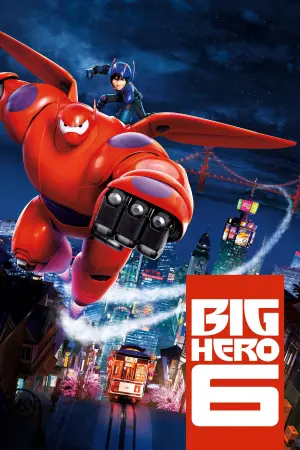
Big Hero 6
Drop everything. Save the world.
Big Hero 6 (2014)
Timing:
1:42 (102 min)

7.7/10
16573
16573

7.975/10
339289
339289

7.8/10
550000
550000

Country
Production
Genre
Adventure, Family, Animation, Action, Comedy
Budget
$165 000 000
Revenue
$657 870 525
Director
Actors
Scenario
Producer
Roy Conli, John Lasseter
Operator
Composer
Artist
Audition
Jamie Sparer Roberts
Editing
Tim Mertens
All team (50)
All team (50)
Short description
A special bond develops between plus-sized inflatable robot Baymax, and prodigy Hiro Hamada, who team up with a group of friends to form a band of high-tech heroes.
What's left behind the scenes
- The screenplay was based on the Marvel comic book of the same name (Big Hero 6).
- In the official teaser for the cartoon, an advertisement for the video game Fix-It Felix Jr. from another Walt Disney Pictures cartoon, "Wreck-It Ralph" (2012), can be seen on one of the city towers.
- During the pre-production stage, much time was spent studying robotics to create a believable Baymax. Don Hall, along with a research group, worked at Carnegie Mellon University. There they learned a lot about the significance of robots in modern pop culture. The director also learned about the development of soft robots (a vinyl hand can inflate and become completely safe for humans). Such a robot is capable of performing simple manipulations. For example, it can brush someone's teeth. Hall liked not only the idea of a soft, safe robot, but also what it becomes as the plot develops. From a nanny robot, it transforms into a brave warrior.
- Several characters from the Big Hero 6 comic book did not make it into the film due to problems obtaining the rights to use them.
- In the first official trailer for the film, you can notice a poster located in the police station on the left wall. It states that Hans is wanted. Hans is a character from Disney's previous film, "Frozen" (2013). And on the far right side of the police officer's desk, you can see photos of Esther and Volt from the film "Bolt" (2008), also produced by Disney.
- Developing the microbot invented by Hiro required specific scientific research. The filmmakers studied the work of scientists from the University of California, Los Angeles, dedicated to nano-robots. They then went to Carnegie Mellon University and MIT and met with some scientists who were also working on creating miniature robots. Although prototypes of robots like the ones Hiro assembled do not yet exist, they are theoretically quite feasible.
- To create the final scene of the film, the filmmakers consulted with theoretical physicist Sean Carroll from the California Institute of Technology (Caltech).
- There are approximately 700 unique characters in the film. For comparison, the film 'Frozen' (2013) has 270 characters, and the film 'Wreck-It Ralph' (2012) has 185 characters.
- The main difficulty in developing Baymax’s vinyl suit was its lighting. The filmmakers conducted numerous experiments in the studio. They tried illuminating a rubber ball, and then conducted similar tests in the Hyperion program. The way light reflects off Baymax’s vinyl surface precisely corresponds to how light reflected off the surface of the ball.
- Artists at Walt Disney Animation created and animated crowds of people using the Denizen program – a powerful utility that includes several separate programs. The Denizen production cycle begins with loading a few characters that define the film’s style. The program analyzes and compares the graphics, outputting a specific algorithm. Then, character creation begins using various clothing items and accessories that were prepared in advance. All the elements are mixed, and a random combination is generated – the character itself, its clothing, and hairstyle. The resulting model can be inserted into the shot and animated without further processing. Each of these characters was dressed in a unique costume consisting of a combination of 32 different elements, plus 32 different hairstyles and 32 skin tones. This means that the filmmakers could populate San Fransokyo with 686,080 unique characters before the first repeat occurred. The Denizen program also allowed for adjustments to the characters, and WDAS employees were asked to pose for some of the background characters. As a result, 200 WDAS employees 'appeared' in cameo roles in the film.
- To create the city, the artists used a special program that contained all the plans for San Francisco – from the layout of streets and blocks to the designation of residential and commercial buildings. According to production designer Paul A. Felix, they created a kind of map of San Francisco. By changing search patterns, they could locate a building of each specific type in a given area. Some building prototypes were selected, and then replicated with minor changes made by the program itself. As a result, there are no two identical buildings in the city, although they all look very similar to each other.
- To prepare enough signage to decorate an entire city, the production designer had to start working on it two years before filming began.
- The San Fransokyo Institute of Technology combines elements of Stanford architecture and Japanese style. For inspiration, the filmmakers specifically visited the campus of the California Institute of Technology, built in the architectural style of the early 20th century. They were interested in the fact that over the decades, other architectural styles had begun to appear on the campus. They also took a tour of the Jet Propulsion Laboratory in Pasadena, where they were given a comprehensive tour of the entire scientific complex and, moreover, were shown special laboratories studying nanotechnology and robotics. The information obtained supplemented the data that the directors had gleaned from other robotics research centers both in the United States and around the world. All this data was subsequently used in the creation of the interiors of the San Fransokyo Institute of Technology.
- The film's technical supervisor explained that usually during computer processing, the entire image is loaded into the computer's memory at once. Currently, the production power of computers is not enough to hold everything necessary in memory, so the creators of this film divided the scenes into layers, processed the layers separately, and only then assembled them into the final image.
- The Hyperion program, which took two years to develop, greatly simplified the work of the lighting artists. According to Walt Disney Animation chief technology officer Andy Hendrickson, Hyperion came close to simulating what happens in the real world. Using this program, all the laws of optics operating in our world were fully modeled – how light reflects off surfaces, how it behaves with different materials, and what happens when light reflects off an object's surface. The system allowed working with multiple reflections, which is one of the most important properties of light. After the issue of physical plausibility was resolved, the artists were able to fully focus on the creative aspect.
- The film's soundtrack features original compositions by Fall Out Boy.
- To record the music for the film, composer Henry Jackman enlisted a 77-piece orchestra.
- When Fred introduces his parents to his friends and shows a photograph, it becomes clear that his father is Stan Lee.
- Animators revealed that the character and mannerisms of the unflappable, emotionally reserved Go Go Tomago were based on renowned actors John Wayne, Clint Eastwood, and Gary Cooper, who embodied the image of legendary cowboys of the Wild West.
- Go Go Tomago's athletic build and movement technique were inspired by professional speed skaters.
- The animators who worked on creating Fred's image drew inspiration from real snowboarders, skateboarders, and surfers.
- To ensure Hiro's charming gap-toothed smile remained perfect from any angle, the animators set control points on his front teeth, allowing them to make adjustments as needed.
- In school, actress Genesis Rodriguez, who provided the voice of Honey Lemon in the original version of the film, was listed as a welder in the robotics club.
- Actor James Cromwell, who originally voiced Professor Robert Callaghan, graduated from Carnegie Mellon University (formerly Carnegie Tech) with a degree in «mechanical engineering». The film's creators conducted extensive research at this university and studied innovative technologies in the field of soft robot design, which ultimately inspired them to create Baymax.
- While working to improve Baymax's combat techniques, the animators paid attention to a popular form of Eastern martial art – karate. To study this technique in detail, the team went to a martial arts studio, where they asked karate masters to demonstrate several moves from this ancient practice while kneeling, because it was in the kneeling position that the human body became proportional to Baymax's torso.
- 23 city districts were rendered in 3D.
- In one of the early scenes of the film, a Ralph toy figure, familiar to viewers from the Disney animated film 'Wreck-It Ralph' (2012), can be seen on Hiro's monitor.
- During testing of the superhero costumes, Baymax's rocket fist breaks a statue of Hans from the animated film 'Frozen' (2013).
- The film contains a total of 18.8 million building blocks.
- The manner of movement of the microbots – with their 'layering' on top of each other, forming whiskers as hooks for moving the main mass to the target – is borrowed from glowworms (Arachnocampa luminosa). They, in turn, use a small tunnel of slime to move from place to place.
- The villain's name, Yokai, means "spirit" or "phantom" in translation from Japanese.
- In the end credits, you can see newspaper headlines reporting the further fate of the cartoon characters. For example, "Hiro Hamada received a grant from the university," "The Tadashi Hamada building opened its doors," "Baymax stopped a malfunctioning tram and saved people," and so on.
- When GoGo shows Hiro the bicycle, she says it uses magnetic levitation, which eliminates friction. However, the creators forgot that without friction, there would be no torque, meaning the wheels wouldn't turn, and therefore the bicycle wouldn't move. Or it wouldn't be a bicycle.
- In the official teaser of the animated film, an advertisement for the video game Fix-It Felix Jr. from another Walt Disney Pictures animated film, "Wreck-It Ralph" (2012), can be seen on one of the city towers.
- In the first official trailer for the film, one can notice a poster located in the police station on the left wall. It reads that Hans is wanted. Hans is a character from Disney's previous film 'Frozen' (2013). And on the far right side of the police officer's desk, you can see photos of Esther and Volt from the film 'Bolt' (2008), also produced by Disney.
- The film features approximately 700 unique characters in total. For comparison, 'Frozen' (2013) has 270 characters, and 'Wreck-It Ralph' (2012) has 185.
- To create the city, artists used a special program that contained all the plans of San Francisco – from the location of streets and blocks to the designation of residential and commercial buildings. According to production designer Paul A. Felix, they created a kind of map of San Francisco. By changing search patterns, they could find a building of each specific type in a given area. Some building prototypes were selected, and then multiplied with minor changes made by the program itself. As a result, there are no two identical buildings in the city, although they all look very similar to each other.
- Actor James Cromwell, who originally voiced Professor Robert Callaghan, graduated from Carnegie Mellon University (formerly Carnegie Tech) with a degree in mechanical engineering. At this university, the filmmakers conducted extensive research and studied innovative technologies in the field of soft robotics, which ultimately inspired them to create Baymax.
- In one of the early scenes of the film, on Hiro's monitor, you can notice a Ralph toy figurine, known to viewers from the Disney animated film of the same name 'Wreck-It Ralph' (2012).
- During the testing of superhero costumes, Baymax's rocket fist breaks a statue of Hans from the animated film "Frozen" (2013).
Did you like the film?
 Auditions in India
 Casting calls in USA
 Castingi w Polsce
 Кастинги в Україні
