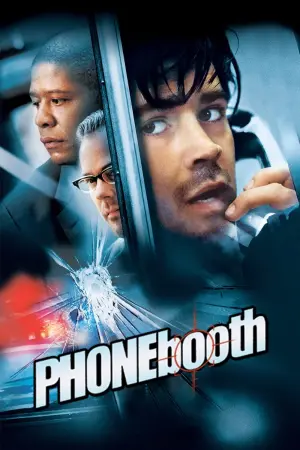
Phone Booth
No options. No lies. No fear. No deals. Just keep talking.
Phone Booth (2003)
Timing:
1:21 (81 min)

6.854/10
3603
3603

7.639/10
183936
183936

7.1/10
301000
301000

Country
Production
Genre
Thriller, Crime
Budget
$13 000 000
Revenue
$97 837 138
Director
Actors
Scenario
Producer
David Zucker, Gil Netter, Ted Kurdyla
Operator
Composer
Artist
Austin Gorg
Audition
Editing
Mark Stevens, Judy Richter, Dennis T. Benatar
All team (309)
All team (309)
Short description
A slick New York publicist who picks up a ringing receiver in a phone booth is told that if he hangs up, he'll be killed... and the little red light from a laser rifle sight is proof that the caller isn't kidding.
What's left behind the scenes
- The main role could have gone to Jim Carrey, Will Smith, Mel Gibson, and Tony Curtis.
- Michael Bay could have directed the film.
- The film is partially based on the New York University student short film "End of the Line" (1996).
- The film was originally scheduled to premiere in the US on November 15, 2002. However, following the tragic events in Maryland and Washington, the studio decided to postpone the premiere. The film was released in the US on April 4, 2003.
- Larry Cohen wrote the screenplay for the film in one month.
- The toy robot speaks Swahili.
- The phone booth is reportedly located in the northern part of West 53rd Street between Broadway and Eighth Avenue.
- In Ireland, the film was released under the title “Phone Box”.
- All the scenes were shot in the exact same order as in the film.
- The shooting period lasted 12 days. Shooting scenes inside the phone booth took 10 days, and 2 days were spent shooting scenes taking place outside the phone booth.
- The shot of Katie Holmes in the restaurant was taken during a break between takes. The director liked her expression and decided to add this episode to the film.
- All the actors wore small headphones and lavalier microphones so that everyone on set could know what other characters in the film were doing at the same time.
- The extras were deliberately not told what the film was about or what would happen in each scene, so the reaction of most people to what was happening was genuine.
- Jared Leto played a small role, but the scene with him was cut from the film.
- The film takes place in real time – it lasts exactly as long as the events it depicts.
- The film's events take place in New York, but it was actually filmed in Los Angeles.
- In the scene where the sniper tells Stew about how he was following him, Sutherland can be seen following the victim wearing a dark wool cap.
- The scene where we indistinctly see the sniper was originally shot with Ron Eldard and then reshot with Kiefer Sutherland.
- In the 1960s, Larry Cohen pitched the concept of a film (the entire action taking place inside a phone booth) to Alfred Hitchcock. Hitchcock liked the idea, but neither he nor Cohen could come up with a convincing reason why the protagonist couldn't leave the phone booth. Cohen returned to the script in the late 1990s, at which time he came up with the idea involving a sniper.
- Kiefer Sutherland played the role of the sniper, but his character was not featured on the posters.
- The scene in which Stu confesses his sins was filmed in one take. Immediately after the "cut" command, the crew gave Colin Farrell a standing ovation.
- The phone was actually working, and Colin Farrell was genuinely talking to someone reading the role of the sniper. However, Kiefer Sutherland's voice was only recorded during post-production.
- Despite appearing in the film for less than three minutes, Kiefer Sutherland's name is listed second on the posters and in the credits. However, we hear his voice throughout the entire film.
- The pistol left by the sniper in the booth, which Stu (Colin Farrell) later finds – a Smith & Wesson Sigma 380 – is, according to the sniper, "the best cop-killer you can buy".
- The sniper’s rifle, which he refers to as a "Model 700, Carbon One modification," is a Remington 700 modified by Christensen Arms, not the Accuracy International AW shown at the end of the film. The case carried by Kiefer Sutherland's character at the end is too short for an Accuracy International, so it is highly likely that it was left as bait for the police, along with the dead pizza delivery guy.
- The main role could have gone to Jim Carrey, Will Smith, Mel Gibson, and Tony Curtis.
- The scene in which Stu confesses his sins was filmed in one take. Immediately after the director called "cut," the film crew gave a standing ovation to Colin Farrell.
- The pistol left by the sniper in the booth, which Stu (Colin Farrell) later finds – a Smith & Wesson Sigma 380 – is, according to the sniper, "the best cop-killer you can buy."
- The sniper's rifle used by the maniac, which he mentions in conversation as "Model 700, Carbon One modification" – is a Remington 700 modified by Christensen Arms, and not the Accuracy International AW shown at the end of the film. The case carried by Kiefer Sutherland's character at the end is too short for an Accuracy International, so it is highly likely that it was left as bait for the police, along with the dead pizza delivery guy.
Did you like the film?
 Auditions in India
 Casting calls in USA
 Castingi w Polsce
 Кастинги в Україні
