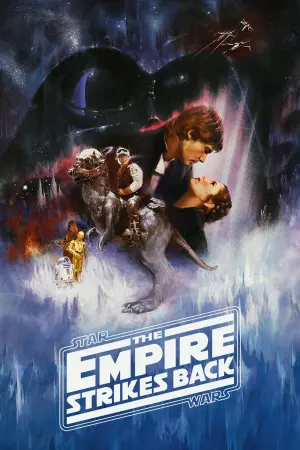
The Empire Strikes Back
The Star Wars saga continues.
The Empire Strikes Back (1980)
Timing:
2:4 (124 min)

8.393/10
18398
18398

8.139/10
319982
319982

8.7/10
1500000
1500000

Country
Production
Genre
Adventure, Action, Science Fiction
Budget
$18 000 000
Revenue
$538 400 000
Director
Actors
Scenario
Producer
Operator
Peter Suschitzky
Composer
Artist
Audition
Terry Liebling, Irene Lamb, Bob Edmiston
Editing
Short description
The epic saga continues as Luke Skywalker, in hopes of defeating the evil Galactic Empire, learns the ways of the Jedi from aging master Yoda. But Darth Vader is more determined than ever to capture Luke. Meanwhile, rebel leader Princess Leia, cocky Han Solo, Chewbacca, and droids C-3PO and R2-D2 are thrown into various stages of capture, betrayal and despair.
What's left behind the scenes
- In the asteroid scene, one of the asteroids was actually a boot. Rumor has it that George Lucas made the effects specialists redo this scene so many times that they became angry and added the boot to it.
- Subsequent scenes with the Wampa (snow creature) were cut from the final version of the film. R2-D2 encountered this creature at the Resistance base, where it was killed by security. In the completed film, a medical droid examines the wounds of a tauntaun killed by a Wampa, and Princess Leia mentions "the creature" during a discussion about the Imperial probe. A scene was filmed, but subsequently cut, where Han, Leia, and C-3PO run along a corridor. Han is about to enter a room with a sign on the door, but Leia warns him that "they keep those creatures in there." They run further, but before that, C-3PO rips the warning sign off the door, hoping that Imperial stormtroopers will go in there.
- The special version of the film has a runtime of 127 minutes.
- George Lucas decided not to seek financial assistance from major studios for the creation of this film. He independently raised the necessary $18 million, using his own earnings from the 1977 film 'Star Wars: Episode 4 – A New Hope' and a bank loan. It was a risky decision, but it more than paid off. Within just three months of the film's release, Lucas recouped his investment, and then did something quite unusual for Hollywood – he shared a portion of the profits (a total of $5 million) with the film's creative team, distributing the money as bonuses.
- The shots in which Mark Hamill's character uses the Force to retrieve his lightsaber, which had flown some distance from him, were filmed as follows: the actor threw the lightsaber, and then the film was run in reverse.
- Mark Hamill had to hit his head against the ceiling of Yoda's dwelling 16 times before the resulting take fully satisfied director Irvin Kershner (1923-2010).
- George Lucas was so impressed with Yoda, operated by Frank Oz, that he spent thousands of dollars on a campaign to support Oz's nomination for the 'Oscar' in the 'Best Supporting Actor' category. The campaign was unsuccessful, as the common opinion was that a puppeteer was not an actor, which Lucas sincerely believed was unfair to Oz, while Oz himself was completely indifferent to the matter.
- During filming in the tiny mountain village of Finse, Norway, the hotel where the actors and film crew were staying was caught in a blizzard. Under normal circumstances, this would have meant a forced break in filming, but director Irvin Kershner decided that these were ideal weather conditions for filming a scene in which Mark Hamill's character trudges through the snow after escaping from the ice cave of a monster. So he sent Hamill outside, while he and the cameraman remained in the hotel's heated lobby.
- Norwegian mountain rescuers played the rebels in the battle for Hoth scene. In gratitude for their assistance in filming, Lucasfilm transferred a certain amount to the account of the Norwegian Red Cross.
- Carrie Fisher (1956-2016) repeatedly had to stand on boxes during filming of scenes with Harrison Ford so that their height difference wouldn't be noticeable to viewers. The actress was about 155 cm tall, while Ford is 182 cm tall.
- Mark Hamill performed all the stunts himself, except for the moment when he is carried out of Cloud City.
- George Lucas insisted on showing all the credits at the end of the film. In the first film of the original trilogy in 1977, the Writers Guild of America and the Directors Guild of America gave permission for this after some hesitation (because no one expected the film to be so successful), but they dug in their heels with this film. They initially tried to prevent the film from being released, but this campaign was unsuccessful. After that, they imposed a large fine on Lucas and attempted to fine Kershner in the same way, but Lucas paid all the fines (almost $250,000) out of his own pocket. After all this, Lucas canceled his own membership in the Writers Guild of America, the Directors Guild of America, and the Motion Picture Association, which subsequently hindered him when casting actors for his films.
- Harrison Ford's character was frozen in carbonite because the filmmakers were unsure if the actor would return for the next film in the franchise. Before filming began on the 1977 film *Star Wars: Episode IV – A New Hope*, Carrie Fisher and Mark Hamill signed contracts for three films, but Ford refused to sign such a document. Ford even asked George Lucas to 'kill' his character, but he refused, stating that Han Solo still had a major role to play in the future film *Star Wars: Episode VI – Return of the Jedi* (1983).
- The scene in which the droid R2-D2 submerges into water was filmed in George Lucas' unfinished swimming pool. A significant portion of the crew was actually underwater, and Lucas himself filmed the entire scene.
- Throughout the entire filming period, it was unclear whether Alec Guinness (1914-2000) would return to the screen as Obi-Wan Kenobi, as he was undergoing eye surgery at the time. He eventually agreed to filming and played all his scenes in just one shooting day – from 8 am to 1 pm. He received a certain percentage of the film's total revenue for his work, literally millions of dollars.
- The only film in the franchise for which Han Solo's starship, the “Millennium Falcon,” was built to full scale. For the 1977 film *Star Wars: Episode IV – A New Hope*, only half of the starship was built, and the 1983 film *Star Wars: Episode VI – Return of the Jedi* only showed parts of it (and even that sandstorm scene did not make it into the final cut). The starship was 19.8 meters in diameter, 4.8 meters high, and 24.3 meters long. It weighed 23 tons.
- Initially, George Lucas only planned to finance the project and serve as executive producer, leaving directing to Irvin Kershner and the day-to-day problems associated with filming to Gary Kurtz (1940-2018). Lucas was so exhausted during the filming of the 1977 film *Star Wars: Episode IV – A New Hope* that he decided to focus on his company, “Lucasfilm,” and his marriage to his then-wife, Marcia Lucas. Nevertheless, when the project fell behind schedule and exceeded its planned budget, Lucas was forced to become more actively involved in filming, including choosing locations and even filming some scenes himself. The rough cut of the film satisfied absolutely no one, and Lucas, facing the prospect of bankruptcy, re-edited the film himself, but the result was even worse than before. This was followed by a period of active reshoots and editing, which had a severely negative impact on the director’s health, family life, and relationships with Kershner and Kurtz. The film was a sensation, but Lucas never worked with Kurtz again, and his marriage fell apart a year later.
- Director Irvin Kershner decided that the rebels in the film would speak with American accents, while the Imperial fleet officers would speak with British accents (by analogy with the times of the American Revolution and the rebellion against Britain). A significant portion of the extras playing rebels on the planet Hoth turned out to be British actors, so during post-production, Kershner had to re-dub some scenes at the Hoth rebel base.
- In some scenes at the rebel base on Hoth, the filmmakers used children as extras. The reason for this was simple – the height of children visually increased the space of the base.
- The scene where Han Solo is frozen by Imperial stormtroopers was very long and complex, and required many takes in a row. Almost at the very end, Leia says to Han: “I love you.” Harrison Ford had heard this phrase so many times that he changed the line given in the script, “I love you too,” to “I know.” Kershner did not want to reshoot the scene, rightly reasoning that it was even better this way.
- David Prowse (1935-2020), the actor who played Darth Vader, had no idea that his character was Luke Skywalker's father until the very last moment, and was very angry with Lucas for this afterward, saying that if he had known in advance, he would have played his character differently.
- Filming was carried out in the strictest secrecy. George Lucas was so determined to maintain the intrigue until the very end that he even instructed David Prowse, the actor playing Darth Vader, to say “Obi-Wan killed your father,” and only later changed it to “I am your father.” Only five people knew the ending before the film was released – Lucas himself (he came up with it after the death of screenwriter Leigh Brackett, 1915-1978), director Irvin Kershner (he was informed during the discussion of the plot), screenwriter Lawrence Kasdan (he also learned during the discussion of the plot), Mark Hamill (he was informed during filming), and James Earl Jones (he found out during studio recordings and decided that Vader was lying).
- Initially, George Lucas planned only to finance the project and serve as executive producer, leaving the directing to Irvin Kershner and the day-to-day problems related to filming to Gary Kurtz (1940-2018). Lucas was so exhausted during the filming of the 1977 film "Star Wars: Episode 4 – A New Hope" that he decided to focus on his company, "Lucasfilm," and his marriage to his then-wife, Marcia Lucas. However, when the project fell behind schedule and exceeded the planned budget, Lucas was forced to take a more active role in filming, specifically choosing locations and even shooting some scenes himself. The rough cut of the film satisfied absolutely no one, and Lucas, already facing the prospect of bankruptcy, re-edited the film himself, but the result was even worse than before. This was followed by a period of active reshoots and editing work, which had a severely negative impact on the director’s health, family life, and relationships with Kershner and Kurtz. The film was a sensation, but Lucas never worked with Kurtz again, and his marriage fell apart a year later.
- In the asteroid scene, one of the asteroids was actually a boot. Rumor has it that George Lucas made the special effects team redo this scene so many times that they became angry and added the boot to it.
- Harrison Ford's character was frozen in carbonite because the filmmakers were unsure if the actor would return for the next film in the franchise. Before filming began on the 1977 film 'Star Wars: Episode IV – A New Hope,' Carrie Fisher and Mark Hamill signed a contract for three films, while Ford refused to sign such a document. Ford even asked George Lucas to 'kill' his character, but he refused, stating that Han Solo still had an important role to play in the future film 'Star Wars: Episode VI – Return of the Jedi' (1983).
- Initially, George Lucas planned only to finance the project and serve as executive producer, leaving direction to Irvin Kershner and the day-to-day filming issues to Gary Kurtz (1940-2018). Lucas was so exhausted during the filming of the 1977 film 'Star Wars: Episode 4 – A New Hope' that he decided to focus on 'Lucasfilm' and his own marriage to then-wife Marcia Lucas. Nevertheless, when the project fell behind schedule and exceeded the planned budget, Lucas was forced to take a more active role in filming, specifically choosing locations and even shooting some scenes himself. The rough cut of the film satisfied absolutely no one, and Lucas, already facing the prospect of bankruptcy, re-edited the film himself, but the result was even worse than before. A period of intensive reshoots and editing followed, which had a severely negative impact on the director's health, family life, and relationships with Kershner and Kurtz. The film was a sensation, but Lucas never worked with Kurtz again, and his marriage fell apart a year later.
- The scene where Han Solo is frozen by Imperial stormtroopers was very long and complex, and required many consecutive takes. Almost at the very end, Leia says to Han, “I love you.” Harrison Ford had heard this phrase so many times that he changed the scripted reply “I love you too” to “I know.” Kershner didn't want to reshoot the scene, rightly reasoning that it was even better this way.
Did you like the film?
 Auditions in India
 Casting calls in USA
 Castingi w Polsce
 Кастинги в Україні
