Ivan Vasilyevich Changes His Profession
Иван Васильевич меняет профессию (1973)
Timing:
0:0 (0 min)

7.893/10
393
393

8.793/10
1267480
1267480

8.2/10
20000
20000
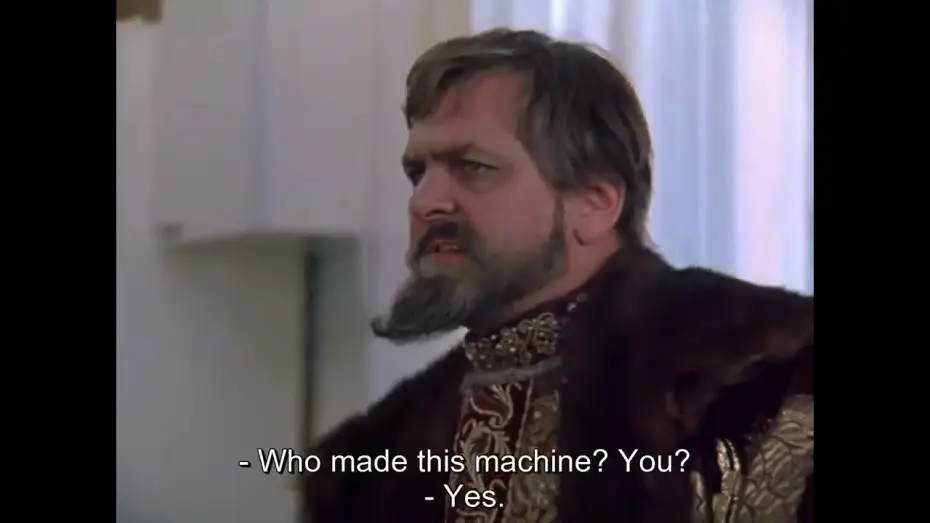
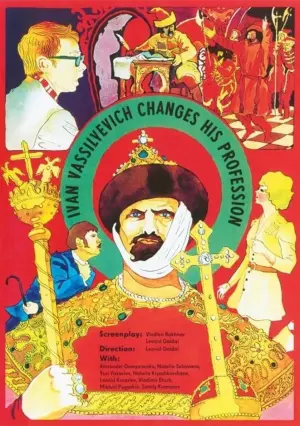
Production
Genre
Comedy, Science Fiction
Budget
$0
Revenue
$0
Director
Actors
Aleksandr Demyanenko, Yuriy Yakovlev, Leonid Kuravlyov, Savely Kramarov, Natalya Seleznyova, Natalya Krachkovskaya, Natalya Kustinskaya, Vladimir Etush, Mikhail Pugovkin, Sergei Filippov
All actors and roles (10)
All actors and roles (10)
Scenario
Vladlen Bakhnov, Leonid Gaidai
Producer
Arkadiy Ashkinazi
Operator
Vitaly Abramov
Composer
Aleksandr Zatsepin
Artist
Audition
Editing
Klavdiya Aleyeva
All team (28)
All team (28)
Short description
A scientist builds a time machine and accidentally sends his apartment complex manager and a petty burglar to 16th century Moscow, while Tsar Ivan the Terrible travels to 1973.
What's left behind the scenes
- The film is based on Mikhail Bulgakov's play "Ivan Vasilyevich".
- Tsar Ivan the Terrible in modern Moscow listens to Vysotsky's song "Oh, once, once more" on a tape recorder.
- The Crimean Khan was indeed having fun on the Izium Path in 1571. He had so much fun that he burned Moscow in May 1571. The following year, the Crimean Khan was defeated in the Battle of Molody.
- The scene of Georges calling Shpak in a 'woman's voice' is voiced by Natalia Kustinskaya; the song "Conversation About Happiness" is sung by Valery Zolotukhin.
- It ranks 17th in attendance among domestic films for the entire history of Soviet film distribution.
- Yuri Nikulin, Georgy Vitsin, and Evgeny Lebedev could have played Ivan Vasilyevich.
- Andrei Mironov, Georgy Yumatov, Sergei Nikonenko, and Georgy Burkov could have played Miloslavsky.
- Sofia Rotaru auditioned for the song "January Blizzard Rings," but her performance, due to her rather low voice, did not suit the comedic genre of the film.
- In foreign distribution, the film was released under the title "Ivan the Terrible: Back to the Future."
- Gaidai initially wrote the first draft of the script for Yuri Nikulin, who, after reading it, flatly refused to film it, arguing that a year of filming would be wasted and the film would be shelved.
- Natalia Selezneva, Natalia Gundareva, and Natalia Gvozdikova were all considered for the role of Zina.
- "The Song About Hares" ("And we don't care... ") performed by Yuri Nikulin, is featured in the film and was originally from Leonid Gaidai's 1968 film "The Diamond Hand."
- Costume designers borrowed the royal costumes from Sergei Eisenstein's painting "Ivan the Terrible," and a young designer, Vyacheslav Zaitsev, made the costume for Selezneva's heroine.
- Filming fees: Leonid Gaidai — 7948 rubles (5948 rubles for filming plus 2000 rubles for the script). According to other sources, the director's total fee was 18,000 rubles, which was one of the reasons for the closure of the experimental creative association "ETO," created as an experiment in commercial cinema; Yuri Yakovlev — 4350 rubles; Leonid Kuravlev — 2312 rubles; Alexander Demianenko — 1663 rubles; Savely Kramarov — 1129 rubles; Mikhail Pugovkin — 788 rubles; Vladimir Etush — 630 rubles; Natalia Selezneva — 362 rubles; Natalia Krachkovskaya — 347 rubles; Sergei Filippov — 258 rubles; Natalia Kustinskaya — 168 rubles; Anatoly Podshivalov — 139 rubles; Nina Maslova — 101 rubles.
- Due to a bruise under her eye, Nina Maslova had to constantly lower her gaze during the feast scene, which ultimately benefited the role – this gesture added coquetry to the queen.
- When asked by Bunsha, the queen replies: "I am Martha Vasilyevna." This can only be Martha Vasilyevna Sobakina, who was Ivan IV the Terrible's wife for only 15 days. Thus, Georges Miloslavsky and Ivan Vasilyevich Bunsha were in ancient Moscow on one of the days between October 28th and November 12th, 1571. Martha Sobakina died on November 13th.
- Gaidai re-dubbed the film due to censorship attacks in several episodes. First: during the royal banquet, Bunsha asks Miloslavsky: "And who will pay?" He replies (censored): "Well, not us, anyway," while the original intention of Gaidai was, "The people, the people, father." Second: the interrogation scene of Ivan the Terrible at the police station: "Place of residence," the Tsar replies: "In the chambers." According to Gaidai's intention: "Moscow - the Kremlin."
- The chase scenes for the "visitors from the future" were filmed in Rostov the Great, Yaroslavl Region.
- Bunsha, disguised as the Tsar, says to the Swedish ambassador "Hitler is finished," but his lips read "Peace, friendship."
- Zina (Shurik's wife), caring for John the Terrible in the apartment, says: "Who knows what they might think!" but her lips read: "You might be seen here!"
- At one point in the film, the viewer might think there's a mistake in the dubbing. When Bunsha asks Miloslavsky how he got into Shpak's apartment, he replies: "Go to hell, what kind of vulgar questions!" while Miloslavsky's mouth is closed. In fact, this phrase is not spoken by Miloslavsky, but by Shurik, who is off-screen at that moment (the voices of Kuravlev and Demianenko are indeed similar).
- The comedic image of the impostor Tsar was perceived as ridicule of Ivan the Terrible, and therefore the episode where the Tsar fries cutlets in Timofeev's kitchen was removed from the film.
- The handle that Miloslavsky stole from Shpak and gave to the ambassador depicted a nude woman. Close-ups were cut from the film because nude women were forbidden to be shown at that time. After all the changes, the film's runtime was reduced by 10 minutes, but the original negative of the film is still stored at the Mosfilm studio.
- The extra phone number "3-62" that Georges Miloslavsky gives when calling Shpak's workplace represents the price of a bottle of ordinary vodka in the USSR. This episode parallels the film "The Diamond Hand," where the director used the same technique, encoding the price of a bottle of vodka in the car's license plate number. In the play, the extra number is 501.
- The phrase spoken by L. Kuravlev, "Citizens! Keep your money in the savings bank," was written in the script, while its continuation – "...if you have any, of course" – was an improvisation by the actor.
- Ivan the Terrible says: "I had one like that too – he made wings. I put him on a barrel of gunpowder – let him fly!" This has certain historical parallels. It is known that Ivan the Terrible ordered the boyar Kazarinov-Golokhvastov, who took monastic vows to avoid execution, to be blown up on a barrel of gunpowder, on the grounds that monks are angels and therefore should fly to heaven.
- During the interrogation scene, when asked about his year of birth, Ivan Vasilyevich replies: "One thousand five hundred and thirty-three from the Birth of Christ." However, Ivan the Terrible was born on August 25, 1530, and the reckoning "from the Birth of Christ" was introduced by Peter I only in 1700. Before that, Russia used the reckoning "from the creation of the world." Therefore, Ivan Vasilyevich's answer should have been "The seven thousand thirty-eighth year from the creation of the world."
- The scepter and orb, held by Bunsha (and depicted in the icon), as symbols of royal power, appeared a hundred years after the events depicted, in the 17th century.
- In the elevator (“They’ve walled us in, demons!”), the Tsar makes the sign of the cross with three fingers. Before 1653, Orthodox Christians made the sign of the cross with two fingers.
- The police arrive to investigate a burglary at an apartment in a traffic police car.
- Miloslavsky and Bunsha flee from the streltsy without closing the chest from which they took their clothes. A fallen helmet lies on the floor. When Miloslavsky returns to close the chest, the helmet is back on the armor.
- When Bunsha hides in the chest during the chase by the streltsy, he changes his body position to the opposite one, without getting out of the narrow chest.
- The film is based on Mikhail Bulgakov's play "Ivan Vasilyevich".
- The film features "The Song About the Hares" ("And we don't care... ") performed by Yuri Nikulin from Leonid Gaidai's 1968 film "The Diamond Arm".
- The costume designers borrowed royal attire from Sergei Eisenstein's painting "Ivan the Terrible," and a young designer, Vyacheslav Zaitsev, created costumes for Selezneva's character.
- Filming fees: Leonid Gaidai — 7948 rubles (5948 rubles for filming plus 2000 rubles for the script). According to other sources, the director's total fee was 18,000 rubles, which became one of the reasons for the closure of the experimental creative association "ETO," created as an experiment in commercial cinema; Yuri Yakovlev — 4350 rubles; Leonid Kuravlev — 2312 rubles; Alexander Demianenko — 1663 rubles; Savely Kramarov — 1129 rubles; Mikhail Pugovkin — 788 rubles; Vladimir Etush — 630 rubles; Natalya Selezneva — 362 rubles; Natalya Krachkovskaya — 347 rubles; Sergei Filippov — 258 rubles; Natalya Kustinskaya — 168 rubles; Anatoly Podshivalov — 139 rubles; Nina Maslova — 101 rubles.
- When asked by Bunsha, the Tsarina replies: "I am Marfa Vasilyevna." This can only be Marfa Vasilyevna Sobakina, who was the wife of Ivan IV the Terrible for only 15 days. Thus, Georgy Miloslavsky and Ivan Vasilyevich Bunsha were in ancient Moscow on one of the days between October 28th and November 12th, 1571. On November 13th, Marfa Sobakina died.
- Zina (Shurik's wife), caring for Ivan the Terrible in the apartment, says: "Who knows what they might think!", but her lips read: "You might be seen here!"
- At one point in the film, viewers might think there's a dubbing error. When Bunsha asks Miloslavsky how he got into Shpak's apartment, he replies: "Go to hell, what impertinent questions!", even though Miloslavsky's mouth is closed. In fact, this line is spoken not by Miloslavsky, but by Shurik, who is off-screen at that moment (the voices of Kuravlyov and Demyanenko are, in fact, very similar).
- In the film, Ivan the Terrible says: "I once had a fellow like that – he made wings. I sat him on a barrel of gunpowder – let him fly!" This has certain historical parallels. It is known that Ivan the Terrible ordered the boyar Kazarinov-Golokhvastov, who had taken monastic vows to avoid execution, to be blown up on a barrel of gunpowder on the grounds that monks are angels and therefore should fly to heaven.
Did you like the film?
 Auditions in India
 Casting calls in USA
 Castingi w Polsce
 Кастинги в Україні
