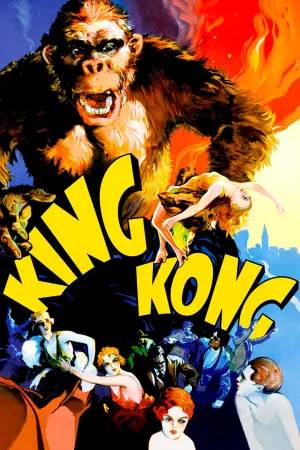
King Kong
A Monster of Creation's Dawn Breaks Loose in Our World Today!
King Kong (1933)
Timing:
1:44 (104 min)

7.6/10
1594
1594

7.094/10
14537
14537

7.9/10
96000
96000

Country
Production
Genre
Adventure, Fantasy, Horror
Budget
$670 000
Revenue
$2 513 540
Director
Actors
Robert Armstrong, Fay Wray, Bruce Cabot, Frank Reicher, Victor Wong, James Flavin, Sam Hardy, Noble Johnson, Steve Clemente, Roscoe Ates
All actors and roles (10)
All actors and roles (10)
Scenario
Producer
Operator
Composer
Artist
Audition
Fred Schuessler
Editing
Ted Cheesman
All team (55)
All team (55)
Short description
Adventurous filmmaker Carl Denham sets out to produce a motion picture unlike anything the world has seen before. Alongside his leading lady Ann Darrow and his first mate Jack Driscoll, they arrive on an island and discover a legendary creature said to be neither beast nor man. Denham captures the monster to be displayed on Broadway as King Kong, the eighth wonder of the world.
What's left behind the scenes
- Each King Kong model was approximately 45 cm tall.
- Throughout the film's runtime, meticulous statisticians counted 40 corpses.
- During filming, the working title of the picture changed constantly. The following film title options were considered: “The Beast,” “The Ape,” “King Ape,” and “Kong.”
- As part of the production of “Creation,” several models of prehistoric reptiles were created. However, the Great Depression intervened, and the project had to be shut down. To ensure that this long and painstaking work was not in vain, a decision was made to use these models in the production of “King Kong.”
- The famous roar of King Kong is actually a combination of a lion and a tiger's roars played in reverse.
- To produce the scene of Kong's battle with the Tyrannosaurus Rex, two real wrestlers were brought in, whose task was to accurately simulate the blows inflicted on each other by the two enormous creatures. After that, the animators took over.
- The original version of the film was released four times between 1933 and 1952, and each new release invariably included additional scenes. Only one filmed scene never saw the light of day. It depicts Kong dispatching four sailors by throwing them into a ravine to be torn apart by giant spiders. This scene was rightfully considered the most brutal in the entire film, and during preview screenings, some people left the theater after watching these particular shots.
- During its debut weekend, the film set a box office record, grossing $90,000.
- Each airplane pilot was paid $10 for their participation in the project.
- It is believed that the releasing company, RKO, avoided bankruptcy by timely releasing the film, which became a true hit number one.
- Numerous posters for the film stated the actual size of the giant gorilla – 50 feet (about 15 meters). Meticulous statisticians calculated that in the scenes on the island, Kong’s size approached 19 feet (about 5 meters), and in the city scenes – 25 feet (about 8 meters).
- It is included in Entertainment Weekly's list of the greatest films of all time, ranking 47th.
- King Kong is one of the first films where the entire visual sequence is accompanied by music. Previously, music was only included in the credits and rare episodes.
- The fully restored version of the film has a runtime of 104 minutes.
- Fay Wray’s iconic scream of terror at the sight of King Kong (considered one of the best hysterical screams in film history) was not actually her own. It was voiced by another actress, Julia Haydon.
- According to legend, reflected in the biographies of director Merian C. Cooper, the image of King Kong was inspired by none other than a poem by Korney Ivanovich Chukovsky. In 1919-1921, while a pilot, Merian flew with the Kościuszko Squadron, fighting on the side of Poland in the Polish-Soviet War. Once, his plane was shot down, and he was captured and spent some time in a Russian prisoner-of-war camp, from which he later escaped, reaching Latvia, receiving an award from the Poles, returning to the United States, working as a civilian pilot, and eventually becoming a director. While in captivity, he had to learn the basics of the Russian language. And a book helped him with his studies – the only one in the entire POW camp. It was Chukovsky's "Crocodile." The third part of which contains these lines: 'A wild gorilla / Snatched the little girl / And ran along the pavement / At a gallop. / Higher, higher, higher, / Now she's on the roof. / On the seventh floor / She jumps like a ball.' The choice of aviation as the force that defeated King Kong is also considered significant – Merian was haunted by the failure of that aerial battle and thus settled the score with his enemies in an artistic form.
- "S.S. Venture" is the ship used to transport King Kong. A similar vessel was featured in the film "The Lost World: Jurassic Park" (1997).
- The film was first shown in the USSR in 1970 at the "Illusion" cinema in Moscow.
- Stop-motion animation of the entire fight scene between Kong and the pterodactyl took seven weeks.
- Animated special effects were to be a significant part of the film, and Willis O'Brien, who also worked on "The Lost World," was brought in to create them. For the first time in the history of cinema, he used a technique of superimposing live-action and animated footage, allowing him to show both live actors and puppet monsters in the same frame.
- In 1991, the film was added to the National Film Registry of the United States as having significant artistic value.
- When the natives flee from the enraged King Kong, one of them jumps from a hut, falls to the ground, and, catching his hair on a basket, loses his wig.
- During their first encounter, Ann's shadow is not reflected on the gorilla's chest.
- When King Kong breaks through the gates, part of his body is visible through one of the trees.
- As Ann and Jack descend the cliff, Ann is wearing shoes, but shortly after, she is barefoot.
- King Kong can easily climb over the wall that protects the natives from danger.
- In the first shot of Kong and the airplane, the wingspan is consistent, but in another shot, the lower part of the plane's wings is shorter than the upper part.
- When the gorilla leaves the scene, the car of the escaping people does not have a windshield, but it appears later.
- One of the sailors falls into the abyss from a log shaken by Kong, and then reappears on the log.
- An enraged Kong grabs a native and puts their head in his mouth, but in another shot, he holds the native by the legs with his mouth.
- According to legend, reflected in the biographies of director Merian C. Cooper, he was inspired to create the image of King Kong by none other than a poem by Korney Ivanovich Chukovsky. In 1919-1921, Merian, as a pilot, flew as part of the Kościuszko Squadron, fighting on the side of Poland in the Polish-Soviet War. Once his plane was shot down, and he himself was captured and spent some time in a Russian prisoner-of-war camp, from which he later escaped, reached Latvia, received an award from the Poles, returned to the United States, worked as a civil aviation pilot, and became a director. While in captivity, he had to learn the basics of the Russian language. And a book helped him in his studies – the only one in the entire prisoner-of-war camp. Namely, 'Crocodile' by Korney Chukovsky. The third part of which contains the following lines: 'A wild gorilla / Stole the baby doll / And ran at a gallop / Along the pavement. / Higher, higher, higher, / Now she's on the roof. / On the seventh floor / She jumps like a ball.' The choice of aviation as the force that defeated King Kong is also considered significant – Merian was burdened by the failure in that aerial battle and thus took revenge on his enemies in an artistic form.
- 'S.S. Venture' – the ship on which King Kong was transported. A similar vessel was used in 'The Lost World: Jurassic Park' (1997).
- Significant part of the film was to be animated special effects, created with the help of Willis O’Brien, who also worked on the filming of ‘The Lost World’. For the first time in the history of cinema, he used the technique of superimposing live-action and animated footage, which allowed him to show both live actors and monsters depicted with puppets in the same frame.
Did you like the film?
 Auditions in India
 Casting calls in USA
 Castingi w Polsce
 Кастинги в Україні
