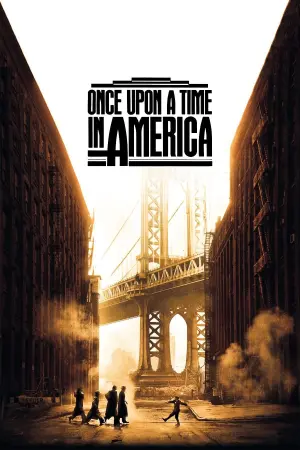
Once Upon a Time in America
Crime, passion and lust for power.
Once Upon a Time in America (1984)
Timing:
3:49 (229 min)

8.381/10
6067
6067

8.278/10
183193
183193

8.3/10
407000
407000

Country
Production
Genre
Drama, Crime
Budget
$30 000 000
Revenue
$5 323 287
Director
Actors
Scenario
Producer
Arnon Milchan, Claudio Mancini
Operator
Composer
Artist
Audition
Cis Corman, Joy Todd
Editing
Short description
A former Prohibition-era Jewish gangster returns to the Lower East Side of Manhattan over thirty years later, where he once again must confront the ghosts and regrets of his old life.
What's left behind the scenes
- The film is based on Harry Grey's novel "Once Upon a Time in America" (The Hoods, 1952).
- "Once Upon a Time in America" is the only film by Sergio Leone not shot in his preferred 2.35:1 aspect ratio.
- The film marked the cinematic debut of 14-year-old model Jennifer Connelly.
- The scenes on the Miami Beach waterfront were filmed in St. Petersburg at Don Cesar Beach.
- In the scene where the elderly "Noodles" is watching television, an interview with a character named James Conway O'Donnell is shown. In the film "Goodfellas" (1990), Robert De Niro's character is also named James Conway.
- While preparing for the role of "Noodles", Robert De Niro requested a personal meeting with the famous crime boss Meyer Lansky, whose image he was basing his portrayal on. Unfortunately, he was denied this meeting.
- Claudia Cardinale unsuccessfully auditioned for the role of Carol.
- Sergio Leone was initially inspired by Harry Gray's autobiographical novella 'The Hoods' (it took the director years to acquire the rights to it), but as the scale of his vision grew, he brought Norman Mailer and Stuart Kaminsky on board as screenwriters.
- When Stuart Kaminsky began working, he was given a plot outline exceeding 400 pages. During the filming process, 10 hours of footage was cut down to 6. Initially, Sergio Leone wanted to release his film as two three-hour installments, but the studio did not support this idea. The film was reduced to its current length by a new editor, Zack Stenberg, who was specifically brought onto the team for this purpose.
- In the mid-70s, Gérard Depardieu was one of the main contenders for the role of 'Max' or 'Lapsha,' and he promised to develop an American accent if necessary. A total of over 200 actors were considered for the leading roles!
- Robert De Niro's friend, Joe Pesci, was one of the candidates for the role of Max. After an unsuccessful audition, the director offered him to choose any role in the film that he liked – and so Pesci played Frankie.
- One of the actors, James Hayden, passed away shortly before the premiere.
- This film was never fully released in US cinemas, as it was believed at the time that audiences would not go to such a long film (227 minutes). Therefore, Leone was forced to cut the film down to 139 minutes, also removing all the violence. However, later a full version of 229 minutes was released on DVD in the US.
- One of the film's characters, known to everyone as Kosoy, constantly plays a small flute called "Pano." This is a reference to Charles Bronson's character in Leone's other film – "Once Upon a Time in the West" (1968), who also played constantly, but only on a harmonica.
- The film was released in Soviet cinemas in 1989 in three separate parts. The first part was seen by 27.6 million viewers, the second by 26.6 million, and the third by 23.1 million people.
- Leone was so outraged that the film was cut to 139 minutes for release in the US, and that all the scenes were re-edited in chronological order by Alan Ladd's company, which destroyed the director's vision and dissipated the film's important aura of uncertainty, that he withdrew from filmmaking for the rest of his life. "The tragedy of the film is that it will be destroyed in the country for which it was primarily intended," the director fumed in the summer of 1984. "But you know the distributors, and Ladd is not the worst of them. One distributor from the Middle East said he was willing to buy the film on the condition that we cut out all the scenes with Jews!"
- Filming began on June 14, 1982, and ended on April 22, 1983.
- The episodic role of a passerby in the scene where Lapsha leaves prison was played by the famous Soviet translator Boris Romanovich Izakov (author of translations of Ernest Hemingway, Somerset Maugham, Graham Greene, and others). He was visiting the United States and ended up on the film set through one of the crew members.
- Robert De Niro suggested that the aging Max have a dazzling smile with pearly white teeth – this was to demonstrate his wealth and vanity. The producers refused to pay for the associated costs, so De Niro covered them himself.
- The hotel to which the newly wealthy Lapsha invited Deborah was filmed in Venice. However, the road they returned home on was on the other side of the ocean – on the coast of New Jersey. The role of the driver was played by the film's producer, Arnon Milchan.
- The film is based on Harry Grey’s novel “Once Upon a Time in America” (The Hoods, 1952).
- While preparing for the role of “Noodles,” Robert De Niro requested a personal meeting with the famous crime boss Meyer Lansky, whose image he was basing his performance on. Unfortunately, he was denied this meeting.
- One of the film’s characters, known to everyone as “Cousin,” constantly plays a small flute called a “Pano.” This is a reference to Charles Bronson’s character in Leone’s other film – “Once Upon a Time in the West” (1968), who also played constantly, but only on a harmonica.
- Leone was so outraged that the film was cut down to 139 minutes for release in the United States, with all the scenes remounted in chronological order by Alan Ladd’s company, which destroyed the director’s intent and dissipated the aura of uncertainty so important to the film, leading him to abandon filmmaking for the rest of his life. “The tragedy of the film is that it will be destroyed in the country for which it was primarily intended,” the director fumed in the summer of 1984. – “But you know distributors, and Ladd is not the worst of them. One distributor from the Middle East said he would buy the film if we cut out all the scenes with Jews!”
Did you like the film?
 Auditions in India
 Casting calls in USA
 Castingi w Polsce
 Кастинги в Україні
