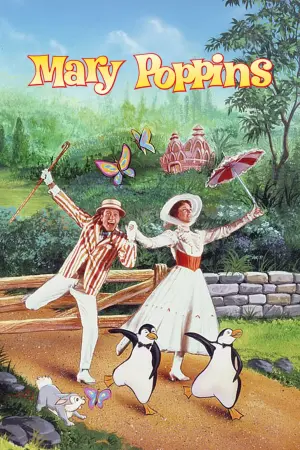
Mary Poppins
The fairest of them all...the funniest of them all!
Mary Poppins (1964)
Timing:
2:19 (139 min)

7.544/10
5003
5003

7.599/10
10597
10597

7.8/10
198000
198000

Country
Production
Genre
Comedy, Family, Fantasy
Budget
$4 650 000
Revenue
$103 100 000
Director
Actors
Scenario
Producer
Operator
Edward Colman
Composer
Artist
Audition
Editing
Short description
Mr Banks is looking for a nanny for his two mischievous children and comes across Mary Poppins, an angelic nanny. She not only brings a change in their lives but also spreads happiness.
What's left behind the scenes
- The film is based on the story "Mary Poppins" by P.L. Travers (1934).
- The author of the book, P.L. Travers, approved the casting of Julie Andrews in the lead role after hearing her only over the phone.
- Walt Disney first tried to acquire the film rights from P.L. Travers in 1938. But it wasn't until 1961 that the author agreed to the deal. The film "Saving Mr. Banks" (2013) reveals the details of this story.
- Walt Disney first tried to buy the film rights from P.L. Travers in 1938. But it wasn't until 1961 that the author agreed to the deal.
- Walt Disney cast Julie Andrews in the lead role after seeing her performance in the Broadway musical "Camelot." Andrews informed Disney that she was pregnant, and he agreed to postpone the start of filming until after the birth and even offered her then-husband Tony Walton a job working on the costumes and some of the sets for the film. Disney personally gave the couple a tour of Disneyland. Andrews had impressed him so much in "Camelot" that he instructed the animators of "101 Dalmatians" to base Anita’s design on her (Anita was voiced by Lisa Davis).
- The superstition that shaking hands with a chimney sweep brings good luck is based on the following: during their work, chimney sweeps inhale coal dust, which means their lives are usually short, and their final years (when they can no longer work) are spent in poverty. It is believed that the luck denied to chimney sweeps themselves can pass on to other people.
- The chimney sweeps' dance on the rooftops to the song “Step in Time” had to be reshot due to a scratched film reel. An entire week was spent filming this episode.
- When Dave Smith, the head of archives at Walt Disney Company, decided to find the glass globe (inside which was a model of St. Paul's Cathedral, and birds were flying around), which appeared in the film, the globe was found in a janitor's closet. It turned out the janitor had seen it in the trash can and decided it was too beautiful to throw away.
- The roles of many candidates for the governess position, shown in the line at the beginning of the film, were played by men in wigs.
- Matthew Garber, who played Michael, was paid an extra ten cents for each take of the tea party scene. The young actor was afraid of heights, so this unusual bonus was offered to him.
- Dick Van Dyke had already been cast as Bert when he read the film's script, but he liked the role of Mr. Dawes Sr. so much that he went directly to Walt Disney and asked to play it, even offering to do so without pay. Disney granted his request, but first tested the actor in the role of Dawes Sr., and then asked him to make a donation to the California Institute of the Arts (one of the best art schools in the US, founded on Disney's initiative in 1961).
- The scene in which Mr. Dawes Sr. (played by Dick Van Dyke) descends a step into the bank's conference room was not in the script. One day, Walt Disney, watching from the projection booth, saw the actor fooling around with the crew, specifically portraying an old man who couldn't bring himself to step off the curb for fear of falling. This episode convinced Disney to give the actor the role of the bank chairman in addition to Bert. Moreover, he asked the set workers to build a high step in the conference room set so Van Dyke could repeat the act with the old man on the curb.
- Matte painting (combining real footage and a painted image in a single frame, i.e., one of the combined shooting techniques) was used to recreate the outlines of London's rooftops in 1910.
- The cherry blossoms shown in the film were plastic, brought from France and Portugal. They were attached to the trees by hand.
- The wires that allowed Mary Poppins to fly were specially coated with shoe polish to prevent them from reflecting the spotlights.
- It is said that the author of the book and screenwriter, Pamela L. Travers, approved the casting of Julie Andrews as Mary Poppins, however, she disliked the resulting film so much that she left the premiere in tears. She was reportedly most upset by the decision to make Mary Poppins not cold and frightening, but warm and friendly.
Did you like the film?
 Auditions in India
 Casting calls in USA
 Castingi w Polsce
 Кастинги в Україні
