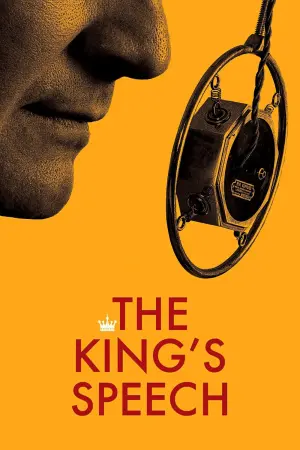
The King's Speech
Find your voice.
The King's Speech (2010)
Timing:
1:58 (118 min)

7.733/10
9235
9235

8.063/10
518303
518303

8/10
731000
731000

Country
Production
Genre
Drama, History
Budget
$15 000 000
Revenue
$410 867 243
Website
Director
Actors
Scenario
David Seidler
Producer
Emile Sherman, Iain Canning, Gareth Unwin, Geoffrey Rush, Bob Weinstein, Harvey Weinstein, Mark Foligno, Paul Brett, Tim Smith
Operator
Danny Cohen
Composer
Artist
Audition
Editing
Short description
The King's Speech tells the story of the man who became King George VI, the father of Queen Elizabeth II. After his brother abdicates, George ('Bertie') reluctantly assumes the throne. Plagued by a dreaded stutter and considered unfit to be king, Bertie engages the help of an unorthodox speech therapist named Lionel Logue. Through a set of unexpected techniques, and as a result of an unlikely friendship, Bertie is able to find his voice and boldly lead the country into war.
What's left behind the scenes
- Guy Pearce plays Edward VIII – the older brother of King George VI (Colin Firth). In reality, Pearce is 7 years younger than Colin Firth.
- Elizabeth Bowes-Lyon (wife of King George VI) outlived him by 50 years and went down in history as the Queen Mother.
- In the film, Lionel says that his father was a brewer, but in reality, he was a clerk. And Lionel's grandfather, on the other hand, was a brewer.
- Westminster Abbey was actually filmed at Ely Cathedral, and the interiors of Buckingham Palace were filmed inside Lancaster House, a luxurious home in London.
- Lionel (played by Geoffrey Rush) forbids Bertie from smoking during their sessions, saying that "inhaling smoke into your lungs will kill you." King George VI (1895-1952) smoked between 20 and 25 cigarettes a day and died from complications resulting from surgery after being diagnosed with lung cancer.
- Nine weeks before filming began, Lionel Logue's grandson, Mark Logue (1880-1953), discovered a large box of his grandfather's personal papers in the attic of his house. It contained his diary, appointment book, notes on sessions with King George VI, and over a hundred personal letters from the King to Logue. It also contained (it is believed) a copy of the very speech from 1939 in which George VI declared war on Nazi Germany. Mark Logue handed all the discovered papers over to director Tom Hooper and screenwriter David Seidler for use in the film. Colin Firth and Geoffrey Rush reviewed all these documents.
- The screenwriter, David Seidler, also stuttered as a child. Moreover, he heard the very historical speech of George VI on the radio himself. He subsequently wrote to Queen Elizabeth II (1926-2022) and the Queen Mother (1900-2002) requesting permission to write a screenplay about George VI. The Queen Mother only asked him in return not to do so during her lifetime, and Seidler fulfilled her wish.
- The role of King George VI was written for Paul Bettany, but he declined to film it, a decision he later regretted.
- George VI's speech in the film comprises only two-thirds of what he actually said. The original speech contained 407 words, while its screen version contains 269 words. Four sentences were completely removed, and another four were shortened.
- Lionel Logue was an actor who later became a speech therapist. While preparing for the role and practicing his character's stutter, as well as the exercises he used to combat this ailment, Colin Firth sought the help of his sister, Katie Firth, an actress who went on to become a speech therapist.
- In one scene, the King mentions the Stone of Scone (also known as the Stone of Destiny), which was placed at the base of the throne during the coronation ceremony. Many British and Scottish monarchs have undergone the coronation ceremony with this stone over the centuries, although it is possible that the original stone has not survived after so long. During the period depicted in the film, the stone was located in Westminster Abbey, and in 1966 it was decided to return it to Scotland with the stipulation that the English would borrow it for future coronations.
- After filming, Colin Firth, like his character, had to seek the help of a specialist to overcome the stutter he had become so accustomed to.
- According to Peter Cobbin, sound engineer at EMI, the original royal microphones had been stored at EMI for over 70 years. Permission was granted to borrow five of them from Abbey Road Studios, three of which were restored to working order and used to record the orchestral music for this film. The microphones, created specifically for George V (1865-1936), George VI, Queen Mary (1867-1953), Queen Elizabeth II, and the Queen Mother, were adorned with silver and chrome details featuring royal coats of arms and other individual emblems. In the 1930s, they were true works of art, and their quality remains superb even compared to modern equipment. Composer Alexandre Desplat and director Tom Hooper were simply delighted with the results of their use in the film.
- In the scene where Bertie reads 'Hamlet' to music, he is wearing headphones. However, they are not connected to the gramophone playing the record, but to a recording device. Furthermore, gramophone playback is a purely mechanical method of sound reproduction, and nothing can be connected to a gramophone.
- When the King delivers his famous speech about the start of the war, his daughters – Princess Elizabeth and Princess Margaret – are present in the hall. Despite the year being 1939, and Elizabeth already being 13 years old, she appears unchanged from 1930, the beginning of the events in the film.
- In the scene where Bertie reads “Hamlet” to music, he is wearing headphones. However, they are not connected to the gramophone playing the record, but to a recording device. Furthermore, gramophone playback is a purely mechanical method of sound transmission; nothing can be connected to a gramophone.
Did you like the film?
 Auditions in India
 Casting calls in USA
 Castingi w Polsce
 Кастинги в Україні
