A Beautiful Mind - videos, teasers and stills from filming
All videos, teasers and footage from the filming of the film "A Beautiful Mind"
A Beautiful Mind (2001)
Timing:
2:15 (135 min)

7.855/10
11077
11077

8.538/10
545934
545934

8.2/10
1000000
1000000
![Watch film A Beautiful Mind | A Beautiful Mind (2001) Original Trailer [FHD]](/amdb/images/posters/1/s/a-beautiful-mind-2001-PpFbI.webp)
What's left behind the scenes
- The director's chair was initially intended for Robert Redford, but his filming schedule did not align.
- Many actors were considered for the role of John Nash: Bruce Willis, Kevin Costner, John Travolta, Tom Cruise, John Cusack, Charlie Sheen, Robert Downey Jr., Nicolas Cage, Johnny Depp, Ralph Fiennes, Jared Leto, Brad Pitt, Alec Baldwin, Mel Gibson, Sean Penn, Guy Pearce, Matthew Broderick, Gary Oldman, and Keanu Reeves.
- A bed scene between the characters Crowe and Connelly was cut from the final version of the film.
- John Nash (played by Russell Crowe in the film) was invited to the set to help the actors play their roles more convincingly. Russell Crowe later admitted that he was impressed by how John made hand gestures and tried to replicate them during filming.
- Portia de Rossi, Katrin McCormack, Meg Ryan, Rachel Griffiths, and Amanda Peet auditioned for the role of Alicia. However, Ryan dropped out before production began. Salma Hayek also aspired to the role of Alicia – interestingly, she was born in the same town of El Salvador as her would-be character. Producers initially didn't consider Jennifer Connelly for the role of Alicia. Previously, she starred alongside Jared Leto in the film “Requiem for a Dream.” When Leto was auditioning for the role of John, Connelly helped him by sitting opposite and reading Alicia’s lines (thus, they performed one of the dialogues). Leto was not chosen by the producers, but Connelly impressed them in the image of Alicia. Ultimately, the actress was approved for the role after Ron Howard compared her and Alicia Nash – their education and facial features were compared.
- The Harvard scenes were actually filmed at Manhattan College.
- Two producers competed for the right to adapt the life of John Nash. Brian Grazer won this dispute, while Scott Rudin was the loser.
- Despite the fact that the film represents a kind of biography of John Nash's life, some details of the great mathematician's life were deliberately omitted: 1) in his youth, John was bisexual – he had close relationships with both women and men; 2) John had an illegitimate child.
- John Nash did indeed receive the Nobel Prize, but not alone, but together with colleagues – Reinhard Selten and Hungarian János Harsányi. Moreover, another Hungarian – János Neumann (John von Neumann) – was the founder of “Game Theory.” Nash distinguished himself by being able to apply the provisions of “Game Theory” to the business world.
- The manuscript shown by the young John Nash to his advisor, Professor Helinger, is a genuine copy of an article published in the journal Econometrica titled “The Bargaining Problem”.
- The film's screenwriter, Akiva Goldsman, had considerable experience working with mentally ill people: during his time as a doctor, he personally developed methods for restoring the mental health of children and adults.
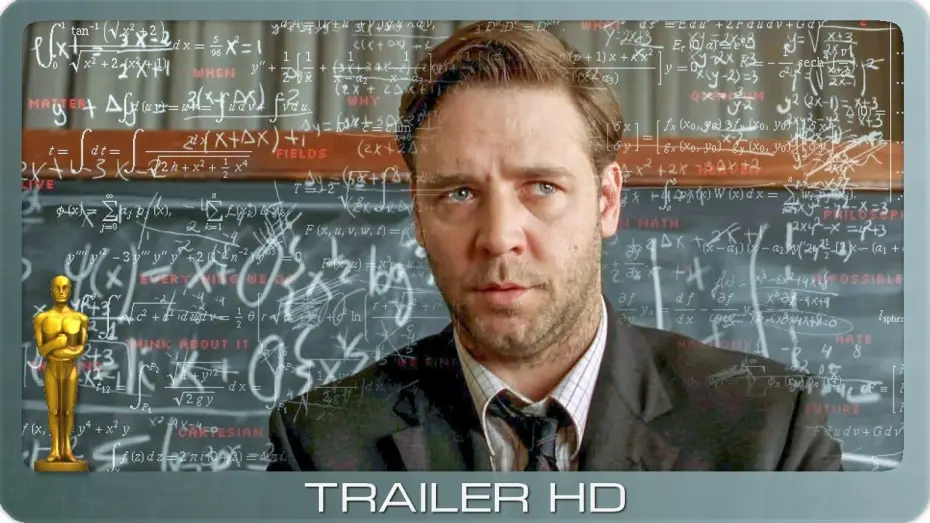
- Professor Dave Bayer of Barnard College served as the film's mathematical consultant – it was his hand that guided Russell Crowe in “writing” the complex formulas on the board. Upon closer inspection, the “complex formulas” turn out to be simply a meaningless set of Greek letters, arrows, and mathematical symbols. Apparently, the professor was paid his salary in vain.
- Jennifer Connelly plays the wife of Russell Crowe's character in the film. In real life, her husband is Paul Bettany, who played the role of Crowe’s friend.
- Filming began the day after the Oscars ceremony, where Russell received the award for Best Actor for “Gladiator”.
- The film's protagonist, mathematician John Forbes Nash, played by Russell Crowe, died in a car accident in Los Angeles on May 23, 2015. He was 86 years old. His wife, Alicia, also died in the accident. The crash occurred because the taxi driver, carrying the mathematician and his wife, lost control of the vehicle, which collided with a guardrail.
- The film is based on Sylvia Nasar's book “A Beautiful Mind: The Life of Mathematical Genius and Nobel Laureate John Nash.”
- Dave Bayer, the film's mathematical consultant, appears in a cameo role as one of the professors who presents Nash with a pen at the pen-giving ceremony near the end of the film.
- Initially, the plan was to simply age Russell Crowe throughout the film; however, at the actor's suggestion, makeup artists gave his face features characteristic of the real John Nash. Greg Cannom used the latest makeup techniques, such as silicone, which could mimic real skin and reduced makeup application time from eight to four hours. Crowe also used numerous dental prosthetics to create a malocclusion.
- Initially, the character Charles Herman was not supposed to be British; however, director Brian Helgeland invited Bettany from “A Knight's Tale” to the project. The filmmakers agreed that the character could be British.
- When Nash first sees Parker, he addresses him as "big brother" (a reference to Orwell's novel "1984"). Another allusion to Orwell occurs later, when we see the number on the door of Nash's office – 101.
- The real John and Alicia Nash divorced at the peak of his illness, but out of pity, Alicia allowed him to live in their home. And during the filming of "A Beautiful Mind," they remarried.
- In the part of the film relating to the period of the Nobel Prize presentation (1994), Nash talks about supposedly taking a new type of antipsychotic drugs, however, in reality, John Nash stopped taking them back in 1970, and his remission was not related to taking neuroleptics.
- Nash's son later also developed schizophrenia.
- In the scene where John Nash is kidnapped by "Russian spies," among the students observing this, one can spot the director Ron Howard's daughter and a well-known actress – Bryce Dallas Howard.
- During filming, Howard decided that Nash's hallucinations should always be introduced first through sound, and then visually. This not only provides a visual representation but also allows showing the visions through Nash's eyes. It should be noted that the real Nash's hallucinations were only auditory; he did not see visual images.
Did you like the film?
 Auditions in India
 Casting calls in USA
 Castingi w Polsce
 Кастинги в Україні
