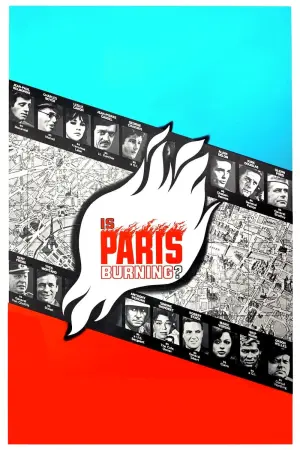
Is Paris Burning?
"Burn Paris!" was the order that had come shrieking over the phone.
Paris brûle-t-il? (1966)
Timing:
2:53 (173 min)

7.2/10
219
219

6.719/10
811
811

6.8/10
5600
5600

Country
Production
Genre
War, Drama, History
Budget
$0
Revenue
$0
Director
Actors
Scenario
Producer
Operator
Marcel Grignon
Composer
Artist
Audition
Editing
Robert Lawrence
All team (37)
All team (37)
Short description
Near the end of World War II, Gen. Dietrich von Choltitz receives orders to burn down Paris if it becomes clear the Allies are going to invade, or if he cannot maintain control of the city. After much contemplation Choltitz decides to ignore his orders, enraging the Germans and giving hope to various resistance factions that the city will be liberated. Choltitz, along with Swedish diplomat Raoul Nordling, helps a resistance leader organize his forces.
What's left behind the scenes
- Francis Ford Coppola claimed that the film was greatly hindered by the demands of French President Charles de Gaulle (1890-1970), who immediately stated that he would simply ban filming on location in Paris (and how could such a film be made without it?). In particular, Charles de Gaulle insisted that the filmmakers not emphasize the role played by the French Communist Party in the liberation of the country from the Nazis. According to Coppola, this was a blatant case of political censorship.
- One of the reasons the film was shot in black and white was that French authorities prohibited the display of red and black Nazi flags in Paris, allowing only black and gray cloths to be used.
- A postman fell off his bicycle on the Champs-Élysées when he saw extras in German uniforms crossing the street during their lunch break. Jumping to his feet, the postman ran off, shouting: "They're here again! They've returned!"
- Orson Welles (1915-1985), who had a small role in the film, was extremely rude to director René Clément (1913-1996) and, although he spoke fluent French himself, refused to communicate with Clément directly, preferring to use Yves Boisset as a translator. According to Boisset, Welles was simply envious of the large budget Clément had been allocated for the filming.
- During World War II, over 60,000 cars in France were converted to run on natural gas, and the film shows several vehicles with cylindrical gas tanks on their roofs.
- The entire film was shot in Paris. 180 locations were used for filming in the city itself and the surrounding suburbs.
- The plot revolves around each member of the acting ensemble speaking their native language. Initially, the film was planned as a joint Franco-German-British project (with a little bit of Swedish involvement). However, in video format, the film was released fully dubbed in only one language.
Did you like the film?
 Auditions in India
 Casting calls in USA
 Castingi w Polsce
 Кастинги в Україні
