Notting Hill
Can the most famous film star in the world fall for the man on the street?
Notting Hill (1999)
Timing:
2:4 (124 min)

7.3/10
6715
6715

7.279/10
69586
69586

7.2/10
333023
333023
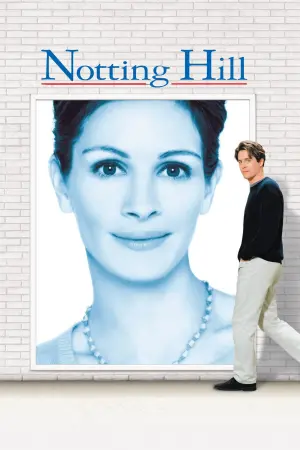
Country
Production
Genre
Romance, Comedy
Budget
$42 000 000
Revenue
$363 889 678
Website
Director
Actors
Scenario
Producer
Duncan Kenworthy, Tim Bevan, Eric Fellner, Richard Curtis
Operator
Michael Coulter
Composer
Trevor Jones
Artist
Audition
Editing
Nick Moore
All team (85)
All team (85)
Short description
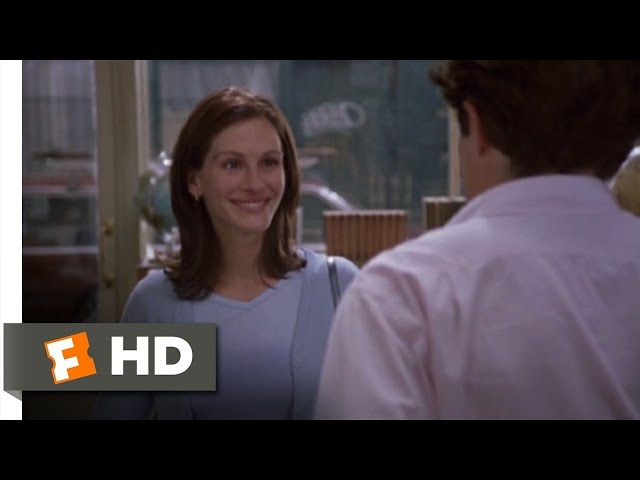
William Thacker is a London bookstore owner whose humdrum existence is thrown into romantic turmoil when famous American actress Anna Scott appears in his shop. A chance encounter over spilled orange juice leads to a kiss that blossoms into a full-blown affair. As the average bloke and glamorous movie star draw closer and closer together, they struggle to reconcile their radically different lifestyles in the name of love.
What's left behind the scenes
- The house where Hugh Grant's character lives once belonged to the film's screenwriter, Richard Curtis. The following year after the film's release, the house was sold, and its new front door (the old blue one having been sold at a Christie's auction) was painted black to make it unrecognizable. However, someone still wrote the following phrase in paint next to the wall: 'This is a Hollywood door.'
- The book that Hugh Grant's character reads on a park bench at the end of the film is called 'Captain Corelli's Mandolin.' Two years later, a film adaptation starring Nicolas Cage and Penélope Cruz was made, released by Universal Studios, which also distributed 'Notting Hill.'
- An existing antique shop, located next to the office of the film's screenwriter Richard Curtis, served as the setting for Tucker's bookstore.
- Omid Djalili, who played the cashier in the coffee shop, was filming 'The Mummy' at the same time and on the same studio lot.
- The film could have been directed by Mike Newell, the director of another major British hit, 'Four Weddings and a Funeral,' but he declined the offer, preferring 'Pushing Tin,' which ironically flopped at the box office. The director later admitted that he had made the wrong financial decision, but added that he did not regret his choice.
- One of the most challenging tasks for the filmmakers was obtaining permits to shoot in various locations in Notting Hill, for which letters were sent to several thousand local residents. Each of them was promised that, at their discretion, the film studio would donate a certain amount of money to charity, and as a result, more than two hundred different charitable organizations and societies received funds.
- Despite all of Tucker’s assurances that his shop only sells guidebooks, a comic book by British author Roger Sabin can be seen on one of the shelves in the background. It’s a large book with an orange hardcover.
- The fictional film starring Anna Scott and Matthew Modine, which Will and Spike watch in one scene and which Spike refers to as a classic, is called “Gramercy Park,” named after the small, private park in New York City.
- The painting by Marc Chagall that appears in the film is called “La Mariée” (The Bride). Permission to create a copy of the famous canvas for the film was granted on the condition that it would be destroyed after filming.
- In the initial plot concept by Richard Curtis, Emma Chambers’ character (Honey) was not Will’s (Hugh Grant’s) sister, but worked in a neighboring record store and was Anna Scott’s rival for his affections. The film’s key resolution was supposed to be the moment when Will ultimately chooses her, preferring the fantastical dream that Anna represents. Later, the author decided he simply couldn’t reject Anna like that, and resolved the situation by making Honey Will’s sister.
- The initial cut of the film after shooting was approximately three and a half hours long, from which 90 minutes were cut during editing immediately before release.
- Well-known British comedian Sanjeev Bhaskar appears in a cameo as one of the loud and boisterous men in the restaurant where Anna and Will are dining.
- The long shot of William Thacker walking through Notting Hill, with the four seasons changing in succession, actually consists of four separate parts, all filmed on the same day. Subsequently, a computer-generated image of Hugh Grant was inserted into the resulting footage.
- The park bench used in the filming of the movie is now located in the Queens Gardens in Perth, Australia. A local resident who wished to remain anonymous purchased it at auction, and now it genuinely 'lives' in a beautiful garden that closes at night, as the main characters dreamed it would.
- The scene in the lobby of the luxurious and prestigious Ritz Hotel in London was actually filmed in the hotel itself, but between 2 and 4 a.m. to avoid disturbing the guests.
- Many of the photographs of Julia Roberts appearing during the opening credits were taken from the television series Entertainment Tonight (1981).
- The scene in which Anna Scott (Julia Roberts) scolds a group of boorishly behaving men in a restaurant was not in the script and was improvised during filming.
- The film's director, Roger Michell, and screenwriter Richard Curtis had considered Julia Roberts and Hugh Grant as the main candidates for the two leading roles from the very beginning.
- The scene where Anna and Will rehearse her lines from the submarine movie was significantly reworked and shortened for the final version of the film. This was done to remove several coarse expressions that could have prevented the film from receiving its desired PG-13 rating. The full version of this scene can be seen on the original DVD release.
- The painting by Marc Chagall that appears in the film is called “La Mariée” (“The Bride”). Permission to create a copy of the famous canvas for the film was granted on the condition that it would be destroyed after filming was completed.
- Filming took place from April 17 to July 1, 1998.
Did you like the film?
 Auditions in India
 Casting calls in USA
 Castingi w Polsce
 Кастинги в Україні
