Dances with Wolves
Inside everyone is a frontier waiting to be discovered.
Dances with Wolves (1990)
Timing:
3:1 (181 min)

7.8/10
4680
4680

8.115/10
75373
75373

8/10
308000
308000
![Watch film Dances with Wolves | Dances with Wolves (1990) ORIGINAL TRAILER [HD 1080p]](https://i.ytimg.com/vi/N4gr-uXUg1M/maxresdefault.jpg)
Country
Production
Genre
Adventure, Drama, Western
Budget
$22 000 000
Revenue
$424 208 848
Director
Actors
Scenario
Producer
Kevin Costner, Jim Wilson, Jake Eberts
Operator
Composer
Artist
Audition
Elisabeth Leustig, Jory Weitz, Rene Haynes
Editing
Short description
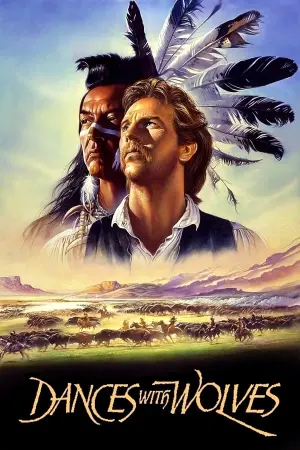
Wounded Civil War soldier, John Dunbar tries to commit suicide—and becomes a hero instead. As a reward, he's assigned to his dream post, a remote junction on the Western frontier, and soon makes unlikely friends with the local Sioux tribe.
What's left behind the scenes
- Almost all scenes were filmed in chronological order.
- Critics praised the film for its lifelike depiction of Native Americans, which at the time differed significantly from typical Hollywood clichés that portrayed Native Americans as either noble or bloodthirsty. For his involvement in the film, the Lakota tribe adopted Kevin Costner as an honorary member.
- During the filming of the buffalo hunt, Kevin Costner rode horseback independently in almost all scenes, including those in which his character gallops without a saddle and fires a rifle, releasing the reins from his hands.
- Virtually none of the Native American actors involved in the filming spoke Lakota, so a linguist had to be hired to teach them the language. She was Doris Leader Charge (a translator and educator who taught the Lakota language at a university for many years), and she also played the wife of the character portrayed by Floyd “Red Crow” Westerman.
- To avoid accusations of animal cruelty, Kevin Costner's company, "Tig Productions," spent $250,000 creating animatronic bison puppets for the hunting scene.
- When Kevin Costner's character runs at the beginning of the film with his arms outstretched and eyes closed, it was an improvisation that caught the stunt coordinator off guard. He only shouted a warning at the last moment, otherwise the actor would have crashed into a fence.
- In the scene depicting the skinning of bison carcasses, animal puppets made of papier-mâché were used. The carcasses looked so realistic that someone from the public called the police during filming, who arrived at the set to arrest what they believed were poachers.
- Due to an $18 million budget overrun and widespread reluctance to invest in Westerns, Kevin Costner had to contribute his own funds to cover the excess costs. He recouped his investment, as the film grossed over $100 million, and Costner, having invested $3 million, received around $40 million.
- Kevin Costner's daughter, Annie, played the child in one of the episodes. She is shown in a flashback running from the place where her family was killed. As she runs, she looks over her shoulder, first one way and then the other, because her father told her to look over her right shoulder, and she was only 6 years old and confused right with left.
- The bison stampede scene could only be filmed with one take per day, because once they started running, these animals could only stop after 15-16 kilometers, and it took a whole day to return them to the filming location.
- The film was shot in the expanses of South Dakota. The cornfield shown at the beginning of the film had to be sown and the crop grown in advance, and the foliage of the trees repainted in autumn colors, as if the action was taking place in Tennessee in the fall.
- The making of the film was often delayed and paused due to unpredictable weather, difficulties in filming practically wild wolves, and the complexity of battle scenes involving Native Americans. Filming the bison hunt was also difficult – it took three weeks, and involved 100 Native American extras and a herd of several thousand bison. During the filming of one scene, Kevin Costner (who performed most of the riding scenes himself) collided with another rider and fell off his horse, but immediately got up and continued filming.
- The length of the first version of the film after final editing was five and a half hours, after which a lot of material was cut.
- With the exception of the Civil War scenes shown at the very beginning of the film (which were filmed last), the film was shot in the order written in the script. This is a rare occurrence in filmmaking.
- The film shows a man ordering a wolf to return home when Kevin Costner's character is on his way to meet friends. A trainer played this role. When he ran, and the beast chased after him, the wolf bit him on the leg, so Kevin Costner himself subsequently stepped in. Costner periodically threw the wolf pieces of raw meat to prevent it from biting him too.
- The film was shot during a drought, so the water in the lake was brought in.
- Michael Blake wrote the screenplay in the early 1980s. Kevin Costner came across the script in 1986. He advised Blake to rewrite the screenplay as a novel, which would increase its chances of being filmed. Blake did so and found a publisher willing to print the novel in 1988. Costner immediately bought the film rights to the novel with the intention of making this film.
- Graham Greene put a slice of smoked sausage in his shoe so that the awkwardness and discomfort he felt would be reflected on his face.
- In the scene at the beginning of the film, when doctors examine Kevin Costner's character, it wasn't the actor himself but his stunt double. The doctors were played by the film's producer Jim Wilson (on the left) and Costner himself, who was also the director, producer, and lead actor. Their voices were dubbed by other actors.
- The helmet held by the character portrayed by Floyd "Red Crow" Westerman, when he speaks about people who "came in his grandfather's time," is a typical helmet of the Spanish conquistadors who conquered a significant part of South and North America in the 15th-16th centuries.
- The novel on which the film is based mentions the Comanche tribe, but the film depicts the Lakota Indians (the reason being that the script required a large herd of bison, which could only be found in South Dakota, where the Lakota lived).
- Battle scenes used reenactments of battles from the American Civil War.
- Studio executives insisted on a film length of 2 hours and 20 minutes. He had to accept the director's cut, which lasted 3 hours.
- Originally, the film was to be shot in Grand Teton National Park in Wyoming, but the park administration proved uncooperative, and after the first week of filming, Kevin Costner, tired of constant petty criticisms and demands, ordered the production to move to South Dakota.
- Practically none of the Native American actors involved in the filming spoke Lakota, so they had to hire a linguist to teach them the language. This was Doris Leader Charge (a translator and educator who taught Lakota at the university for many years), and she also played the wife of the character played by Floyd 'Red Crow' Westerman.
- The helmet in the hands of the character played by Floyd 'Red Crow' Westerman, when he talks about the people who 'came in his grandfather's time,' is a typical helmet of the Spanish conquistadors who conquered a significant part of South and North America in the 15th-16th centuries.
Did you like the film?
 Auditions in India
 Casting calls in USA
 Castingi w Polsce
 Кастинги в Україні
