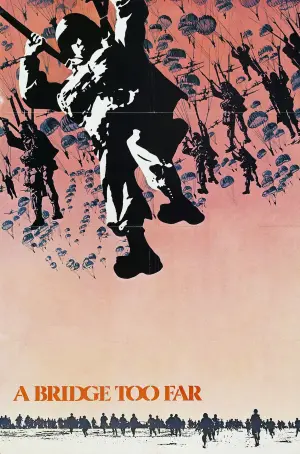
A Bridge Too Far
Out of the sky comes the screen's most incredible spectacle of men and war!
A Bridge Too Far (1977)
Timing:
2:55 (175 min)

7.214/10
914
914

7.074/10
3032
3032

7.4/10
60358
60358

Country
Production
Genre
Drama, History, War
Budget
$22 000 000
Revenue
$50 750 000
Director
Actors
Scenario
Producer
Joseph E. Levine, Richard P. Levine
Operator
Composer
Artist
Audition
Miriam Brickman
Editing
Short description
The story of Operation Market Garden—a failed attempt by the allies in the latter stages of WWII to end the war quickly by securing three bridges in Holland allowing access over the Rhine into Germany. A combination of poor allied intelligence and the presence of two crack German panzer divisions meant that the final part of this operation (the bridge in Arnhem over the Rhine) was doomed to failure.
What's left behind the scenes
- In the scenes depicting the departure from Great Britain, a British paratrooper with a chicken is shown twice. He portrays Lieutenant Joseph Glover of the 10th Parachute Battalion with his pet chicken, Myrtle. Initially, Glover stole her from a farm in England while betting on whether chickens could fly. Between July and September 1944, Myrtle participated in several drops, and on September 18, Glover and Myrtle, as part of the 4th Parachute Brigade, landed in Arnhem as part of the second wave of the airborne assault (the film shows the first wave). On September 19, 1944, Myrtle was found dead and buried with “wings” (the emblem of the paratroopers).
- James Caan agreed to star in this film primarily because of the scene in which his character points a weapon at a military medic and literally forces him to perform surgery on one of his friends. According to Caan, Attenborough found him in Los Angeles and offered him several roles to choose from, and Caan chose the role of the sergeant specifically for this reason.
- Laurence Olivier (1907-1989) arrived on set in an old suit and worn-out black boots and told the director that he had spent a month working in the garden in those boots to make them suitable for his character.
- During filming, the real Colonel John Frost (1912-1993) reprimanded Anthony Hopkins for running from house to house during the filming of the Battle of Arnhem. According to Hopkins, Frost stated that a British officer would never run, but would walk at a measured pace to demonstrate contempt for death. Hopkins later recounted that he tried, but at the first sound of explosions, the instinct for self-preservation took over, and he started running again.
- Sean Connery played one of the most significant roles in the film; he became furious when he learned that Robert Redford’s fee – despite having a much less significant role – was noticeably higher than his own. He even refused to film further until his fee was increased, which was soon done.
- According to Michael Caine, director Richard Attenborough did not inform him in advance that the column of tanks (mock-ups, of course) behind the jeep in which Caine's character was traveling would be destroyed to capture his genuine reaction to the explosions.
- Steve McQueen (1930-1980) and Audrey Hepburn (1929-1993) were initially considered for small roles in the film, however, McQueen stated that he only appeared in leading roles, not in projects whose casts consisted solely of screen stars, and Hepburn usually demanded excessively high fees. Furthermore, it was stated that Hepburn, who once lived in Nazi-occupied Netherlands, had witnessed German soldiers shooting civilians in the street and lost friends in bombings, and would find it difficult to play this role simply because she had actually been through all of that.
- Director Richard Attenborough understood that he would have only one chance to film the paratrooper landing scene, so 19 cameras were used in the shooting.
- According to stunt coordinator Vic Armstrong, over 100 stuntmen and doubles were involved in the film.
- Nearly 823,000 feet of film were shot. At a normal speed of 27 feet per minute for 35mm film, this equates to over 500 hours of screen time.
- The filming of the bridge battle in the city of Nijmegen was jokingly referred to as "filming costing a million dollars an hour." Traffic on the bridge was quite active, so the film crew was given permission to shoot only between 7 and 8 a.m. on October 3, 1976. If the scene hadn't been completed, a reshoot would have been required, and considering Robert Redford's overtime pay, the total cost would have reached at least $1 million. That's why director Richard Attenborough insisted that the actors portraying corpses lie with their eyes closed.
- The costume department created over 2,000 costumes for the filming.
- The scene in which Private Marsh dies while trying to reach the canister is based on a true story, although the corporal involved, Johnny Johnson, survived. In the original book (1974) by Cornelius Ryan (1920-1974), which served as the literary basis for the film, it is said that he was very angry to learn what was actually inside.
Did you like the film?
 Auditions in India
 Casting calls in USA
 Castingi w Polsce
 Кастинги в Україні
