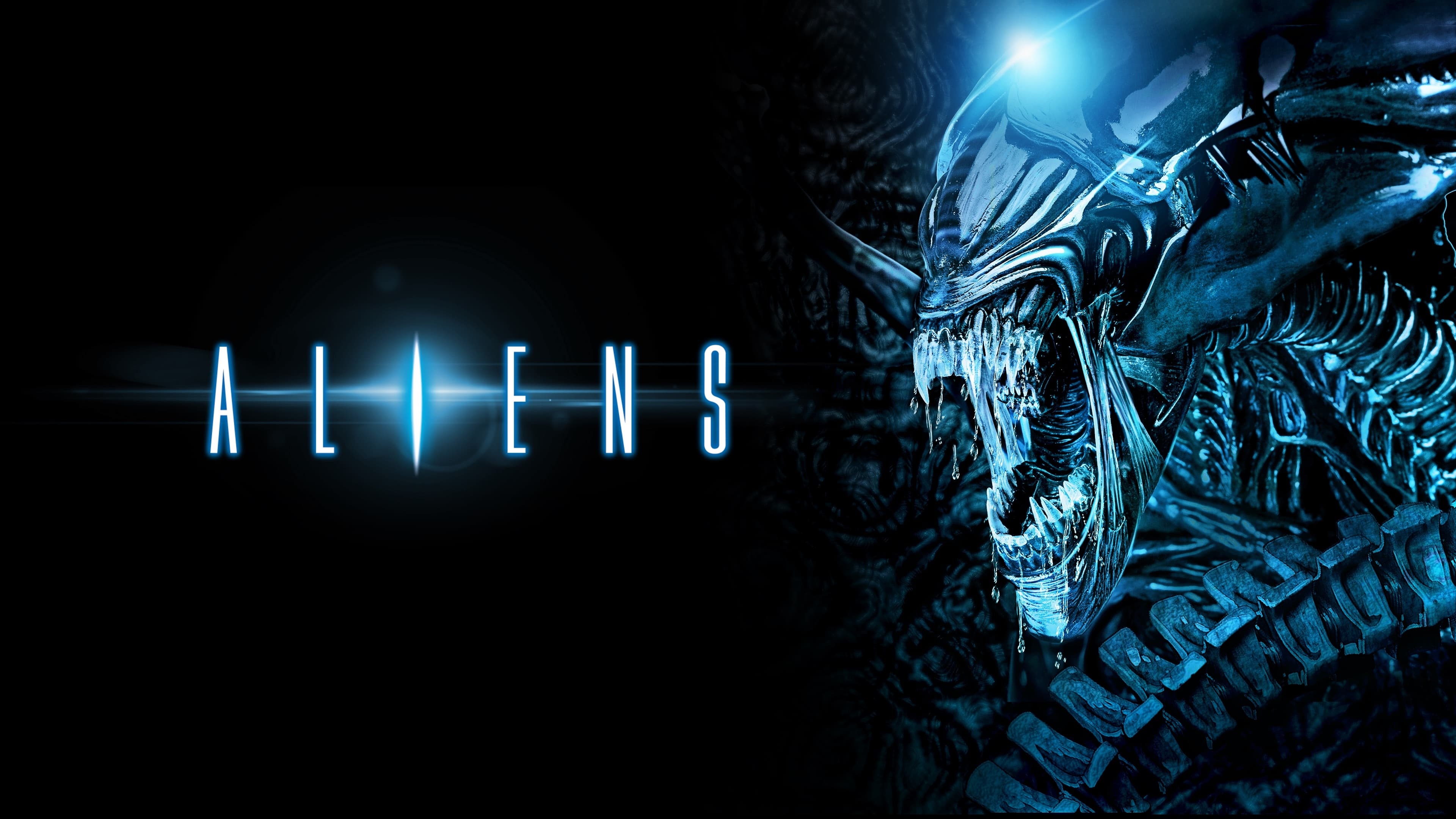
Aliens
This time it's war.
Aliens (1986)
Timing:
2:17 (137 min)

7.962/10
10841
10841

8.063/10
285089
285089

8.4/10
837000
837000

Country
Production
Genre
Action, Thriller, Science Fiction
Budget
$18 500 000
Revenue
$183 316 455
Director
Actors
Scenario
Producer
Operator
Composer
Artist
Audition
Jane Feinberg, Mike Fenton, Mary Selway
Editing
Short description
When Ripley's lifepod is found by a salvage crew over 50 years later, she finds that terra-formers are on the very planet they found the alien species. When the company sends a family of colonists out to investigate her story—all contact is lost with the planet and colonists. They enlist Ripley and the colonial marines to return and search for answers.
What's left behind the scenes
- James Remar was originally cast to play Hicks, but was replaced by Michael Biehn a few days after filming began. The official reason given was creative differences with the film's director, James Cameron.
- Cinematographer Dick Bush left the project due to creative differences with James Cameron and Gale Anne Hurd (the film's producer).
- The set decoration for the Alien hive was preserved after filming was completed. It was later used as the set for the Axis Chemicals plant in 'Batman' (1989).
- One of the most challenging scenes in the film—the marines entering the Alien hive—was shot before James Remar was replaced by Michael Biehn. Reshooting the scene would have been too expensive, so viewers only see the back of Corporal Hicks, played by Remar in that scene.
- Filming took place in England, so the director and producers decided to cast American actors living in England. Carrie Henn, who played Newt, is of American descent but lived in England. In the film, Newt's brother is named Timmy; in real life, he is Carrie's brother, Christopher Henn.
- Composer James Horner confessed that James Cameron gave him so little time to write the music for the film that he was forced to use parts from his previous compositions, and also to write his own interpretation of 'Gayane Ballet Suite' for the opening and closing credits. Horner claimed that during post-production, he decided he would never work with Cameron again. However, Cameron was so impressed with Horner’s music for 'Braveheart' (1995) that he offered him the chance to write the music for 'Titanic' (1997). Horner agreed.
- Negotiations between Sigourney Weaver and the studio regarding her participation in the film were extremely tense. At the same time, James Cameron and Gale Anne Hurd got married. They announced that if an agreement between the studio and Sigourney wasn't reached before they returned from their honeymoon, they would leave the project. When they returned, no agreement had been reached. Cameron desperately wanted to make the film, so he devised a clever scheme to lure Weaver into the sequel to 'Alien' (1979). Cameron called Arnold Schwarzenegger's agent and casually mentioned that he was developing an alternate script for 'Aliens' that would completely exclude Sigourney Weaver's character. As Cameron had hoped, the agent immediately called his colleague representing Weaver, who in turn immediately contacted the head of production at '20th Century Fox,' Lawrence Gordon. Both sides rightly decided that a sequel was only possible with Weaver’s participation and signed the contract without further delay.
- The actors who played the marines underwent special training under the guidance of real marines. The training lasted at least two weeks. Michael Biehn did not undergo training, as he replaced James Remar a week after filming began. Sigourney Weaver, Paul Reiser, and William Hope did not undergo training because James Cameron decided that this would help create a separation between this trio and the marines. These three actors played characters not connected to the unit. Ripley was a consultant during the flight to 'LV-426'; Burke represented the financial interests of the Company; and Lieutenant Gorman had just been appointed commander of the unit, and also had much less combat experience than the rest of the personnel.
- In addition to training, reading Robert A. Heinlein's novel 'Starship Troopers' was mandatory preparation for the actors who played the marines.
- None of the 'Narcissus' models, the shuttle 'Nostromo' from 'Alien' (1979) have survived. To recreate the ship's model and interiors, the set decorators and special effects team had to repeatedly review 'Alien' (1979).
- The special edition of the film includes a number of additional scenes. Here are some of them: 1) Newt's parents find an alien ship on 'LV-426'. 2) Scenes in which Ripley discusses her daughter. 3) Hudson boasts about his weaponry. 4) The sentry robots repel the first alien attack. 5) Hicks and Ripley tell each other their names.
- Al Matthews, who played the Sergeant, was in real life the first African American marine in Vietnam to be promoted to the rank of Sergeant.
- In both versions, the theatrical and the director's cut, the final fifteen-minute countdown actually lasts exactly fifteen minutes.
- In a deleted scene, Elizabeth Inglis played Ripley's daughter. In reality, Elizabeth is Sigourney Weaver's mother.
- During negotiations regarding Sigourney Weaver's fee, the studio asked James Cameron to write an alternative script without Ripley. Cameron refused, stating that he couldn't envision a sequel without Ripley.
- The studio negotiated with H.R. Giger to create new sets and Alien models, but James Cameron opposed this decision. The only new model in the film was the Alien Queen, whose design Cameron had developed himself by that time.
- In one scene, Bishop says: "I cannot harm or allow any action to be taken that would harm a human." Thus, he repeats the first law of robotics, formulated by Isaac Asimov.
- Like most films, "Aliens" was not shot in sequential order. But for greater realism, James Cameron filmed the scene of the first appearance of the marines on screen as one of the last. Since the actors had spent several months together, Cameron thereby tried to show the spirit of camaraderie among the marines.
- For greater realism, James Cameron asked the actors playing the marines to add some personal details to their gear. Most soldiers in Vietnam did the same, painting their helmets and gear. For example, the helmet of Corporal Dietrich (Cynthia Dale Scott) says "Blue Angel." Marlene Dietrich starred in "The Blue Angel" (Der Blaue Engel). "Blue Angel" is the English title of the film. On the flak jacket of Private Hudson (Bill Paxton) is written "Louise." In real life, Bill Paxton's wife is named Louise Newbury.
- In the scene where Vasquez shoots the alien with a shotgun, Jenette Goldstein could not handle the recoil of the weapon. As a result, in the shooting scenes, Gale Anne Hurd (the film's producer) substituted for Janet. Gale was the only woman on the set who had previously fired that type of weapon.
- Three different types of smoke were used during filming, one of which was later banned for use in film shoots.
- Due to budget constraints, several mirrors were used in the first scene aboard the "Sulaco" to show more cryogenic sleep pods than there actually were.
- The town where the colonists live is called "Hadley's Hope".
- In the scene where Burke and Ripley discuss the latter's mental state, a copy of "People" magazine can be seen on the table.
- According to Entertainment Weekly, the film ranked 42nd on the list of "The Greatest Movies of All Time." The film was described as "the best action movie of all time."
- During the film's editing, one of the initial scenes, concerning the lives of the colonists on "LV-426," was removed. However, some elements of this scene can be found in James Cameron's later works. For example, the phrase "...and they always answer the same way—don't ask" was used in "Terminator 2: Judgment Day" (1991). The name of one of the characters, Leidecker, was used in "Dark Angel" (2000).
- Sigourney Weaver was reluctant to reprise her role as Ripley. She rejected numerous offers from "20th Century Fox" because she was dissatisfied with none of the proposed sequel concepts. However, after reading James Cameron's script, which devoted considerable time to developing her character and the mother-daughter relationship between Ripley and Newt, Weaver agreed to participate in the film.
- Even after James Cameron was approved to write the screenplay, the producers agreed not to hand the project over to others and waited for Cameron to film “The Terminator” (1984). The studio made such concessions because they really liked his screenplay proposal.
- An abandoned power plant, which had been closed shortly before filming began, was used to film the action scenes in the Alien hive.
- The armored vehicle was built on the basis of an aircraft tug purchased from Heathrow Airport. The filmmakers had to work hard to reduce the standard weight of the vehicle from 75 to 30 tons.
- One of the design companies offered Cameron its services to develop the appearance of the armored vehicle, however, due to budgetary constraints, the film's producers had to refuse the company's services.
- A toilet from British Airways airplanes was used to decorate Ripley's bathroom in her apartment.
- Jenette Goldstein misunderstood the character's description and arrived at the audition dressed as a 19th-century Irish immigrant. She still landed the role in the film, but the other actors constantly teased her about her audition outfit. Eventually, James Cameron had to add several similar jokes to the script as verbal sparring between Vasquez and Hudson (Bill Paxton). Jenette’s unusual audition wasn’t forgotten even during the filming of 'Titanic' (1997). True, in that film by Cameron, she finally played an Irish immigrant.
- Lance Henriksen wanted to wear special contact lenses that created the effect of two pupils in one eye for the scene where he works in the laboratory and gives a rather creepy look to one of the marines. Lance showed up on set wearing those lenses, but James Cameron persuaded him to abandon the idea, assuring him that even without the lenses, his gaze was more than menacing.
- The sound effects used for opening/closing doors are identical to the sound effects for automatic doors in the film 'The Prisoner' (1967).
- The sound of the video phone ringing in the scene between Ripley and Burke is exactly the same as the sound of the phones in 'The Prisoner' (1967).
- The special mechanism used to move the facehuggers in the tubes was also used in James Cameron's earlier film 'Piranha 2: The Spawning' (1981). It took 9 people to animate a facehugger: one person for each leg and one to operate the tail.
- Only six alien costumes were used for filming the movie.
- The waist mounts for Vasquez and Drake's smart guns were taken from a Steadicam.
- The pulse rifles (M41A) of the marines were designed based on the Thompson M1A1 submachine gun, and the under-barrel grenade launcher – based on the Franchi SPAS 12 shotgun.
- The marines' smart guns (M-56) and the weaponry of the 'guards' were constructed based on the German MG 42 machine gun.
- The helmets worn by the marines are a modified version of the M-1 ballistic helmet.
- Bishop performs the same knife trick as Boiler in John Carpenter's "Dark Star" (1974). A similar trick can be seen in the films "Knife in the Water" (1962) and "Alien vs. Predator" (2004).
- In Joseph Conrad's book "Nostromo," one of the cities is called Sulaco.
- The inscription “El riesgo vive siempre!” can be seen on Vasquez’s body armor, which literally translates from Spanish as: “He who dares risks always lives!”
- Several people were involved in developing the appearance of the shuttle delivering marines from the "Sulaco" to the colonists' planet, but Cameron disliked all the proposed models. In the end, James himself designed the shuttle shown in the film.
- If you look closely at the newborn alien emerging from the chest of one of the colonists, you can notice small hands. In the first film, at Ridley Scott’s insistence, the little alien was “deprived” of hands.
- Currently, one of the facehugger eggs is located at the Smithsonian Institution in Washington.
- The Alien Queen has transparent teeth, unlike the warrior aliens.
- After seeing the theatrical version of the film, Sigourney Weaver threatened to never appear in Alien films again. As a compromise, a special edition on Laser-Disc was released in 1987.
- Marine personal identification numbers: Sergeant Apone, A A19/TQ4.0.32751E8 Private Crowe, T A46/TQ1.0.98712E6 Corporal Dietrich, C A41/TQ8.0.81120E2 Private Drake, M A23/TQ2.0.47619E7 Corporal Ferro, C A71/TQ9.0.09428E1 Private Frost, R A17/TQ4.0.61247E5 Lieutenant Gorman, S A09/TQ4.0.56124E3 Corporal Hicks, D A27/TQ4.0.48215E9 Private Hudson, W A08/TQ1.0.41776E3 Private Spunkmeyer, D A23/TQ6.0.92810E7 Private Vasquez, J A03/TQ7.0.15618E4 Private Wierzbowski, T A14/TQ8.0.20034E7
- After David Giler and Walter Hill read Cameron's script for 'The Terminator' (1984), they were determined to make a film with him. During a meeting with Giler and Hill, Cameron proposed several ideas for future projects, but none of them interested the producers. As the meeting was drawing to a close, Giler and Hill casually mentioned that they were planning a sequel to 'Alien' (1979). Cameron immediately became interested in the project and wrote a 40-50 page screenplay outline that was largely based on his own script 'Mother'. The producers liked Cameron's vision for the sequel and signed a contract with James. On the same day, Cameron signed a contract to write the screenplay for 'Rambo: First Blood Part II' (1985).
- At the very beginning of filming, the crew was quite hostile towards James Cameron, not understanding why an unknown director was chosen for 'Aliens' (at that time, 'The Terminator' (1984) had not yet been released in British distribution). Gale Anne Hurd even had to fire the assistant director.
- Despite an Oscar nomination, James Horner was extremely dissatisfied with how his music was treated. The fact was that the finished soundtrack did not quite fit the final cut of the film. Since Horner was working on another project during editing, James Cameron independently edited the music.
- Michael Biehn received a call on Friday offering him the role of Hicks. He began filming the following Monday.
- A special mixture of milk and yogurt was used as the "blood" for the android Bishop.
- In the first draft of the script, Bishop specifically emphasized that the android Ash from 'Alien' (1979) may have been malfunctioning, as he was an older model, Cyberdyne Systems 120-A/2. Cyberdyne Systems is the name of the company from 'The Terminator' (1984).
- Before being drafted into military service, Vasquez and Drake were serving time in the same juvenile detention center. This is not mentioned in the film, but is stated in the script.
- Lance Henriksen suggested that in the knife scene, his hand should rest on top of Bill Paxton's hand.
- The inscription on Drake's smart gun reads "my bitch".
- The inscription on Vasquez's smart gun reads "Adios".
- The director's cut of the film has a runtime of 154 minutes.
- The script for this film was ready as early as September 1983, but when Cameron became interested in the project, he completely rewrote it.
- Some of the sound effects were created using an Australian-made digital sampler called «Fairlight». Although this 8-bit synthesizer seems laughable now, at the time it cost $30,000 and was used in their concerts by stars such as Prince, Kate Bush, and Jan Hammer.
- Ron Cobb's original design for the armored vehicle envisioned its wheels being able to rotate 360 degrees.
- The appearance of the Apache helicopter served as the basis for the model of the landing module.
- Filming began on September 30, 1985.
- The final version of the film was ready just a week before the premiere – due to this, the studio didn't even have time to organize test screenings.
- The treatment for the film was completed on September 21, 1983, and was titled "Alien 2." Here are some of the differences between the treatment and the finished film: 1) The character of Carter Burke (Paul Reiser) was absent; his lines were given to a certain Dr. O'Neil, who did not travel with Ripley and the marines to the colony planet. 2) Ripley was not sent to "Gateway Station," but to "Earth Station Beta." 3) The colony planet was called "Acheron" instead of "LV-426." This name of the planet was taken from the script for "Alien" (1979). 4) Ripley's daughter was alive. The treatment also included a scene of a video call between Ripley and her daughter, in which the daughter accused her mother of abandoning her by flying into space. 5) There were several atmospheric processors on the colony planet. 6) In the course of the film, cocoons are made from Ripley, Newt, and Hicks. 7) The Aliens who make cocoons from people are a different breed. They look like smaller, albino versions of the warrior Aliens. 8) Bishop refused to land the shuttle and pick up Ripley, Hicks, and Newt. He explains this by the fact that the risk of infecting other inhabited planets is extremely high. Ripley uses one of the colony shuttles to return to the "Sulaco." Bishop tells her – "you were right about me."
- The first draft of the script was completed on May 30, 1985. It differs significantly from the treatment and is much closer to the final script version. However, it still contains a number of differences from the final version: 1) Ripley gives the marines a more detailed briefing about the Aliens. 2) About thirty atmospheric processors are installed on the colony planet. The final version had only one. 3) Newt offers to be adopted by Ripley. 4) When Bishop crawls through the tunnel, he encounters an Alien. 5) The first draft of the script includes a scene in which Ripley, while saving Newt, accidentally encounters Carter Burke (Paul Reiser), who has been cocooned. He asks Ripley for help. In response, she gives him a grenade. This scene was filmed, but was not included in either the theatrical or director's cut.
- Sigourney Weaver asked James Cameron to have her character in the film do three things: not carry a weapon; die; and have sex with an Alien. Although none of these wishes were granted, her character did all of these things in subsequent Alien films.
- The music playing in the scene where Ripley and Newt wait for the elevator and the Alien Queen appears is part of Jerry Goldsmith's composition that he wrote for "Alien" (1979).
- It took 14-16 people to operate the Queen Alien model.
- For the scene where Ripley, holding Newt, runs from the Queen Alien, the special effects team created a life-size doll of Newt.
- In the scene where the Sulaco crew awakens from hypersleep, a list of all crew members can be seen on the monitor. Notably, after the surname of each character is the first letter of the actor who played them, with the exceptions of “Hicks, D,” “Ripley, E.” and “Gorman, S.”
- After the film's release, Caterpillar (CAT), a company that manufactures heavy construction equipment, received several inquiries from people interested in purchasing the walking forklift-exoskeleton CAT (short for Caterpillar) used by Ellen Ripley to fight the Alien queen in the film's final scene. In turn, Caterpillar had to explain that this equipment only exists in the fictional film.
- The film contains references to “The Terminator” (1984): When the squad commander Eypont, learning that the Alien hive is located in a highly explosive area, collected magazines and ammunition from all the Marines, Corporal Hicks, after handing over the ammunition, pulls a shotgun identical to the one in “The Terminator” (1984) from his backpack and says to his partner: “This will come in handy. A useful thing.” The android Bishop mentioned Hyperdyne, referring to Ash’s malfunction. The Marines’ landing craft (in transport, not combat, condition) closely resemble the Skynet hunter-killers.
- James Remar was originally cast as Hicks, but was replaced by Michael Biehn several days after filming began. The official reason was creative differences with the film's director, James Cameron.
- Cinematographer Dick Bush left the project due to creative differences with James Cameron and Gale Anne Hurd (the film's producer).
- The Alien nest set was preserved after filming was completed. It was subsequently used as the Axis Chemicals factory set in "Batman" (1989).
- The film was shot in England, so the director and producers decided to cast American actors who resided in England. Carrie Henn, who played Newt, is of American origin but lived in England. In the film, Newt's brother is named Timmy; in real life, he is Carrie's biological brother, named Christopher Henn.
- Composer James Horner confessed that James Cameron gave him so little time to write the music for the film that he was forced to use some parts from his previous compositions, and also write his interpretation of “Gayane Ballet Suite” for the opening and closing credits. Horner claimed that during post-production, he decided he would never work with Cameron again. However, Cameron was so impressed with Horner’s music for “Braveheart” (1995) that he offered him to write the music for “Titanic” (1997). Horner agreed.
- Negotiations between Sigourney Weaver and the studio regarding her participation in the film were extremely tense. At the same time, James Cameron and Gale Anne Hurd got married. They announced that if an agreement between the studio and Sigourney wasn’t reached before they returned from their honeymoon, they would leave the project. When they returned, an agreement hadn’t been reached. Cameron desperately wanted to make this film, so he devised a clever scheme to lure Weaver into the sequel to “Alien” (1979). Cameron called Arnold Schwarzenegger’s agent and, as if in passing, said that he was developing an alternative script for “Aliens” in which Sigourney Weaver’s character would be completely absent. As Cameron had hoped, the agent immediately called his colleague representing Weaver’s interests, who in turn immediately contacted the head of production at “20th Century Fox,” Lawrence Gordon. Both sides reasonably decided that a continuation was only possible with Weaver’s participation, and they signed the contract without delay.
- The actors playing the marines underwent special training under the guidance of real marines. The training lasted at least two weeks. Michael Biehn did not undergo training, as he replaced James Remar a week after filming began. Sigourney Weaver, Paul Reiser, and William Hope did not undergo training because James Cameron decided it would help create a separation between this trio and the marines. These three actors played characters not connected to the unit. Ripley was a consultant during the flight to “LV-426”; Burke represented the financial interests of the Company; and Lieutenant Gorman had just been appointed commander of the unit, and also had far less combat experience than the rest of the personnel.
- In addition to training, reading Robert A. Heinlein’s novel “Starship Troopers” was a mandatory part of the preparation for the actors who played the marines.
- None of the 'Narcissus' models, the shuttle 'Nostromo' from 'Alien' (1979), have survived. To recreate the ship's model and interiors, the set decorators and special effects team had to repeatedly re-watch 'Alien' (1979).
- Al Matthews, who played the Sergeant, was in real life the first African American Marine in Vietnam to be promoted to the rank of Sergeant.
- In a deleted scene, Elizabeth Inglis played Ripley's daughter. In reality, Elizabeth is Sigourney Weaver's mother.
- During negotiations regarding Sigourney Weaver's fee, the studio asked James Cameron to write an alternative script in which Ripley did not appear. Cameron refused, stating that he did not see a continuation without Ripley.
- In one scene, Bishop says: “I can’t harm or allow any harm to come to a human being.” Thus, he repeats the First Law of Robotics, formulated by Isaac Asimov.
- Like most films, "Aliens" was not shot in sequential order. But for greater realism, James Cameron filmed the scene of the first appearance of the marines as one of the last. Since the actors had spent several months together, Cameron thereby tried to show the spirit of camaraderie among the marines.
- For greater realism, James Cameron asked the actors playing the marines to add some personal details to their gear. This is what most soldiers in Vietnam did, painting their helmets and equipment. For example, the helmet of Corporal Dietrich (Cynthia Dale Scott) reads “Blue Angel.” Marlene Dietrich played the main role in “The Blue Angel” (Der Blaue Engel). “Blue Angel” is the English title of the film. On the flak jacket of Private Hudson (Bill Paxton) is written “Louise.” In real life, Bill Paxton’s wife is named Louise Newbury.
- In the scene where Vasquez fires a shotgun at the alien, Jenette Goldstein could not handle the recoil of the weapon. As a result, Gale Anne Hurd (the film’s producer) substituted for Janet in the shooting scenes. Gale was the only woman on set who had fired that type of weapon before.
- According to Entertainment Weekly, the film ranked 42nd on the list of “Greatest Movies of All Time.” The film was characterized as “the greatest action film of all time.”
- During the editing of the film, one of the opening scenes, concerning the life of the colonists on “LV-426,” was removed. But some elements of this scene can be found in James Cameron’s subsequent works. For example, the phrase “…and they always answer the same—don’t ask” was used in “Terminator 2: Judgment Day” (1991). The name of one of the characters, Laydecker, was used in “Dark Angel” (2000).
- Sigourney Weaver was not eager to reprise the role of Ripley. She rejected numerous offers from 20th Century Fox, as she was not satisfied with any of the proposed sequel concepts. However, after reading James Cameron’s script, which dedicated considerable time to developing her character and the mother-daughter relationship between Ripley and Newt, Weaver agreed to participate in the film.
- After James Cameron was approved to write the script, the producers agreed not to hand the project over to others and waited for Cameron to film “The Terminator” (1984). The studio made such concessions because they were very impressed with his script proposal.
Did you like the film?
 Auditions in India
 Casting calls in USA
 Castingi w Polsce
 Кастинги в Україні
