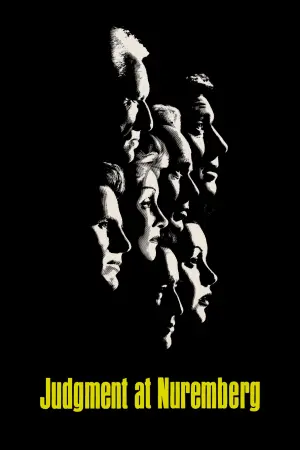
Judgment at Nuremberg
We have to forgive if we are to go on living.
Judgment at Nuremberg (1961)
Timing:
3:11 (191 min)

8.01/10
925
925

8.157/10
18989
18989

8.3/10
82773
82773
![Watch film Judgment at Nuremberg | Judgment at Nuremberg (1961) ORIGINAL TRAILER [HD 1080p]](https://www.acmodasi.in/amdb/images/movie/h/6/judgment-at-nuremberg-1961-157698.jpg)
Country
Production
Genre
Drama, History, War
Budget
$3 000 000
Revenue
$10 000 000
Director
Actors
Scenario
Producer
Stanley Kramer, Philip Langner
Operator
Ernest Laszlo
Composer
Artist
Audition
James Lister
Editing
Frederic Knudtson
All team (26)
All team (26)
Short description
In 1947, four German judges who served on the bench during the Nazi regime face a military tribunal to answer charges of crimes against humanity. Chief Justice Haywood hears evidence and testimony not only from lead defendant Ernst Janning and his defense attorney Hans Rolfe, but also from the widow of a Nazi general, an idealistic U.S. Army captain and reluctant witness Irene Wallner.
What's left behind the scenes
- Marlon Brando (1924-2004) wanted to play the role of lawyer Hans Rolfe. The actor even asked director Stanley Kramer (1913-2001) to cast him, which was completely uncharacteristic of Brando. Kramer and screenwriter Abby Mann were flattered that an actor of his stature was interested, but both were impressed by Maximilian Schell’s (1930-2014) performance in the same subject matter in a 1959 project. Schell ultimately played Rolfe and received an 'Oscar' for 'Best Actor' for the role.
- By the time filming was completed, all convicted Nazi criminals held in the American occupation zone of Germany had already been released.
- Marlene Dietrich (1901-1992), who always paid great attention to her appearance, underwent plastic surgery (not her first) before filming. She was extremely disappointed with the results of the filming with her 'new face.'
- The song that Frau Berthold tells Judge Haywood about is "Lili Marlene." During World War II, it was very popular with both German soldiers and the opposing Allied armies. In the 1940s and 1950s, this song was also recorded by Marlene Dietrich, the actress who played the role of Frau Berthold.
- Some episodes in the courtroom include the showing of film footage depicting the atrocities committed in concentration camps.
- Marlene Dietrich struggled with the dialogue scene with Judge Haywood, where her character claims that ordinary Germans had no idea about the atrocities committed by the Nazis during the war. During the war, Dietrich herself was on the side of the Allied powers and held an anti-German position. She found her character Frau Berthold's statement so hypocritical and repulsive that she couldn't deliver it convincingly. This only became possible after a conversation with Spencer Tracy. The actress's grandson later recounted that Dietrich felt unwell after playing this scene. Once, the actress’s daughter, Maria Riva, advised her to “portray her own mother.” Dietrich heeded the advice. Her Frau Berthold is a screen embodiment of Marlene Dietrich's mother.
- The film was shot in Nuremberg, Germany.
- Since the release of her previous musical "A Star Is Born" (George Cukor, 1954), Judy Garland (1922-1969) had gained weight. The actress intended to lose weight, but director Stanley Kramer dissuaded her from the idea.
- To liven up the monotonous scenes in the courtroom, Stanley Kramer tried shooting in motion. In one scene, for example, he decided to circle Richard Widmark (1914-2008) with the camera while his character delivered a speech. This took a lot of time, as the crew had to be trained to move around the actor with the filming equipment and cables.
- Despite serious problems caused by an excessive fondness for alcohol, Spencer Tracy went to Germany for lengthy filming and then worked tirelessly at the Hollywood studio. It is believed that Katharine Hepburn (1907-2003) constantly looked after him, their creative and romantic partnership lasting 26 years until his death. Tracy was most afraid of forgetting his lines. The director scheduled filming in such a way that Tracy wouldn't get tired. Tracy's contract even included a clause stating that his filming day ended precisely at 5 o'clock.
- Marlene Dietrich paid attention to every detail. She demanded, for example, that all her costumes for the role be sewn by designer Jean Louis (1907-1997). At her request, the portrait of her character's husband was redrawn. Every morning she came to the set and immediately began giving instructions on how the lighting should be and where the cameras should be placed.
- Stanley Kramer dreamed of filming in the same courtroom where the Nuremberg trials took place, but he was refused, as court sessions were still being held there. A copy of the courtroom was built on the studio lot, only slightly smaller – for the convenience of filming.
- In the actual courtroom, the distance between where the prosecutor sat and the witness stand was 12 meters, but in the set built for filming, it was reduced to 8 meters. To keep the actors sitting in the distance in focus, many spotlights had to be directed at them, causing the actors to sweat profusely.
- Spencer Tracy's (1900-1967) 11-minute final speech was filmed in one take.
Did you like the film?
 Auditions in India
 Casting calls in USA
 Castingi w Polsce
 Кастинги в Україні
