My Neighbor Totoro
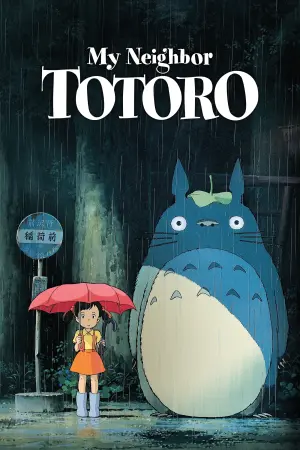
He's your friendly neighbourhood forest spirit!
となりのトトロ (1988)
Timing:
1:26 (86 min)

8.061/10
8802
8802

8.249/10
282103
282103

8.1/10
428000
428000

Country
Production
Genre
Fantasy, Animation, Family
Budget
$3 700 000
Revenue
$41 000 000
Director
Actors
Noriko Hidaka, Chika Sakamoto, Hitoshi Takagi, Shigesato Itoi, Sumi Shimamoto, Tanie Kitabayashi, Toshiyuki Amagasa, Yuko Maruyama, Masashi Hirose, Reiko Suzuki
All actors and roles (10)
All actors and roles (10)
Scenario
Producer
Operator
Hisao Shirai
Composer
Artist
Audition
Editing
Short description
Two sisters move to the country with their father in order to be closer to their hospitalized mother, and discover the surrounding trees are inhabited by Totoros, magical spirits of the forest. When the youngest runs away from home, the older sister seeks help from the spirits to find her.
What's left behind the scenes
- Hayao Miyazaki used some autobiographical motifs in "My Neighbor Totoro" (for example, the long illness of the heroines' mother with tuberculosis), and also drew attention to the impending urbanization and destruction of the traditional Japanese rural landscape—fields and forests. He donated three million dollars and the rights to the image of Totoro to a nature conservation society in his hometown of Tokorozawa (now a suburb of Tokyo).
- The original Japanese release of the animated film was screened as a double feature with "Grave of the Fireflies" (1988), as distributors considered releasing it independently to be too risky.
- The first English-dubbed version appeared as early as 1988 exclusively for transoceanic flights of Japan Airlines. In the US, the dub was released in 1993 by Troma Studios, and subsequently on VHS and DVD by Fox Video. After the rights of these studios to the film expired, they were acquired by Disney, which released a completely new dubbed version in March 2006.
- The cartoon did not perform particularly well at the Japanese box office, fully recouping its costs only two years later, when plush dolls of Big Totoro appeared in stores and became very popular.
- One of the asteroids discovered by Japanese astronomers in 1994 was named 10160 Totoro in honor of the fantastical creatures from the cartoon.
- Hayao Miyazaki originally planned to build the plot of the cartoon around one girl, who combined the character traits of Mei and Satsuki, and was approximately midway in age between them.
- Totoro also appears as a plush toy in the animated film "Toy Story 3" (2010).
- Totoro can be seen in several episodes of the 11th season of the series "South Park" (1997), and the scene of Cartman in a raccoon costume meeting Cthulhu in the episode "Mystery Vortex" completely copies the scene of Mei meeting Totoro.
- The main character of the series "Samurai Jack" (2001-2004) meets Totoro in the 33rd episode – an excessively friendly creature that constantly hinders him.
- A species of peripatid from Vietnam, Eoperipatus totoro Oliveira et al., is named after Totoro. This many-legged invertebrate resembles the animal Totoro rides on.
- Totoro is referred to in various ways – from "giant fluffy thing" to "rabbit-like spirit." Primarily, Totoro is a forest spirit. Totoro is not a traditional Japanese character: he was entirely invented by Hayao Miyazaki. He appears to be a mixture of several animals: a tanuki, a cat, and an owl. His name comes from Mei’s mispronunciation (she has a slight lisp) of the word totoru, which in Japanese corresponds to the word "troll." When Satsuki asks her, "Totoro? Do you mean the troll from our book?", she is referring to the book "Three Billy Goats Gruff." In the end credits, there is a drawing of the girls' mother reading this book to them. In the picture book released with the film, the cover shows a goat running across a bridge, with a troll resembling Totoro looking up at it from underneath.
- There is an interpretation of the cartoon adhered to by proponents of the "conspiracy theory." This interpretation was invented specifically in an attempt to persuade the Japanese government to ban the cartoon. The authors of the interpretation are marketing competitors of the cartoon's creators. Its essence is as follows: The Sayama Incident. It occurred in Japan in 1963 in the city of Sayama. On May 1st, a 16-year-old girl was kidnapped while walking home from school. On May 4th, the body of the kidnapped girl was found buried on one of the farms. It is said that after the girl's sister saw the body, she fell into a prolonged depression and insisted she had seen a large ghostly cat and a tanuki (a creature between a bear and a raccoon in Japanese folklore). Later, the girl's sister committed suicide. Evidence that the action takes place in this area is provided by scenes where the grandmother is unpacking a box of dishes. The box has "Sayama tea" written on the back. The hospital shown in the cartoon is also from the same area. The murder took place in May. The girls' names allude to this. The younger sister is named Mei (a reference to May in English), and the older one is named Satsuki, which means the fifth month (a reference to May in Japanese). The number 4 also appears several times. The older sister is in the fourth grade, and the younger one is four years old. When Mei disappears, Satsuki goes to look for her and passes through a tunnel where she meets Totoro, who acts as a kind spirit of death. The tunnel serves as a symbolic transition between the world of the living and the dead. When Totoro calls the Catbus, he changes the destination signs. One of the signs shows hieroglyphs that mean "cemetery" and "road." Thus, the Catbus acts as a guide between worlds. The "conspiracy theory" mentions that during the last 10 minutes, the characters do not cast shadows, which is unusual for Japanese animation, which pays close attention to detail. However, this claim is debatable, as the action takes place at dusk and the presence of a shadow is doubtful. When Mei is found, she is sitting near six statues of Buddha. Japanese people believe that when a person dies, they become a Buddha. And there should be seven places in a sacred place, but there are only six. Thus, Mei is the seventh Buddha. – In fact, these are statues of Jizo – patrons of children and travelers.
- Hayao Miyazaki used some autobiographical motifs in "My Neighbor Totoro" (for example, his mother’s long illness with tuberculosis), and also drew attention to the impending urbanization and destruction of the traditional Japanese rural landscape – fields and forests. He donated three million dollars and the rights to the image of Totoro to the nature conservation society of his hometown of Tokorozawa (now a suburb of Tokyo).
- Totoro can be seen in several episodes of the 11th season of the series "South Park" (1997), and the scene of Cartman in a raccoon costume meeting Cthulhu in the episode "Rise of the Mysterions" completely copies the scene of Mei meeting Totoro.
- The main character of the series "Samurai Jack" (2001-2004) meets Totoro in the 33rd episode – an overly friendly creature that constantly hinders him.
- Totoro is referred to in various ways—from a "giant fluffy thing" to a "rabbit-like spirit." Primarily, Totoro is a spirit of the forest. Totoro is not a traditional Japanese character: he was entirely created by Hayao Miyazaki. He appears to be a mixture of several animals: a tanuki, a cat, and an owl. His name comes from Mei's mispronunciation (she has a slight lisp) of the word totoru, which in Japanese corresponds to the word "troll." When Satsuki asks her, "Totoro? Do you mean the troll from our book?", she is referring to the book "Three Mountain Goats" (The Three Billy Goats Gruff). There is a drawing in the end credits—the girls' mother is reading this book to them. In the picture book published alongside the film, the cover shows a goat running across a bridge, with a troll resembling Totoro looking up at him from underneath.
- There is an interpretation of the cartoon adhered to by proponents of a "conspiracy theory." This interpretation was invented specifically in an attempt to prompt the Japanese government to ban the film. The authors of the interpretation were marketing competitors of the film's creators. Its essence is as follows: The Sayama Incident. It occurred in Japan in 1963 in the city of Sayama. On May 1st, a 16-year-old girl was abducted while walking home from school. On May 4th, the body of the abducted girl was discovered buried on one of the farms. It is said that after the girl's sister saw the body, she fell into a prolonged depression and insisted that she had seen a large ghostly cat and a tanuki (something between a bear and a raccoon in Japanese folklore). Later, the girl's sister committed suicide. Evidence that the action takes place in this area is provided by scenes where the grandmother is unpacking a box of dishes. On the box behind it is written "Sayama tea." The hospital shown in the cartoon is also from the same area. The murder took place in May. The girls' names allude to this. The younger sister is named Mei (a reference to May in English), and the older one is Satsuki, which means the fifth month (a reference to May in Japanese). The number 4 also appears several times. The older sister is in the fourth grade, and the younger one is four years old. When Mei goes missing, Satsuki goes to look for her and passes through a tunnel where she meets Totoro, who acts as a kind spirit of death. The tunnel serves as a symbolic transition between the world of the living and the dead. When Totoro summons the catbus, he changes the destination signs. One of the signs shows hieroglyphs meaning "cemetery" and "road." Thus, the catbus acts as a guide between worlds. The "conspiracy theory" mentions that for the last 10 minutes, the characters do not cast shadows, which is atypical for Japanese animation, which pays close attention to detail. However, this claim is debatable, as the action takes place at dusk and the presence of a shadow is doubtful. When Mei is found, she is sitting near six statues of Buddha. Japanese people believe that when a person dies, they become Buddha. And there should be seven places in a holy site, but there are only six. Thus, Mei is the seventh Buddha. — In fact, these are statues of Jizo—patron saints of children and travelers.
Did you like the film?
 Auditions in India
 Casting calls in USA
 Castingi w Polsce
 Кастинги в Україні
