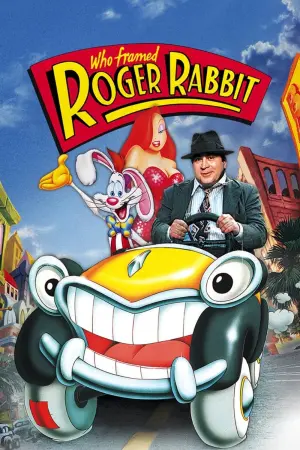
Who Framed Roger Rabbit
It's the story of a man, a woman, and a rabbit in a triangle of trouble.
Who Framed Roger Rabbit (1988)
Timing:
1:44 (104 min)

7.535/10
6120
6120

7.853/10
132964
132964

7.7/10
232000
232000

Country
Genre
Fantasy, Animation, Comedy, Crime
Budget
$70 000 000
Revenue
$329 803 958
Director
Actors
Scenario
Operator
Composer
Artist
Audition
Reuben Cannon, Priscilla John
Editing
Short description
'Toon star Roger is worried that his wife Jessica is playing pattycake with someone else, so the studio hires detective Eddie Valiant to snoop on her. But the stakes are quickly raised when Marvin Acme is found dead and Roger is the prime suspect.
What's left behind the scenes
- The plot is based on Gary K. Wolf's 1981 novel "Who Censored Roger Rabbit?"
- The film showcases legendary PCC streetcars (these streetcars, created in the early 1930s, are still used in some cities in the US and Europe). The streetcars rumble, spark, but the city's residents still love them. Even a local pub is called "Terminal Station Bar."
- Much of the cinematic tradition and several scenes in the film are a tribute to Roman Polanski's "Chinatown".
- The initial absence of a question mark in the title can be explained, presumably, by superstition that films with a question mark in the title collect low box office receipts.
- The film's credits run for almost ten minutes. Upon release, the film was a record holder for the longest sequence of credits in the history of cinema.
- The road planned to be built through Toontown is called the route "from here to Pasadena." Perhaps it refers to the "Pasadena" freeway, starting from downtown Los Angeles (completed in 1940 and lost its significance), or California State Route 134, which runs near Burbank, California.
- This is the first film from the Disney studio to be shown on the "Cartoon Network" television channel, owned by "Time Warner".
- Over a hundred separate film segments were optically combined to integrate live-action and animation elements. The animated characters themselves were hand-drawn without computer animation; analog optical effects were used to add shadows and lighting to the cartoons, giving them a 'more realistic', three-dimensional look.
- Most fans of the film label Jessica Rabbit as a 'Frankenstein of film goddesses': she speaks with the voice of Lauren Bacall (at her own request, Kathleen Turner is uncredited), has the legs of Betty Grable, the torso and buttocks of Marilyn Monroe, the breasts of Jayne Mansfield, the hair of Veronica Lake, the eyes of Marlene Dietrich, and the singing voice of Judy Garland (performed by Amy Irving).
- For the first time on screen, animated characters created by different film studios – Disney and Warner Bros. – appear simultaneously.
- Initially, the director's chair was offered to Terry Gilliam, and Harrison Ford, Sylvester Stallone, or Jack Nicholson were considered for the role of Eddie.
- The scenes with live actors were directed by Robert Zemeckis and were filmed mainly at the 'Borehamwood' film studios in Hertfordshire (England). The animated material was directed by Richard Williams and filmed at his London animation studio.
- In scenes where Jessica uses real objects, specially hired stunt doubles were used to portray her due to her human-like appearance. The scene in the 'Ink and Paint' club – the very first scene featuring Jessica – was shot for almost a year due to its complexity.
- Initially, according to the first script draft, Judge Doom was supposed to be a hunter who shot and killed Bambi’s mother, thereby more fully revealing his sadist, cruel, and callous nature towards his cartoon brethren. However, it is assumed that Disney rejected this idea, believing that the idea of mass murder was more preferable, not wanting to frighten young viewers with this character more than necessary for the film’s emotional purposes. This idea was later used in Disney's 'Beauty and the Beast,' and supposedly Gaston was the one who killed Bambi’s mother. In this case, there is no definitive information about who Judge Doom actually is, and a large number of fans are lost in speculation.
- The film's plot is based on the so-called 'tram conspiracy,' in which 'General Motors,' 'Standard Oil,' and 'Firestone Tires' formed 'National City Lines,' which bought up and deliberately dismantled the 'Red Car' tram system in Los Angeles in the 1940s-1950s. In the film, the real company 'NCL' is replaced by the fictional corporation 'Cloverleaf Industry,' owned exclusively by Judge Rock.
- One of the weasels from 'the cartoon patrol' is armed with two Colt Trooper Mk III revolvers, production of which began only in 1969, while the film takes place in 1947.
- The title lacks a question mark due to superstition – it is believed that films with question marks in the title perform poorly at the box office.
- Over a hundred separate film elements were optically combined to integrate live-action and animation. The animated characters themselves were hand-drawn; analog optical effects were used to add shadows and lighting to the cartoons, giving them a more realistic three-dimensional appearance.
- Scenes featuring live actors were directed by Robert Zemeckis and were filmed primarily at the Borehamwood Studios in Hertfordshire (England). The animation material was directed by Richard Williams and filmed at his London animation studio.
- When Jessica interacts with real objects, stunt doubles were used to portray her. The scene in the 'Ink and Paint Club' took almost a year to film.
- The film was produced by Touchstone Pictures, a subsidiary of Walt Disney Studios, and therefore Warner Bros. only allowed the use of their most popular cartoon characters, Bugs Bunny and Daffy Duck, on the condition that they had the same amount of screen time as Disney's Mickey Mouse and Donald Duck. This is why they appear on screen exclusively with each other, as in the piano-playing competition between Daffy and Donald, or the parachute jump (Bugs and Mickey). The same applies to Porky Pig and Tinker Bell at the end of the film.
- When Eddie (played by Bob Hoskins) leads Roger Rabbit into the service room of the bar, where they try to remove his handcuffs, a lamp hanging from the ceiling swings. A tremendous amount of work was done to ensure that the shadows in the animation and live-action scenes matched. Since then, the expression “bump the lamp” (or “shake the lamp”) has become common among employees of “Walt Disney Studios” and means extra effort put into making a special effect even more special, even though viewers are unlikely to notice or appreciate it.
- According to Bob Hoskins, when his youngest son watched the film, he didn't talk to his father for two weeks afterward. When he was finally asked to explain what was wrong, he replied that he was offended his father hadn't introduced him to Bugs Bunny, despite working with him.
- The audience at the first preview were mostly 18-19 years old, and they didn't like the film. Almost all of them got up and walked out of the theater, but director Robert Zemeckis stated that he would not change anything in the film.
- During the production of the film, there was a dispute about how the “Looney Tunes” characters should look. “Warner Bros.” insisted that they be shown as they appeared at the time the project was being worked on (and, accordingly, as they looked in promotional materials, advertising products, etc.), while the producers argued that these characters should be drawn as they were during the time the film was set, i.e., from the mid to late 1940s. Images of the characters in a “modern” guise were sent to “Warner Bros.” for approval, and the film used images that matched the desired era.
- Each frame of the film, where live-action footage was combined with animation, had to be printed as a still. Then, the animator drew an illustration on tracing paper placed over the still. After that, the outlines of the drawing were colored in by hand, and only then was the drawing inserted into the original frame using an optical printer.
- While working on the project, Richard Williams, responsible for the animation, broke three rules that everyone had always applied when working on combining live-action film and animation. He frequently moved the camera to prevent the cartoon characters from looking stiff against a flat background, used light and shadow in a way no one had before, and, finally, showed how cartoon characters interact with actors and objects filmed on celluloid.
- According to Bob Hoskins, filming was already finished, and Jessica hadn't even been drawn yet, so he had no idea what she would look like. Director Robert Zemeckis advised Hoskins to remember his most lavish sexual fantasy, and – again, according to Hoskins – what he imagined paled in comparison to the stunning Jessica who was soon drawn and inserted into the film.
- The gag with the cartoon pelican falling off a bicycle was conceived by accident. It was originally intended for the pelican to simply ride past the camera on a bicycle, but the special effects team couldn't keep the bicycle upright. After that, it was decided to have the bicycle fall over and show the pelican losing its balance.
- The film features a club called "The Ink & Paint," where cartoon characters are only admitted as employees, but not as patrons. This is a reference to the practice of segregation in entertainment venues in the United States in the mid-20th century, when African Americans were allowed in only if they were staff, but patrons were exclusively white. Segregation against people and cartoon characters was more pronounced in Gary K. Wolf's 1981 novel, which served as the literary source for the screenplay.
- While preparing to film among the cartoon characters, Bob Hoskins secretly observed his three-year-old daughter as she played with imaginary friends.
- One of the challenges faced by the filmmakers was the need to realistically depict the interaction of cartoon characters with the sets. Realism was achieved in two ways. Some props (such as Roger’s friend’s cigar, who was actually not a baby but a dwarf, or the plates that Roger breaks over his head) were moved in the frame using remote-controlled devices – the operator was responsible for this. Then, during post-production, the necessary character was simply drawn over the device. The second method involved the use of puppeteers. The most striking example is the scene in the “Ink & Paint” club. The glasses held by the octopus bartender were actually controlled by a puppeteer positioned above the frame, and the trays carried by the penguin waiters moved on rods controlled from below the bottom edge of the frame. After that, the rods and wires were removed from the frame, and cartoon characters were added.
- 326 animators worked on the film. A total of 82,080 frames were drawn (including storyboards and concept art). According to Richard Williams’ estimates, over a million drawings were created for the film.
- During the conversation between Eddie and Roger Rabbit in the cinema, the cartoon “Goofy Gymnastics” from 1949 is shown on the screen. This cartoon was released a couple of years after the time period depicted in the film. Members of the film crew who chose this particular cartoon later said that it was the funniest thing they found in the archives.
- During filming, life-size rubber figures of Roger Rabbit were used to make it easier for the actors in the film to interact with the imaginary character.
- To convince studio executives that they could release this project, the filmmakers created a short video in which Roger Rabbit bumps into some boxes, and then Eddie, played by Joe Pantoliano, appears. After seeing the video, some Disney executives decided that it was just a simple costume change trick with a little animation sprinkled in. They refused to believe that it was all animation.
- According to the first script version, Judge Doom was supposed to be a hunter who killed Bambi's mother. However, it is assumed that Disney rejected this idea, considering the concept of mass murder more preferable. This idea was later used in Disney's animated film «Beauty and the Beast», and supposedly, Gaston was the one who killed Bambi's mother.
- The plot of the film is based on the so-called trolley conspiracy, in which General Motors, Standard Oil, and Firestone Tires formed National City Lines, which bought up and deliberately dismantled the Red Car tram system in Los Angeles in the 1940s and 1950s. In the film, the real NCL company is replaced by the fictional Cloverleaf Industry corporation, owned exclusively by Judge Rock.
- The liquid that kills the cartoon characters is a mixture of turpentine, acetone, gasoline, and solvents.
- One of the weasels from the cartoon patrol is armed with two Colt Trooper Mk III revolvers, production of which began only in 1969, while the film's setting is 1947.
- The question mark is absent from the title due to superstition – it is believed that such films do not perform well at the box office.
- The scenes featuring live actors were directed by Robert Zemeckis and filmed primarily at the Borehamwood Studios in Hertfordshire (England). The animated material was directed by Richard Williams and filmed at his London animation studio.
- When Jessica used real objects, stunt doubles were used to portray her. The scene at the "Ink and Paint" club took almost a year to film.
- According to the first draft of the script, Judge Doom was supposed to be a hunter who killed Bambi's mother. However, it is believed that Disney rejected this idea, considering the concept of a mass murder more preferable. This idea was later used in Disney's "Beauty and the Beast", and it is assumed that Gaston was the one who killed Bambi's mother.
Did you like the film?
 Auditions in India
 Casting calls in USA
 Castingi w Polsce
 Кастинги в Україні
