Dr. Strangelove or: How I Learned to Stop Worrying and Love the Bomb - videos, teasers and stills from filming
All videos, teasers and footage from the filming of the film "Dr. Strangelove or: How I Learned to Stop Worrying and Love the Bomb"
Dr. Strangelove or: How I Learned to Stop Worrying and Love the Bomb (1964)
Timing:
1:35 (95 min)

8.124/10
6088
6088

8.011/10
73265
73265

8.3/10
550000
550000





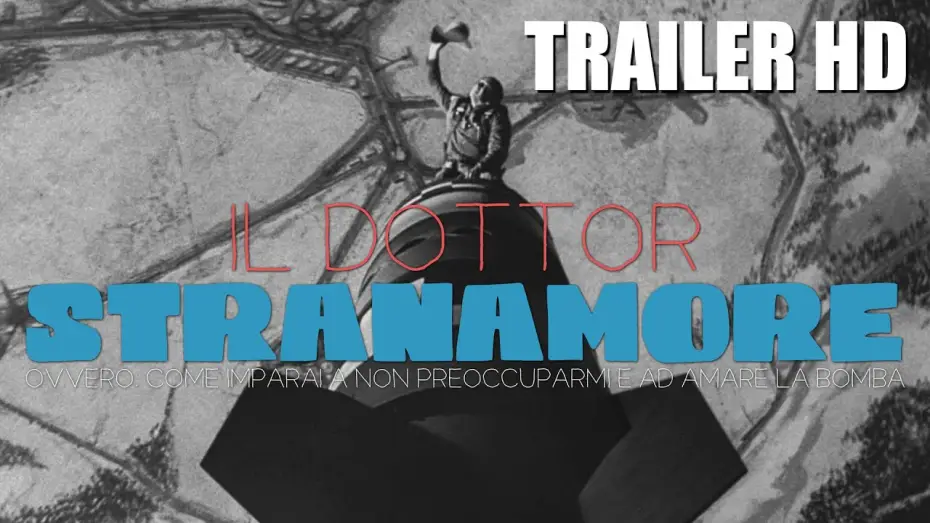
![Watch film Dr. Strangelove or: How I Learned to Stop Worrying and Love the Bomb | DR. STRANGELOVE OR: HOW I LEARNED TO STOP WORRYING AND LOVE THE BOMB Official Trailer [1964]](https://i.ytimg.com/vi/Ja3n2Mxf21s/sddefault.jpg)
![Watch film Dr. Strangelove or: How I Learned to Stop Worrying and Love the Bomb | Dr Strangelove - Official Trailer [1964] HD Remaster](/amdb/images/posters/9/a/dr-strangelove-or-how-i-learned-to-stop-worrying-and-love-the-bomb-1964-rkpBP.webp)
What's left behind the scenes
- The film is based on Peter George's novel "Red Alert" (1958).
- A more accurate translation of the word 'worry' is 'to worry'. The film's title parodies the title of Dale Carnegie's book "How to Stop Worrying and Start Living".
- Dr. Strangelove's illness – alien hand syndrome – became known as "Dr. Strangelove Syndrome" after the film's premiere.
- Notably, the idea of the Doomsday Machine was drawn by Kubrick from Leo Szilard's cobalt bomb projects, as well as real thermonuclear weapons of the Teller-Ulam design.
- The surname of US President Muffley can be translated as "mumbling under one's breath".
- General Jack D. Ripper – the character's name is a play on words referencing Jack the Ripper.
- Captain Lionel Mandrake – the surname, in English, means mandrake, the root of which resembles a human figure.
- Major J.T. "King" Kong – the character is named as a play on words referencing King Kong.
- The Soviet ambassador, Alexei D. Sadetsky, is a character named by assonance with the Marquis de Sade.
- Colonel “Bat” Guano – the nickname and surname together translate as “bat guano”.
- Dr. Strangelove – the surname translates into Russian as “strange love”; from conversations with other characters, it is understood that before obtaining American citizenship, the doctor was named Merkwürdigliebe, which means the same thing in German.
- In the scene where Major Kong reads the contents of the inviolable reserve, the original dialogue was: “Shoot, a fella could have a pretty good weekend in Dallas with that stuff!” (“Damn, a guy could have a pretty good weekend in Dallas with that stuff!”). Since shortly before the film's premiere, President Kennedy was assassinated in Dallas, this scene was re-dubbed to “Vegas” – however, you can clearly read the word “Dallas” on the lips.
- In 1989, the film was included in the U.S. National Film Registry as “culturally significant”.
- Believing that the box office success of such a risky project could only be ensured by Sellers' participation, Columbia Pictures insisted on assigning him several roles in the film, as had been done, for example, in the 1959 film "The Mouse That Roared." Kubrick agreed to the demand, taking into account that "such a crude and grotesque arrangement was a prerequisite for commercial success."
- Sellers improvised most of the dialogue with Kubrick before filming, so that the invented lines would be included in the final script.
- To convincingly portray President Merkin Muffley, Sellers smoothed out his English accent, making it resemble the speech of an American from the Midwest. He drew inspiration for the role from the image of Adlai Stevenson, the former governor of Illinois, a Democratic candidate for President of the United States in 1952 and 1956, and the US Permanent Representative to the United Nations during the Cuban Missile Crisis.
- During filming, Sellers played up symptoms of a cold to emphasize Muffley's weak character. This caused laughter among the crew, ruining several takes. Ultimately, Kubrick decided to abandon this detail, feeling that the President of the United States should look serious.
- The prototypes for Strangelove included: RAND Corporation strategist Herman Kahn, mathematician and one of the leading developers of the Manhattan Project, John von Neumann, German scientist Wernher von Braun, "the father of the hydrogen bomb" Edward Teller, and Dr. Zempf – a character from Kubrick's previous film "Lolita," played by the same Sellers. The accent was influenced by Wiggie, an Austrian-American photographer who worked for Kubrick as a special consultant on photographic effects. There is also a widespread belief that Henry Kissinger served as a prototype for the character, but Kubrick and Sellers denied this. In reality, Kissinger became a Presidential advisor only in 1969.
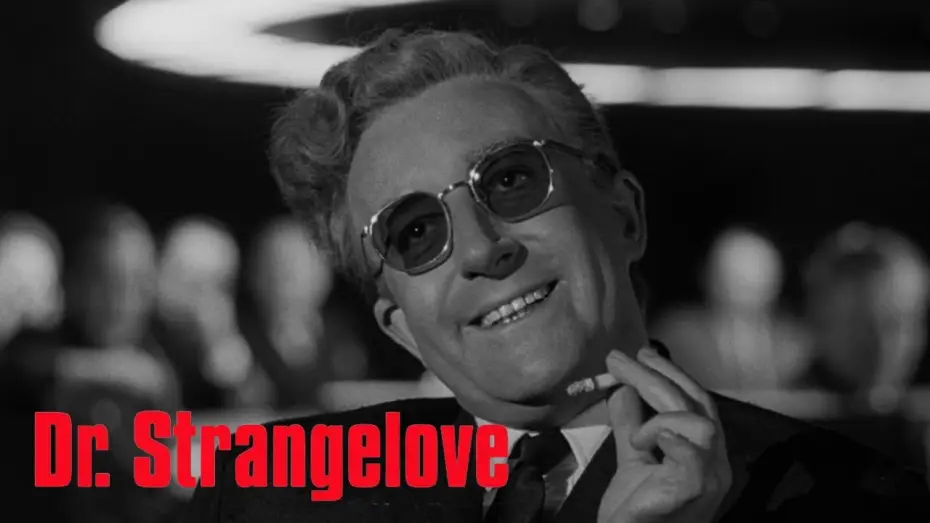
- Strangelove's appearance echoes that of the mad inventor Rotwang from Fritz Lang's film *Metropolis*: a black glove on one hand and disheveled hair. Kubrick suggested the black glove, but Sellers made the glove come to life on its own.
- Immediately after Sellers injured his leg, the role of J. T. 'King' Kong (which he was also supposed to play in addition to three others) was offered to John Wayne, but he refused immediately. Dan Blocker, a popular television actor at the time, was also considered for the role, but, according to Terry Southern, Blocker's agent rejected the script as “too pinko” (a term used in the US during the Cold War to describe someone sympathetic to communism). Slim Pickens ultimately got the role, with an established cowboy persona, especially since he had already worked with Kubrick during the preparation of *One-Eyed Jacks*—a film Kubrick was preparing to direct.
- Kubrick biographer John Baxter recounted in the documentary *Inside the Making of Dr. Strangelove*: “As it turned out, Pickens had never left the United States. He rushed to get his passport. When he arrived on set, someone said, ‘My God, he’s come in [cowboy] costume!’ not realizing that he always dressed that way—in a cowboy hat, fringed jacket, and cowboy boots—and that he wasn’t trying to portray the character—that’s how he talked.”
- During filming, Kubrick and Scott disagreed on certain scenes, leading to frequent arguments. After the work was completed, Scott vowed never to work with Kubrick again. Despite this, Scott, a skilled chess player, greatly respected the director for his chess prowess, which they often displayed on set.
- After returning to the US from the UK following the filming of *Lolita*, Kubrick became increasingly preoccupied with the topic of nuclear war. He began subscribing to magazines about weaponry, and by 1963 had collected around eighty books on nuclear strategy. At this time, Alastair Buchan, president of the International Institute for Strategic Studies, recommended Peter George's *Red Alert* to him. The novel, highly praised by game theory specialist and future Nobel laureate in economics Thomas Schelling, impressed Kubrick so much that he immediately bought the film rights.
- In collaboration with George, the director began writing the screenplay based on the book. In the early stages of work with Kubrick, his longtime friend James B. Harris discussed the project, believing that the anarchic humor in the film would be a mistake. They soon amicably decided to dissolve their business partnership. From the very beginning, Kubrick found the uncompromisingly serious tone of the novel unacceptable. “We started fooling around,” Harris recalled. “’What if they get hungry, call a diner, and a waiter in an apron comes to command headquarters and asks who wants what sandwich?’ And everyone, of course, started laughing.” After deciding to make a comedy, Kubrick invited Terry Southern, author of the satirical novella “The Magic Christian” – a book Peter Sellers had given to Kubrick – to work on the film as a co-writer. During the work, Kubrick and George held brief consultations with Thomas Schelling, and later with Herman Kahn.
- Among the working titles of the film were “Dr. Doomsday, or: How to Start World War III Without Even Trying,” as well as “Dr. Strangelove’s Secret Uses of Uranus, and Wonderful Bomb.”
- Production of the film began in October 1962. The film was shot at Shepperton Studios in the London suburbs, as Peter Sellers was going through a lengthy divorce at the time, and insisted the film be shot in England. Kubrick happily agreed to this condition, as he did not want to shoot the film in the United States and believed he could not find such a filming base there. The sets occupied three main soundstages: the War Room in the Pentagon, the interior of a B-52 Stratofortress bomber, and Ripper’s office, while the studio building was used for filming the military base.
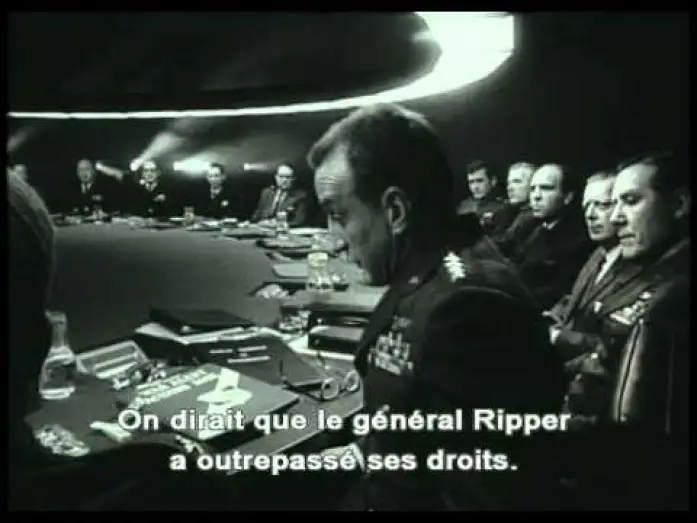
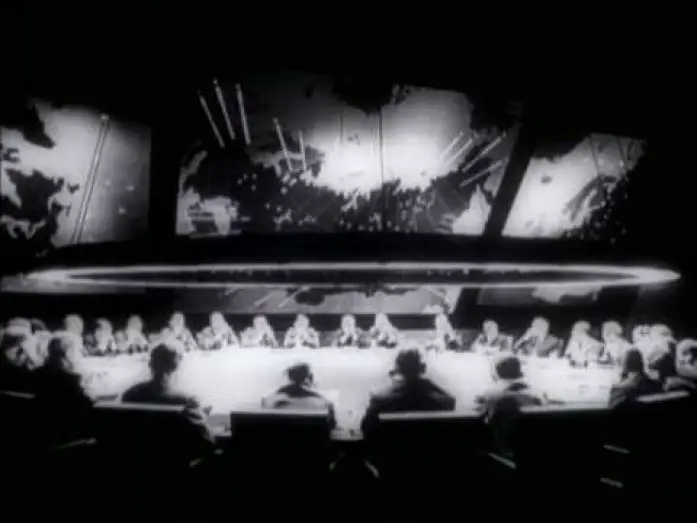
- Ken Adam worked on the design of the War Room. The result was a huge, expressionistic room (40 m long, 30 m wide, and 11 m high ceilings), reminiscent of a bomb shelter with a triangular shape (according to Kubrick, this type of bunker was most resistant to explosions). On one side of the Room were giant strategic maps, reflected in the shiny black floor, in the center – a round table with a diameter of 7 meters, illuminated from above with lamps, resembling a poker table. Kubrick insisted on covering it with green baize to enhance “the impression that they are playing” for the fate of the world, however such a clever solution was unlikely to be noticeable in the black and white film. The huge maps were outlined in the art department, enlarged to a size of 3 by 4 feet, then enlarged photographically, glued onto plywood shields, and overlaid with plexiglass. Holes were cut in the plywood, to which the maps were glued, and 75-watt floodlights with automatic circular switching were placed behind them.
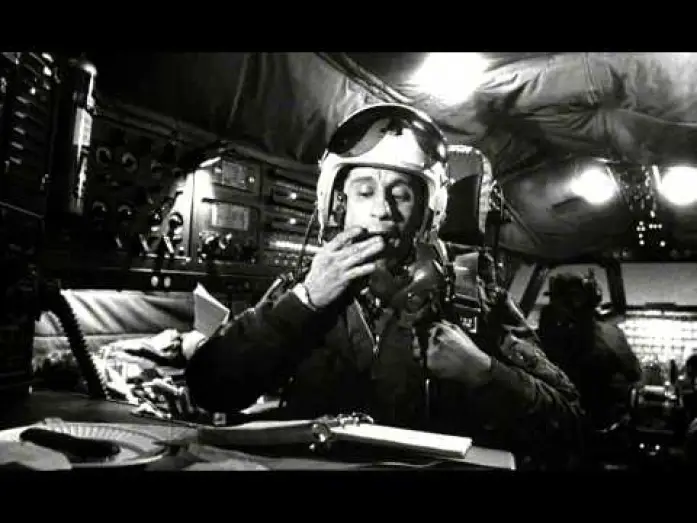
- Due to the lack of cooperation from the Pentagon in creating the film, the designers were forced to reconstruct the interior of the bomber, to the best of their ability, using aviation magazines. Everything was reproduced so accurately that the Air Force feared that the filmmakers had obtained secret information about the bomber through espionage. In some shots showing the bomber flying over the polar ice on its way to Russia (a model against a pre-shot video), the shadow of a B-17 can be seen on the snow, as it was used to film the background.
- Filming wrapped on April 23, 1963, but the rough cut of the film dismayed the crew. Ultimately, with a budget of nearly $2 million, the majority of the money went into editing, which Kubrick worked on for 8 months.
- During filming, Kubrick learned that another film with an identical theme, but darker and more realistic – Sidney Lumet's "Fail-Safe" – was being filmed concurrently with his project, so he worried about box office receipts, especially if his film were to be released second. Kubrick was most concerned that Lumet, who had by that time filmed "12 Angry Men," had cast major stars – Henry Fonda as the President of the United States and Walter Matthau as his advisor, Professor Grotheschild. The 1962 novel "Fail-Safe" by Eugene Burdick and Harvey Wheeler, on which the film of the same name was based, was so similar to "Red Alert" that Peter George sued the creators for plagiarism, but the case was settled out of court. In the end, "Fail-Safe" was released eight months after "Dr. Strangelove," receiving positive critical reviews but not bringing its creators significant profits.
- Initially, the film ended with a scene in which everyone in the War Room engaged in a pie fight, but Kubrick cut this segment after a preview screening. In a 1969 interview, he explained: "I decided it was a farce that was inappropriate compared to the satirical nature of the rest of the film." Another possible reason for removing the pie fight scene is the moment when Turdsson exclaims about a pie hitting the President: "Gentlemen! Our brave president has been struck in his prime!" Editor Anthony Harvey claimed that if the scene had remained, Columbia Pictures would have been horrified, considering it an insult to the President and his family. These shots are preserved in the archives of the British Film Institute.
- The film's first pre-premiere screening was scheduled for November 22, 1963 – the day of Kennedy's assassination – the premiere itself for December, but the release was postponed until the end of January 1964, as it was decided that the public would not be in the mood for such a film beforehand.
- Strangelove's plan to shelter in mines to restore humanity – is a reference to proposals by Nelson Rockefeller, Edward Teller, Herman Kahn, and Chester E. Holifield to spend billions of dollars building a nationwide network of underground shelters that could accommodate millions of people. The military “loyalty checks,” and the folder labeled “megadeath” (a term coined by Kahn, which denotes the number of millions of people killed), which Turdsson clutches to his chest – are also allusions to Kahn.
- A year after the film's release, American science fiction writer Philip K. Dick wrote the novel "Dr. Bloodmoney, or How We Lived After the Bomb," whose plot and title were inspired by Kubrick's film: a bleak world of the 1970s living after a nuclear war.
- According to some veterans of the United States Strategic Air Command, "Dr. Strangelove" most accurately reflects the realities of this organization.
- In the film, Sellers plays only three of the four roles written for him. He was supposed to play Major Aviation J. T. "King" Kong, commander of a B-52 Stratofortress bomber, but from the beginning Sellers was reluctant to take on this role. He felt his workload would be too great and worried that he would not be able to properly portray the character's Texan accent. Kubrick asked the film's screenwriter, Terry Southern, who grew up in Texas, to record Kong's voice on tape with the appropriate drawl. Listening to Southern's tape helped Sellers speak with the correct accent, and then filming of the scenes in the plane began. But soon Sellers sprained his ankle and was unable to work in the cramped cockpit. Ultimately, Slim Pickens played the role.
- In one scene showing the attack of Marine Corps troops on General Ripper's base, the battle takes place against the backdrop of a poster reading "Peace is our profession" (the motto of the United States Strategic Air Command).
- At the end of the film, showing the beginning of the nuclear war, documentary footage of the atomic bombings of Hiroshima and Nagasaki, the Trinity nuclear bomb test, Operation Crossroads at Bikini Atoll, Operation Plumbbob, Operation Redwing, and Operation Plumbbob was used. In some footage, military ships used as targets are clearly visible, including the German heavy cruiser "Prinz Eugen." The idea to use the song "We'll Meet Again" under the apocalyptic footage belonged to Peter Sellers' friend, Spike Milligan.
- The film is based on Peter George's novel 'Red Alert' (1958).
- Believing that the box office success of such a risky project could only be ensured by Sellers' participation, Columbia Pictures insisted on assigning him several roles in the film, as had been done, for example, in the 1959 film "The Mouse That Roared." Kubrick agreed to the requirement, taking into account that "such a crude and grotesque position is an essential condition for commercial success."
- The prototypes for Strangelove included: RAND Corporation strategist Herman Kahn, mathematician and one of the leading developers of the Manhattan Project, John von Neumann, German scientist Wernher von Braun, "father of the hydrogen bomb" Edward Teller, and Dr. Zempf — a character from Kubrick's previous film "Lolita," played by the same Sellers. The accent was influenced by Wiggy, an Austrian-American photographer who worked with Kubrick as a special consultant on photographic effects. There is also a widespread belief that Henry Kissinger served as a prototype for the character, but Kubrick and Sellers denied this. In reality, Kissinger only became a Presidential advisor in 1969.
- Strangelove's appearance echoes the mad inventor Rotwang from Fritz Lang's film "Metropolis": a black glove on one hand and disheveled hair. Kubrick suggested the black glove for Strangelove, but Sellers brought the glove to life on its own.
- Immediately after Sellers injured his leg, the role of J.T. "King" Kong (which he was also supposed to play in addition to three others) was offered to John Wayne, but he immediately refused. Dan Blockker—a popular television actor at the time—was also considered for the role, but, according to Terry Southern, Blockker’s agent rejected the script as “too pinko” (in the US during the Cold War: a person sympathetic to communism). Ultimately, Slim Pickens, already established as a cowboy actor, got the role, especially since he had already worked with Kubrick during the filming of "One-Eyed Jacks"—a film Kubrick was developing.
- Kubrick biographer John Baxter recounted in the documentary "Inside the Making of Dr. Strangelove": "As it turned out, Pickens had never left the United States. He was in a hurry to get his passport. When he arrived on set, someone said, 'Good God, he's come in [cowboy] costume!' not realizing that he always dressed like that—in a cowboy hat, fringed jacket, and cowboy boots—and that he wasn't trying to portray a character—that's how he always spoke."
- After returning from the UK to the US following the filming of Kubrick's "Lolita", the theme of nuclear war increasingly occupied his thoughts. He began subscribing to journals on weaponry, and by 1963 had collected around eighty books on nuclear strategy. During this time, Alastair Buchan, President of the International Institute for Strategic Studies, recommended Peter George's "Red Alert" to him. The novel, highly praised by game theory specialist and future Nobel laureate in Economics Thomas Schelling, so impressed Kubrick that he immediately bought the film rights.
- In collaboration with George, the director began writing a screenplay based on the book. Early in the process, Kubrick discussed the project with his long-time friend James B. Harris, who believed that anarchic humor in the film would be a mistake. They soon amicably agreed to dissolve their business partnership. From the outset, Kubrick found the uncompromisingly serious tone of the novel unacceptable. “We started to goof around,” Harris recalled. — “What if they got hungry, called a diner, and a waiter in an apron came to command post and asked who wanted what sandwich?” And everyone, of course, started to laugh.” After deciding to make a comedy, Kubrick invited Terry Southern, author of the satirical novella “The Magic Christian” – a book Peter Sellers had given him – to work on the film as a co-writer. During development, Kubrick and George held brief consultations with Thomas Schelling, and later with Herman Kahn.
- Ken Adam worked on the design of the War Room. The result was a huge, expressionistic space (40 meters long, 30 meters wide, with a ceiling height of 11 meters), evoking a bomb shelter with a triangular shape (Kubrick believed this type of bunker was most resistant to explosions). On one side of the Room were giant strategic maps, reflected in the shiny black floor; in the center was a round table 7 meters in diameter, illuminated from above with lamps, resembling a poker table. Kubrick insisted on covering it with green baize to enhance the “impression that they were playing” for the fate of the world, but such a clever solution was unlikely to be noticeable in the black-and-white film. The enormous maps were drawn in the art department, enlarged to a size of 3 by 4 feet, then photographically enlarged, glued onto plywood panels, and overlaid with plexiglass. Holes were cut in the plywood onto which the maps were glued for the symbols, and 75-watt floodlights with automatic circular switching were placed behind them.
- During filming, Kubrick learned that another film with an identical theme, but more somber and realistic – Sidney Lumet's "Fail-Safe" – was being made in parallel, and he worried about box office receipts, especially if his film was released second. Kubrick was most concerned that Lumet’s film, after having directed “12 Angry Men”, starred major actors – Henry Fonda as the President of the United States and Walter Matthau as his advisor, Professor Grotheshil. The 1962 novel by Eugene Burdick and Harvey Wheeler, upon which Lumet’s film was based, was so similar to “Red Alert” that Peter George sued the creators for plagiarism, but the case was settled out of court. Ultimately, “Fail-Safe” was released eight months after “Dr. Strangelove”, receiving positive critical reviews, but not bringing its creators great profits.
Did you like the film?
 Auditions in India
 Casting calls in USA
 Castingi w Polsce
 Кастинги в Україні
