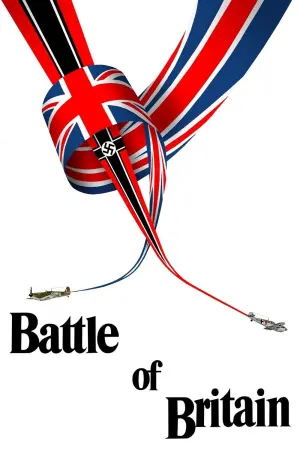
Battle of Britain
Battle of Britain (1969)
Timing:
2:12 (132 min)

6.8/10
291
291

6.746/10
676
676

6.9/10
23997
23997

Country
Production
Genre
Drama, History, War, Action
Budget
$12 000 000
Revenue
$0
Director
Actors
Scenario
Producer
Harry Saltzman, Benjamin Fisz
Operator
Composer
Ron Goodwin
Artist
Audition
Carl Duering, Maude Spector
Editing
Bert Bates, Sydney Streeter
All team (45)
All team (45)
Short description
In 1940, the Royal Air Force fights a desperate battle against the might of the Luftwaffe for control of the skies over Britain, thus preventing the Nazi invasion of Britain.
What's left behind the scenes
- Myles Kane was initially afraid that he was too young to play the squadron leader. However, war veterans assured him that he was not too young for the role, but even a bit old.
- The scene of the first aerial battle of Polish pilots was filmed based on a real event. The 303rd Polish Squadron named after (the military and political figure of the Polish-Lithuanian Commonwealth and the United States, the leader of the Polish uprising of 1794, Tadeusz) Kościuszko was conducting training flights under the command of Royal Air Force officer Ronald Kellett (1909-1998) when one of the Poles, Ludwik Witold Paszkiewicz (1907-1940), spotted a Luftwaffe Dornier bomber and requested permission to attack. Kellett forbade him from doing so, but Paszkiewicz shot down the German plane anyway. He subsequently received a reprimand from Kellett in front of the troops, but privately (unofficially) Kellett praised him. Paszkiewicz did not return from a combat mission on September 27, 1940.
- Many of the actors were actually too old to play pilots. The average age of RAF pilots during the Battle of Britain was 20 years old.
- 27 Spitfire fighters of varying degrees of airworthiness were found for filming, and only 12 of them were repairable. 6 Hurricane fighters were also found, 3 of which were repairable. All of the Messerschmitt 109 fighters used in the film had recently been withdrawn from service with the Spanish Air Force. The filmmakers purchased around 50 World War II aircraft and repaired 17 of them. These were piloted during filming by personnel from the Spanish Air Force and the so-called Confederate Air Force (the Confederate Air Force is an American non-profit organization dedicated to preserving and showcasing historic military aviation at airshows, primarily in the US and Canada). The filmmakers also leased 32 Heinkel bombers with crews from the Spanish Air Force, which were still used for cargo transport and as aerial targets. Ultimately, the filmmakers bought 2 of these aircraft and, together with 17 Messerschmitt bombers, transported them to England for filming. Two Junkers 52 transports were also leased from the Spanish Air Force.
- The prototypes for Majors Fen and Falk, flight leaders, were Adolf Galland (1912-1996) and Werner Mölders (1913-1941), two of the most famous German fighter aces of World War II. Galland was present on the film set as a consultant. He became so angered that the Germans were portrayed exclusively within the confines of clichés and stereotypes that he almost left the production. At his insistence, numerous changes were made to the original script.
- The scene in which Hermann Göring (1893-1946) accuses Albert Kesselring (1885-1960) of treason as the train departs is based on a real event. Göring left in such a hurry that the service personnel did not even have time to disconnect the telephone cables running between the train and the station building. Director Guy Hamilton (1922-2016) wanted to show the severed wires trailing behind the train as it gained speed, but he decided it would look too comical.
- The first film to use radio-controlled model airplanes during filming. Such models are commonplace now, but at the time it was something special, and experienced specialists were hired to build the models, who left their jobs and spent several months constructing the aircraft models and preparing them for filming.
- During World War II, Laurence Olivier (1907-1989) volunteered for the Royal Air Force, but he proved to be such a poor pilot that the command decided Olivier would best serve his country by continuing to act in films.
Did you like the film?
 Auditions in India
 Casting calls in USA
 Castingi w Polsce
 Кастинги в Україні
