The Killing
In all its fury and violence...
The Killing (1956)
Timing:
1:25 (85 min)

7.667/10
1453
1453

7.631/10
10751
10751

7.9/10
105000
105000

Country
Production
Genre
Crime, Thriller
Budget
$320 000
Revenue
$0
Director
Actors
Scenario
Producer
James B. Harris
Operator
Composer
Gerald Fried
Artist
Audition
Editing
Betty Steinberg, Clarence Eurist
All team (41)
All team (41)
Short description
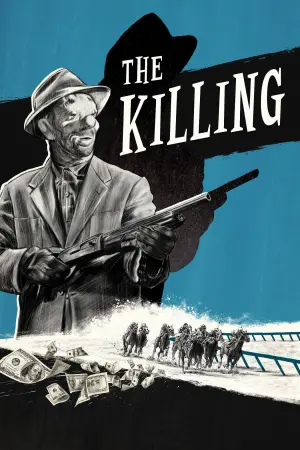
Career criminal Johnny Clay recruits a sharpshooter, a crooked police officer, a bartender and a betting teller named George, among others, for one last job before he goes straight and gets married. But when George tells his restless wife about the scheme to steal millions from the racetrack where he works, she hatches a plot of her own.
What's left behind the scenes
- The film is based on Lionel White's novel "The Big Score".
- The appearance of the character Sterling Hayden (Johnny Clay), going on a job in a hat and with a briefcase in his hands, was successfully parodied by E. Rязаnov in the comedy "Beware of the Car" (1966).
- The Killing is a slang term meaning "big score".
- The film shows 8 corpses.
- The results of the initial preview screenings were disappointing due to the non-linear nature of the narrative. Stanley Kubrick was forced to sit in the editing room and re-edit the film so that the script unfolded linearly, but this only further confused the entire plotline. In the end, the film was released in its original form (i.e., with a non-linearly developing plot), and it subsequently had a huge influence on other films with a similar plot structure – such as Quentin Tarantino’s thriller *Reservoir Dogs* (1991) or his drama *Pulp Fiction* (1994).
- The text by the author was added to the film at the insistence of the studio management. Stanley Kubrick disowned this idea as much as he could, but was forced to comply. A significant portion of the information provided to viewers by the narrator turned out to be incorrect or erroneous.
- This was Kubrick’s first film for which he hired a cinematographer. Lucien Ballard was invited to the project because Kubrick was working under union rules for the first time, and therefore was not allowed to be both director and cinematographer, as he had been in his previous films. Kubrick and Ballard constantly argued, and their relationship deteriorated over time to the point where Ballard even stopped coming in the evenings to watch the footage shot during the day.
- Sterling Hayden's character approaches Morris (played by Kola Kwariani) with a proposition at a chess club on 42nd Street in New York. Director and screenwriter Stanley Kubrick was a regular there (as was Morris).
- The script originally called for Sterling Hayden's character to be chopped up by an airplane propeller when he went to collect money, but this plot point was changed to show him simply being shot by police. This occurred because American Airlines claimed the episode implied insufficient safety precautions and that viewers would interpret Hayden’s character’s death in that way.
- It is known that Stanley Kubrick was a very demanding director and always shot many takes. The horse race scene, for example, was filmed 45 times in a row, so the horse used in the filming was sent to slaughter directly from the set. It was the 1950s, so no one paid much attention to this (referring to various public organizations advocating for animal rights).
Did you like the film?
 Auditions in India
 Casting calls in USA
 Castingi w Polsce
 Кастинги в Україні
