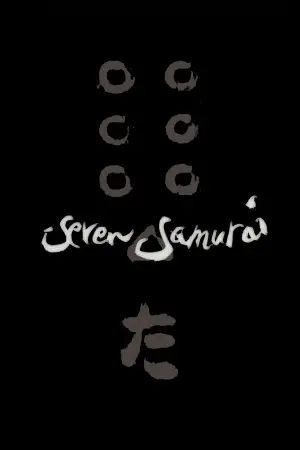
Seven Samurai
The Mighty Warriors Who Became the Seven National Heroes of a Small Town
七人の侍 (1954)
Timing:
3:27 (207 min)

8.5/10
4229
4229

8.179/10
65076
65076

8.6/10
400000
400000
![Watch film Seven Samurai | Seven Samurai (1954) Original Trailer [4K]](https://i.ytimg.com/vi/6jZF-Ujv2z4/maxresdefault.jpg)
Country
Production
Genre
Action, Drama
Budget
$500 000
Revenue
$502 812
Director
Actors
Scenario
Producer
Operator
Composer
Artist
Audition
Editing
Short description
A samurai answers a village's request for protection after he falls on hard times. The town needs protection from bandits, so the samurai gathers six others to help him teach the people how to defend themselves, and the villagers provide the soldiers with food.
What's left behind the scenes
- The film ranks first on Empire magazine's list of "The 100 Best Films of World Cinema," compiled in 2010.
- Actor Seiji Miyaguchi, who played the swordsman Kyuzo, had never actually practiced swordsmanship.
- Toho Studio attempted to halt filming several times, as it was widely believed the film would be a complete financial failure, and the director consistently exceeded his budget. Each time, Kurosawa had to persistently persuade the producers to resume funding.
- Filming of the final battle had to be stopped several times due to a shortage of horses.
- One scene in the film contains a detail that allows for the precise dating of the events. A stolen birth certificate of Kikuchiyo states that he was born in the second year of the Kinsei period, which corresponds to 1574, and Kambei concludes that Kikuchiyo is therefore only 13 years old. Considering the Japanese method of calculating age (a newborn child is considered one year old), the events of "Seven Samurai" unfold in 1586.
- The film came about largely because Akira Kurosawa very much wanted to try his hand at the jidaigeki genre (historical film about the adventures of samurai), which was popular in Japan, and to make it both profound in meaning and engaging in form. Initially, he intended to make a parable-like film about one day in the life of a samurai, tracing all of the hero’s actions up to the evening, when he was to commit ritual suicide. In the end, Kurosawa did not dare to tackle such material, believing he did not know the necessary nuances well enough. However, while working on this plot, he came across a case where a village belonging to one of the slain feudal lords hired several ronin to protect it from bandits (strictly speaking, ronin themselves), and decided to base the film on this story.
- It is believed that the film 'Seven Samurai' was the first to introduce the element of an adventure drama – the selection of a team consisting of people, each of whom is gifted in their own way. This plot device subsequently became frequently used.
- In 1981, the Gorky Film Studio released the film 'The Sixth,' in which, in the early years after the Civil War, young Soviet police in a provincial town clash with bandits.
- The role of Kikuchiyo was a favorite for actor Toshiro Mifune, who remembered every word spoken by his character throughout his life.
- All of the firearms in the film are historically accurate: they are antique Japanese muskets called tanegashima.
- In the film "28 Panfilovs," the characters retell the plot of "Seven Samurai" and "The Magnificent Seven" as a tall tale.
- In the film, Kurosawa first introduces a contrast between traditional samurai cold weapons and firearms, which are perceived as incompatible with warrior honor. In the film, only bandits have guns, and only Kikuchiyo, the "non-samurai," fires a gun, and only once. Later, in other films by Kurosawa, this motif was amplified and emphasized – for example, in "Yojimbo" (1961) – and culminated in "Kagemusha: The Shadow Warrior" (1980).
- The plot of "Seven Samurai" has been used in many films. Even the plot of Pixar's animated film "A Bug's Life" (1998) almost completely copies "Seven Samurai" in the first half of the film. Ants act as the peasants, and locusts as the bandits. One episode almost verbatim quotes an episode from "Seven Samurai," specifically the moment when the grieving peasants realize that even if their village buys off the bandits, its inhabitants still face starvation.
- Toho Studio repeatedly tried to halt filming, as it was generally believed the film was destined for complete financial failure, and the director was constantly exceeding his budget. Each time, Kurosawa had to persuade the producers to resume funding.
- The film came about largely because Akira Kurosawa really wanted to try his hand at the jidaigeki genre, making it both profound in meaning and captivating in form. He initially intended to make a parable film about one day in the life of a samurai, tracing all the hero's actions up to the evening when he was to commit ritual suicide. Ultimately, Kurosawa didn't dare tackle such material, believing he didn't know the nuances well enough. However, while working on this plot, he stumbled upon a case where a village, belonging to one of the slain feudal lords, hired several ronin to protect it from bandits.
- The role of Kikutyō became a favorite of actor Toshiro Mifune, who remembered every word spoken by his character throughout his life.
- The film ranks first on Empire magazine's list of "The 100 Best Films of World Cinema," compiled in 2010.
- One scene in the film contains a detail that allows for the precise dating of events. A stolen birth certificate of Kikuchiyo states that he was born in the second year of the Kinsei era, which corresponds to 1574, and Kambei concludes that Kikuchiyo is therefore only 13 years old. Considering the peculiarities of age calculation in Japan (a newborn child is considered one year old), the events of "Seven Samurai" unfold in 1586.
- It is believed that the film "Seven Samurai" was the first to introduce the element of an adventure drama – the selection of a team of people, each gifted in their own way. This plot device was subsequently frequently used.
- The film marks the first time in Kurosawa's work that a contrast arises between traditional samurai cold weapons and firearms, which are perceived as incompatible with warrior honor. Guns are present in the film only with the bandits, and only "half-samurai" Kikuchiyo fires a gun, and only once. Subsequently, in other films by Kurosawa, this motif was intensified and emphasized – for example, in "Yojimbo" (1961) – and reached its climax in "Kagemusha: The Shadow Warrior" (1980).
Did you like the film?
 Auditions in India
 Casting calls in USA
 Castingi w Polsce
 Кастинги в Україні
